Home / iGCSE Mathematics (0580) – C1.2 Sets- Exam Style Questions Paper 1

iGCSE Mathematics (0580) - C1.2 Sets- Exam Style Questions Paper 1- New Syllabus

Question

\(\mathcal{E} = \{\text{students in a year group}\}\)
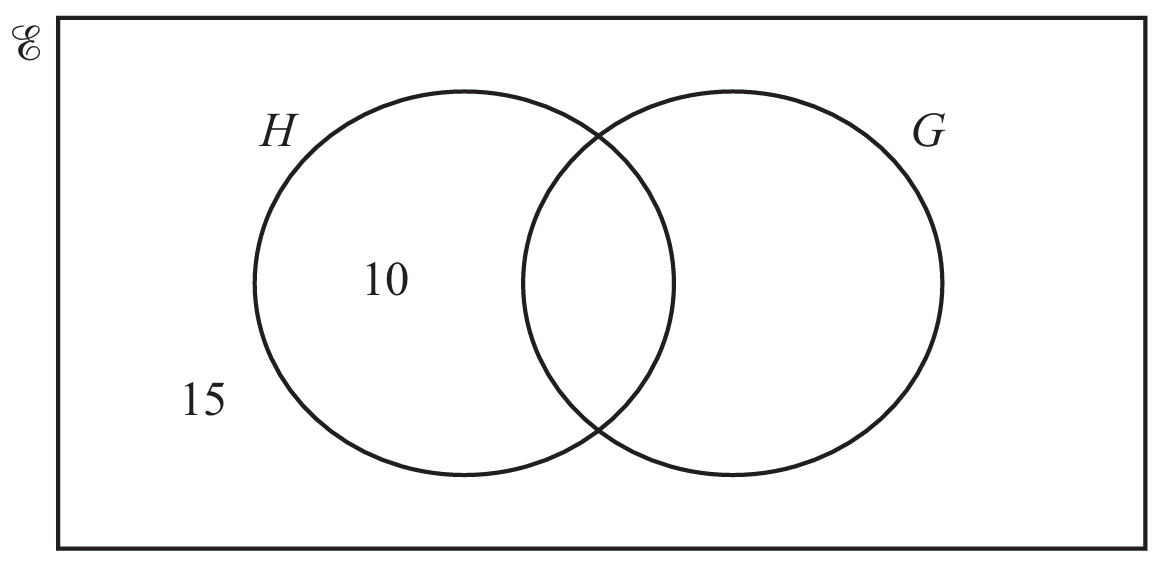
\(H = \{\text{students who study History}\}\)
\(G = \{\text{students who study Geography}\}\)

80 students are in the year group.
40 students study History.

(a)  Complete the Venn diagram.

(b)  Find \(n(G)\).

(c)  A student is chosen at random.

     Work out the probability that the student does not study History and does not study Geography.

Most-appropriate topic codes (Cambridge IGCSE Mathematics 0580):

TOPIC C1.2 Sets: Understand and use set language, notation and Venn diagrams to describe sets — \(n(A)\), \(A \cup B\), \(A \cap B\), complement, universal set (Core)
TOPIC C8.1 Introduction to probability: Calculate the probability of a single event (Core)
▶️ Answer/Explanation

(a)
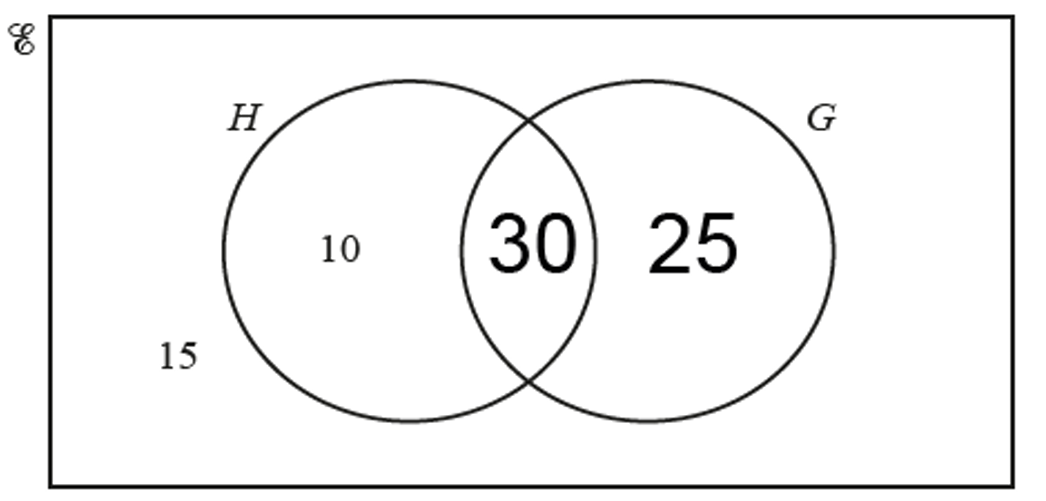
Since \(n(H) = 40\) and \(H\)-only already shows 10: \(H \cap G = 40 – 10 = 30\).
Total \(= 10 + 30 + G\text{-only} + 15 = 80\), so \(G\text{-only} = 80 – 55 = 25\).
Write \(30\) in the intersection \(H \cap G\) and \(25\) in the \(G\)-only region.
(b)
\[n(G) = (H \cap G) + G\text{-only} = 30 + 25 = 55\]
Answer: \(55\)

(c)
The number of students outside both circles = 15.
\[P(\text{not } H \text{ and not } G) = \frac{15}{80}\]
Answer: \(\dfrac{15}{80}\) (or equivalent, e.g. \(\dfrac{3}{16}\))
Question

\(\mathcal{E} = \{1, 2, 3, 4, 5, 6, 7, 8, 9, 10\}\)
\(A = \{1, 3, 5, 7, 9\}\)
\(B = \{1, 3, 6, 10\}\)

(a) Use this information to complete the Venn diagram.

(b) List the elements of \(A \cap B\).

(c) Find \(n(B’)\).

Most-appropriate topic codes (Cambridge IGCSE Mathematics 0580):

TOPIC C1.2 Sets: Understand and use set language, notation and Venn diagrams to describe sets; use \(A \cap B\), \(A \cup B\), \(A’\) and \(n(A)\) (Core)
▶️ Answer/Explanation

(a)
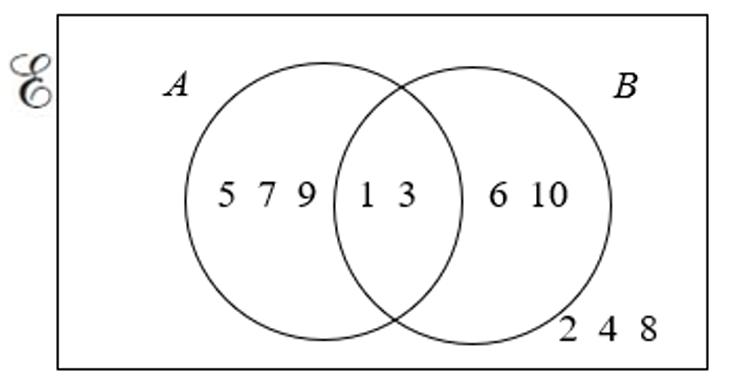
Elements in \(A\) only (not in \(B\)): \(\{5, 7, 9\}\). Elements in \(A \cap B\) (in both): \(\{1, 3\}\). Elements in \(B\) only: \(\{6, 10\}\). Elements outside both sets: \(\{2, 4, 8\}\).
(b)
\(A \cap B\) contains elements belonging to both \(A\) and \(B\): the numbers 1 and 3 appear in both sets.
Answer: \(A \cap B = \{1,\, 3\}\)

(c)
\(B’ \) is the complement of \(B\), i.e., all elements in \(\mathcal{E}\) not in \(B = \{1,3,6,10\}\).
So \(B’ = \{2, 4, 5, 7, 8, 9\}\), giving \(n(B’) = 6\).
Answer: \(6\)

Question

(a) 

 
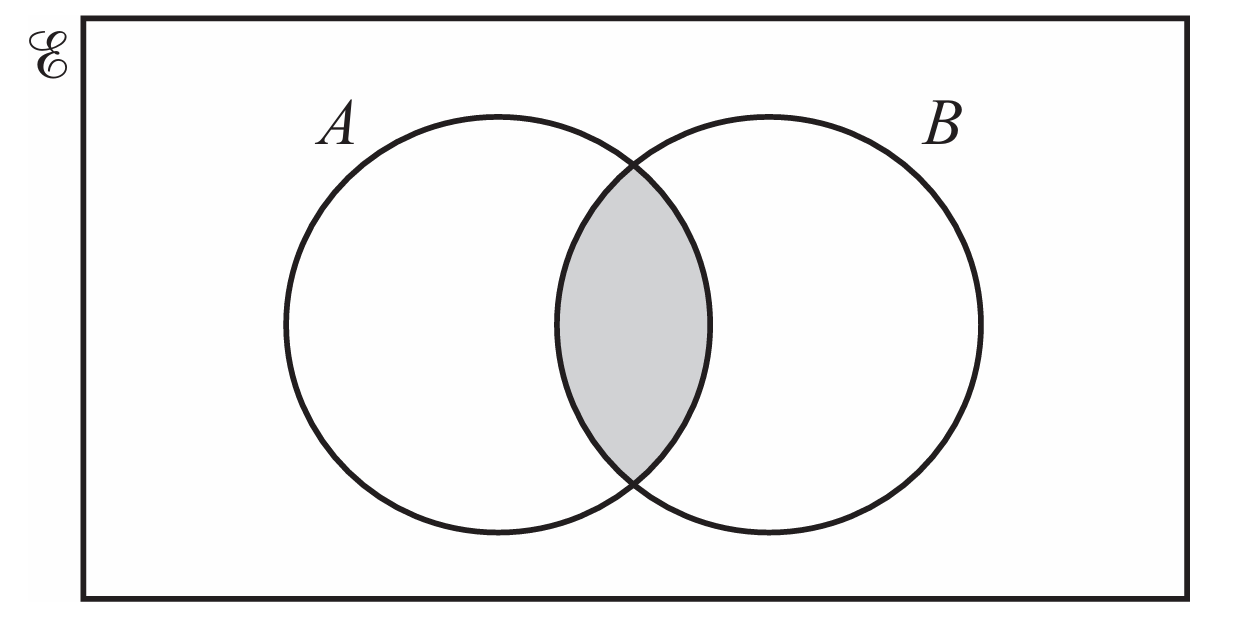
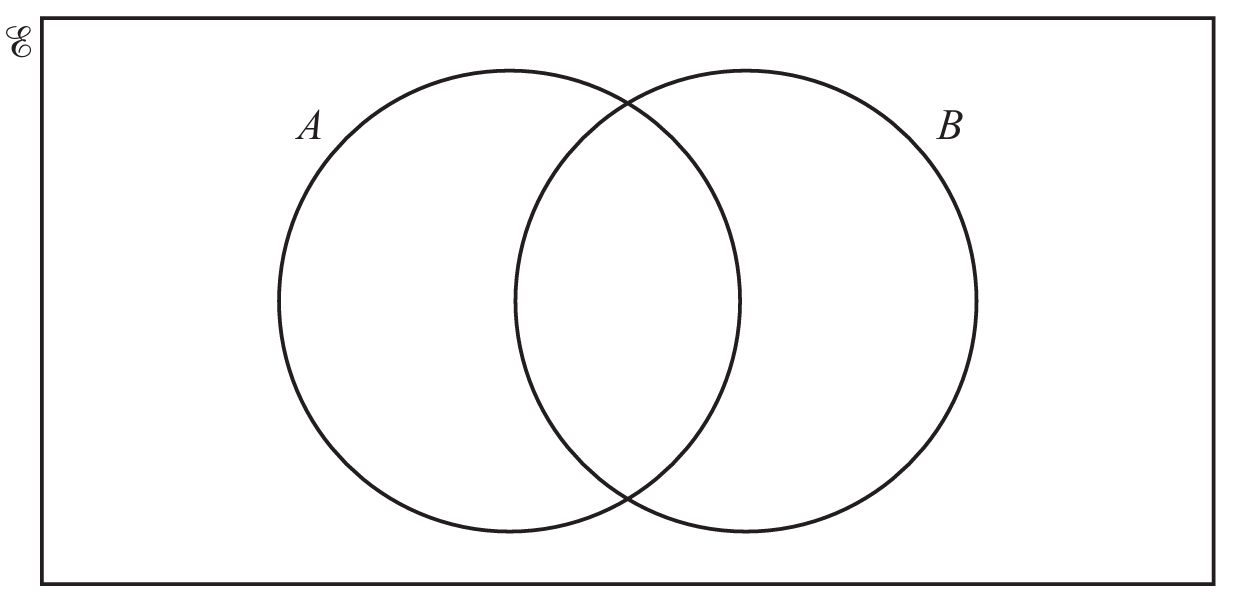
Use set notation to describe the shaded region.

(b)
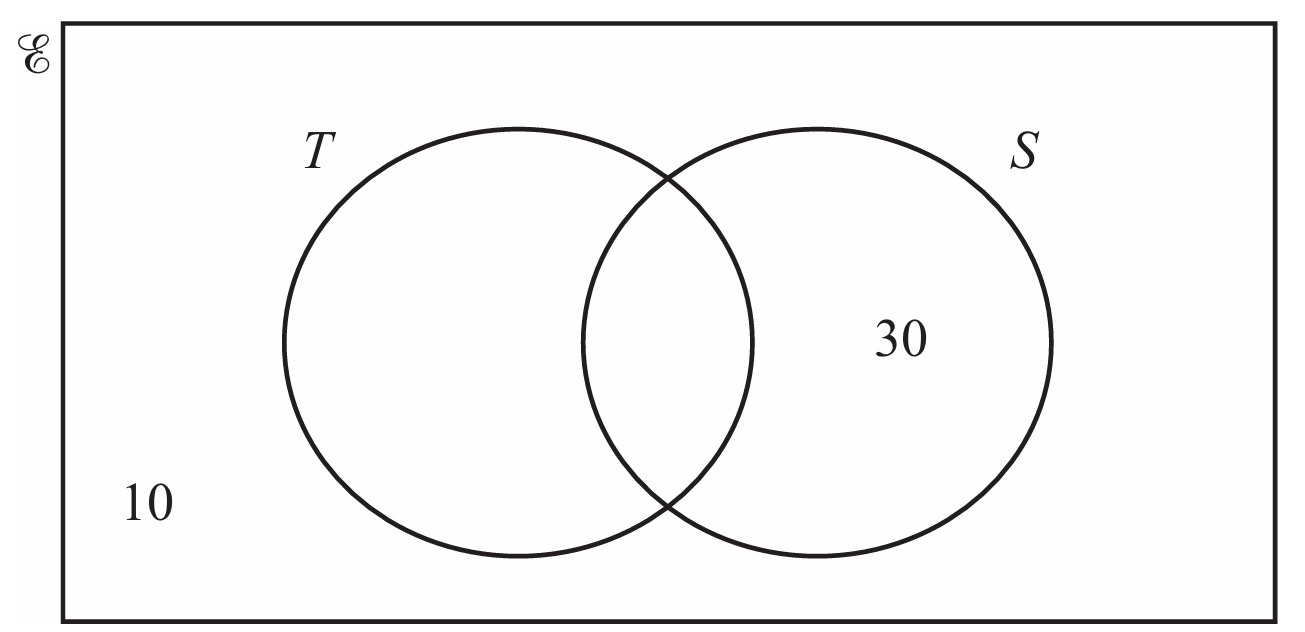
\(\mathscr{E} = \{\text{people in a club}\}\)
\(T = \{\text{people who play tennis}\}\)
\(S = \{\text{people who go swimming}\}\)
There are \(60\) people in the club. \(36\) people go swimming. 


(i) Complete the Venn diagram.
(ii) Find \(n(T’)\).

Most-appropriate topic codes (Cambridge IGCSE Mathematics 0580):

Topic C1.2 Sets
▶️ Answer/Explanation

(a)
The shaded region is where set \(A\) and set \(B\) overlap. This is the intersection.
Answer: \(A \cap B\)

(b)(i)
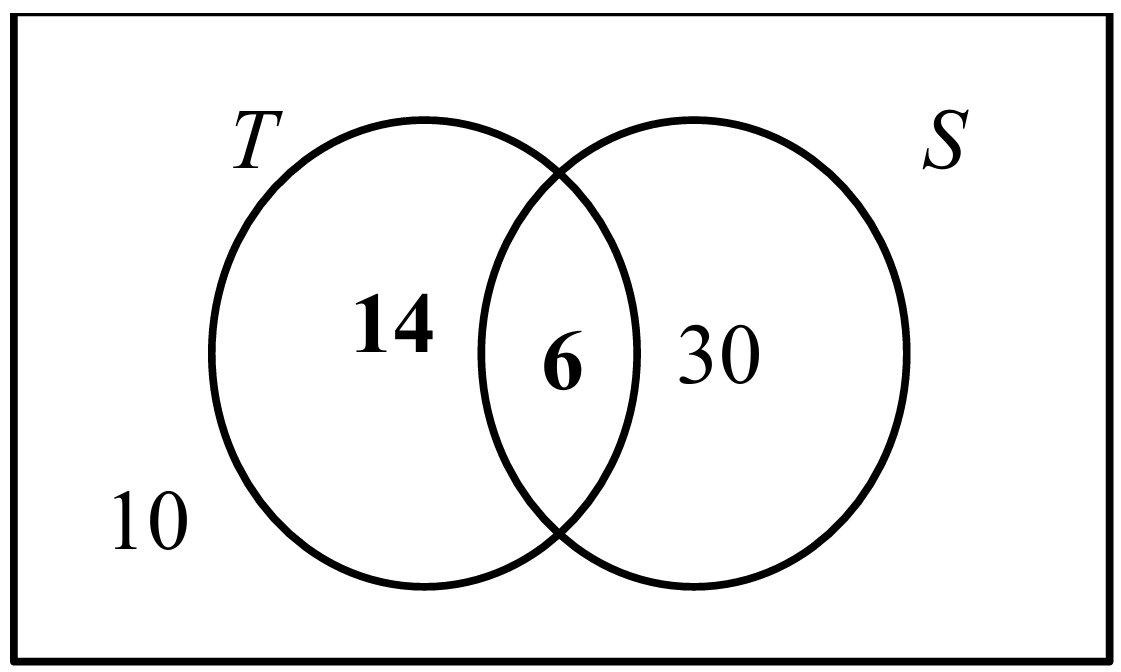
We know \(36\) people swim (\(n(S) = 36\)). Since \(30\) are in the ‘swimming only’ part, the intersection must be \(36 – 30 = 6\).
The total is \(60\). The sum of all parts is \(n(\text{Tennis only}) + 6 + 30 + 10 = 60\).
Solving for ‘Tennis only’: \(60 – 46 = 14\).
Answer: 

(b)(ii)
\(n(T’)\) refers to the number of people who do NOT play tennis.
This includes the ‘swimming only’ group (\(30\)) and those who do neither (\(10\)).
\(30 + 10 = 40\).
Answer: \(40\)

Scroll to Top