▶️ Answer/Explanation
(a) Let’s evaluate the function for missing values:
• At $x = -3$, $y = (-3+3)(-3-2) = 0 \times (-5) = 0$.
• At $x = 0$, $y = (0+3)(0-2) = 3 \times (-2) = -6$.
• At $x = 2$, $y = (2+3)(2-2) = 5 \times 0 = 0$.

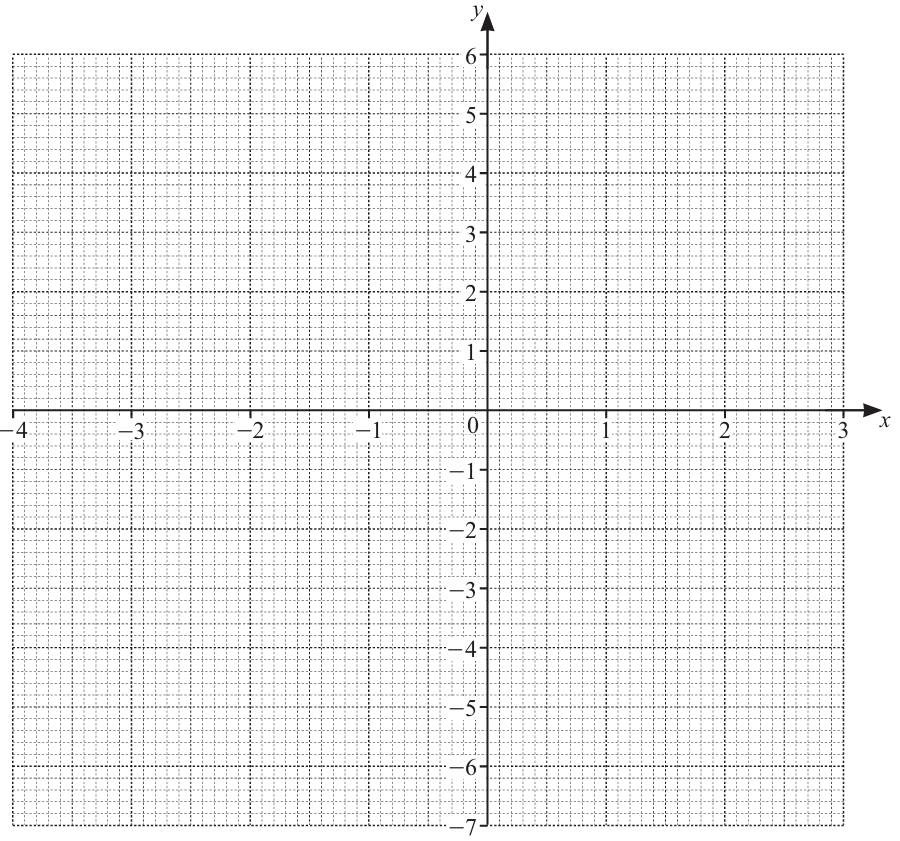
(b) Plot these coordinates carefully onto your axis grid and draw a smooth parabolic curve passing through them.
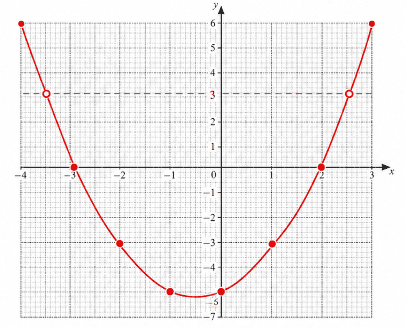
(c) The minimum vertex is located exactly halfway between the $x$-intercepts ($x=-3$ and $x=2$), which means $x = -0.5$. Substituting gives $y = (-0.5+3)(-0.5-2) = 2.5 \times (-2.5) = -6.25$.
(d) The axis of symmetry runs vertically down through the center of the vertex, yielding the line equation $x = -0.5$.
(e) To solve where the curve equals $3$, look across the graph at height $y=3$ and read the matching $x$ values, which give approx $-3.5$ and $2.5$.
✅ Answer: (a) missing row values are 0, -6, 0 (b) Smooth parabola curve (c) (-0.5, -6.25) (d) $x = -0.5$ (e) $x \approx -3.5$ or $x \approx 2.5$
• At $x = -3$, $y = (-3+3)(-3-2) = 0 \times (-5) = 0$.
• At $x = 0$, $y = (0+3)(0-2) = 3 \times (-2) = -6$.
• At $x = 2$, $y = (2+3)(2-2) = 5 \times 0 = 0$.
(b) Plot these coordinates carefully onto your axis grid and draw a smooth parabolic curve passing through them.
(c) The minimum vertex is located exactly halfway between the $x$-intercepts ($x=-3$ and $x=2$), which means $x = -0.5$. Substituting gives $y = (-0.5+3)(-0.5-2) = 2.5 \times (-2.5) = -6.25$.
(d) The axis of symmetry runs vertically down through the center of the vertex, yielding the line equation $x = -0.5$.
(e) To solve where the curve equals $3$, look across the graph at height $y=3$ and read the matching $x$ values, which give approx $-3.5$ and $2.5$.
✅ Answer: (a) missing row values are 0, -6, 0 (b) Smooth parabola curve (c) (-0.5, -6.25) (d) $x = -0.5$ (e) $x \approx -3.5$ or $x \approx 2.5$