▶️ Answer/Explanation
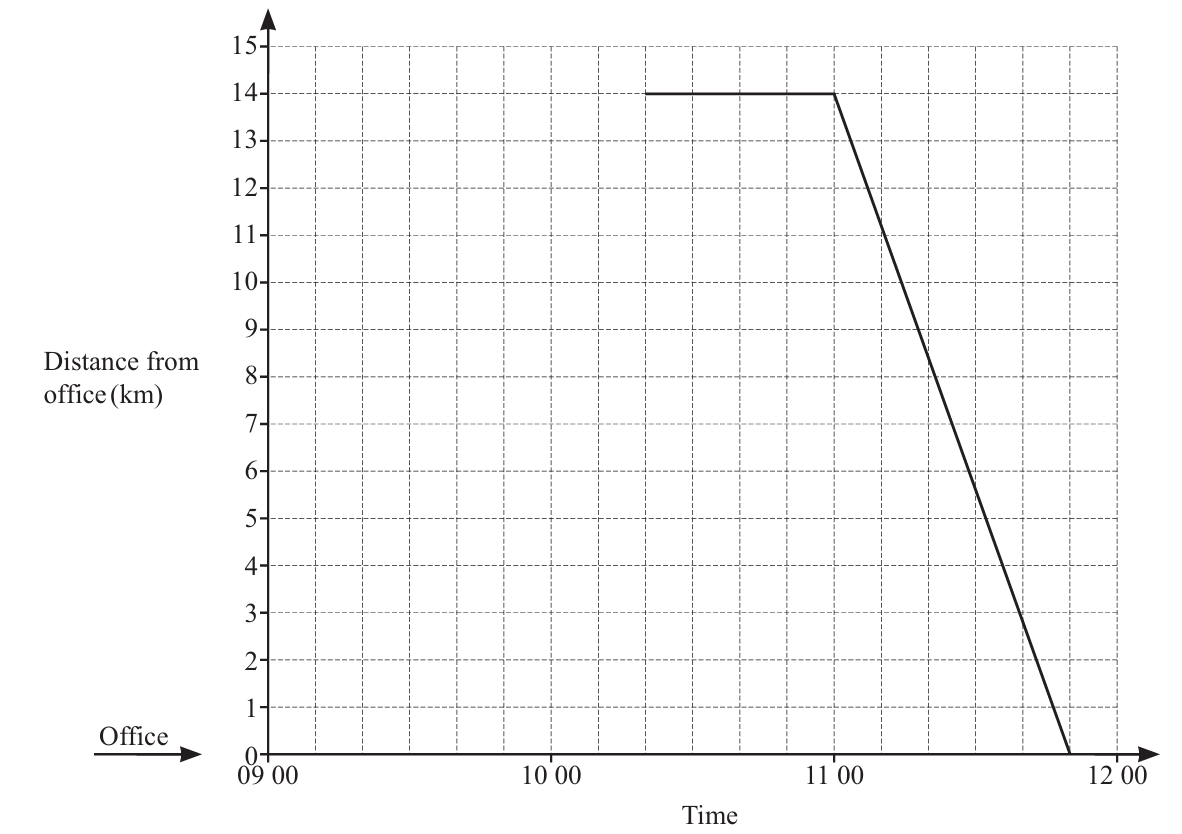
(a) Looking at the flat horizontal line on the graph, it represents when Ky is stationary at the meeting. The distance value on the vertical axis for this line is $14\text{ km}$.
(b) The horizontal line starts at $10:20$ and ends at $11:00$. Calculating the duration between these two times gives $40\text{ minutes}$.
(c) Following the straight sloping line representing his return journey down to the horizontal axis (distance = $0$), it lands precisely on the grid mark for $11:50$.
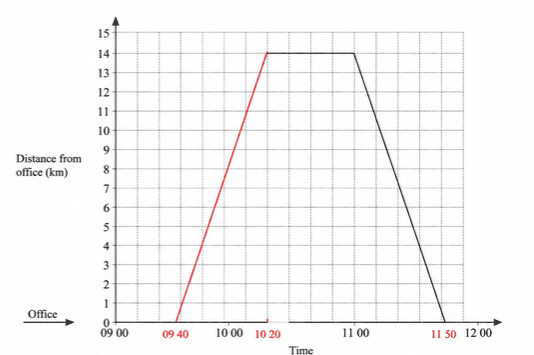
(d) To find out how long the outward trip took, we use the formula $\text{time} = \frac{\text{distance}}{\text{speed}} = \frac{14\text{ km}}{21\text{ km/h}} = \frac{2}{3}\text{ of an hour} = 40\text{ minutes}$. Since he arrived at the meeting at $10:20$, he must have started cycling from the office $40$ minutes prior, which is at $09:40$. To complete the travel graph, draw a straight line from $(09:40, 0)$ to $(10:20, 14)$.
✅ Answer:
(a) $14\text{ km}$
(b) $40\text{ min}$
(c) $11:50$
(d) Graph completed with a line drawn from $(09:40, 0)$ to $(10:20, 14)$.
(b) The horizontal line starts at $10:20$ and ends at $11:00$. Calculating the duration between these two times gives $40\text{ minutes}$.
(c) Following the straight sloping line representing his return journey down to the horizontal axis (distance = $0$), it lands precisely on the grid mark for $11:50$.
(d) To find out how long the outward trip took, we use the formula $\text{time} = \frac{\text{distance}}{\text{speed}} = \frac{14\text{ km}}{21\text{ km/h}} = \frac{2}{3}\text{ of an hour} = 40\text{ minutes}$. Since he arrived at the meeting at $10:20$, he must have started cycling from the office $40$ minutes prior, which is at $09:40$. To complete the travel graph, draw a straight line from $(09:40, 0)$ to $(10:20, 14)$.
✅ Answer:
(a) $14\text{ km}$
(b) $40\text{ min}$
(c) $11:50$
(d) Graph completed with a line drawn from $(09:40, 0)$ to $(10:20, 14)$.