
▶️ Answer/Explanation
Answers:
(a) Parallel lines never meet, remaining equidistant apart.
(b) (5,8)
(c)(i) Parallelogram (ii) 15cm² (base×height)
(d)(i) 2/5 (rise/run) (ii) y=(2/5)x+6 (using y=mx+c)
The equation of line L is \(y=5x-3\).
(a) Write down the gradient of line L.
(b) Write down the equation of a line parallel to line L.
Most-appropriate topic codes (Cambridge IGCSE Mathematics 0580):
(a)
In the slope-intercept form \(y = mx + c\), the value of \(m\) represents the gradient.
Here, \(m = 5\).
✅ Answer: 5
(b)
Any line parallel to line L must share the same gradient (\(m = 5\)) but can have a different y-intercept (\(c\)).
An example is \(y=5x\).
✅ Answer: \(y=5x+k\) (where \(k \neq -3\))
The diagram shows a point P, a shape S and lines A and B on a \(1cm^{2}\) grid.
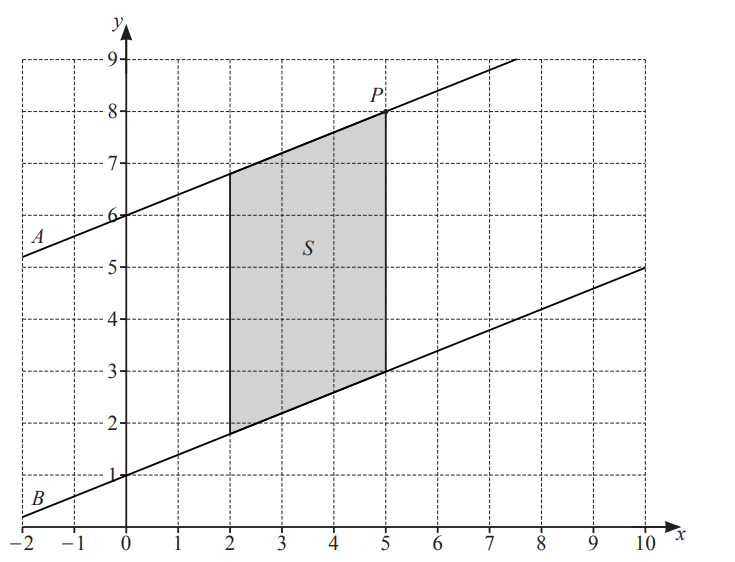
(a) Line A is parallel to line B. Explain what parallel means.
(b) Write down the coordinates of point P.
(c) (i) Write down the mathematical name for shape S.
(ii) Work out the area of shape S.
(d) (i) Find the gradient of line A.
(ii) Write down the equation of line A.
(a) Parallel lines never meet, remaining equidistant apart.
(b) (5,8)
(c)(i) Parallelogram (ii) 15cm² (base×height)
(d)(i) 2/5 (rise/run) (ii) y=(2/5)x+6 (using y=mx+c)