▶️ Answer/Explanation
(a)
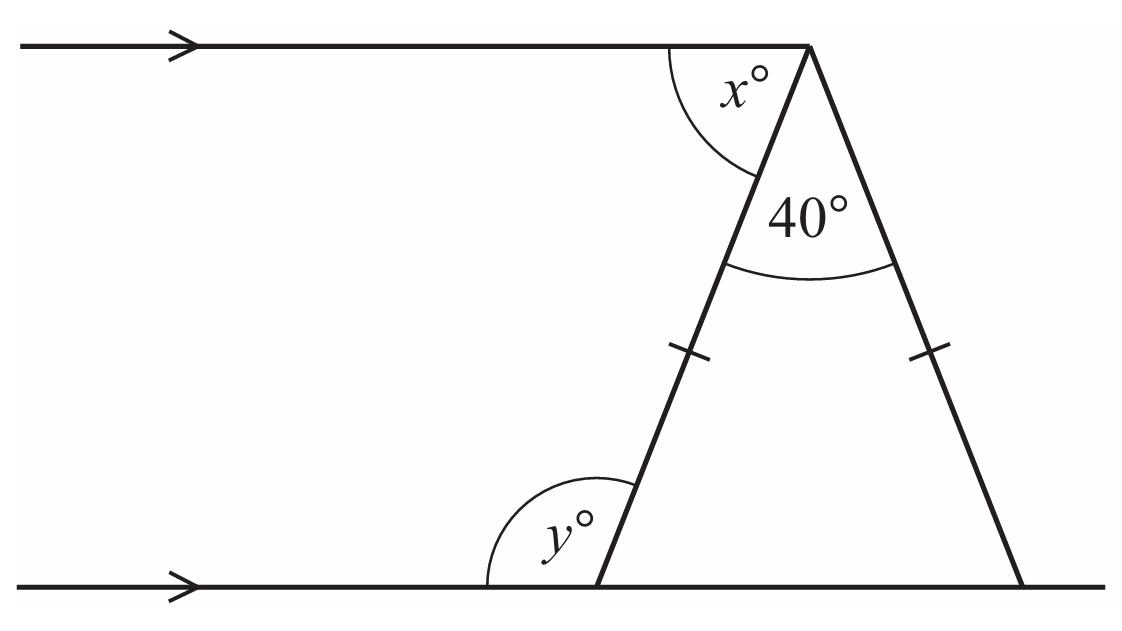
The sum of angles in a triangle is \(180^{\circ}\). Since the triangle is isosceles, the two base angles are equal.
Subtract the top angle from \(180^{\circ}\): \(180^{\circ} – 40^{\circ} = 140^{\circ}\).
Divide by \(2\) to find the base angle \(x\): \(\frac{140^{\circ}}{2} = 70\).
✅ Answer: \(70\)
(b)
Based on the diagram and angle rules, \(y\) forms a straight line with the base angle \(x\).
Calculate \(y\): \(180^{\circ} – 70^{\circ} = 110^{\circ}\).
The geometrical reason is that angles on a straight line add up to \(180^{\circ}\).
✅ Answer: \(110\) because angles on a straight line add to \(180^{\circ}\)
▶️ Answer/Explanation
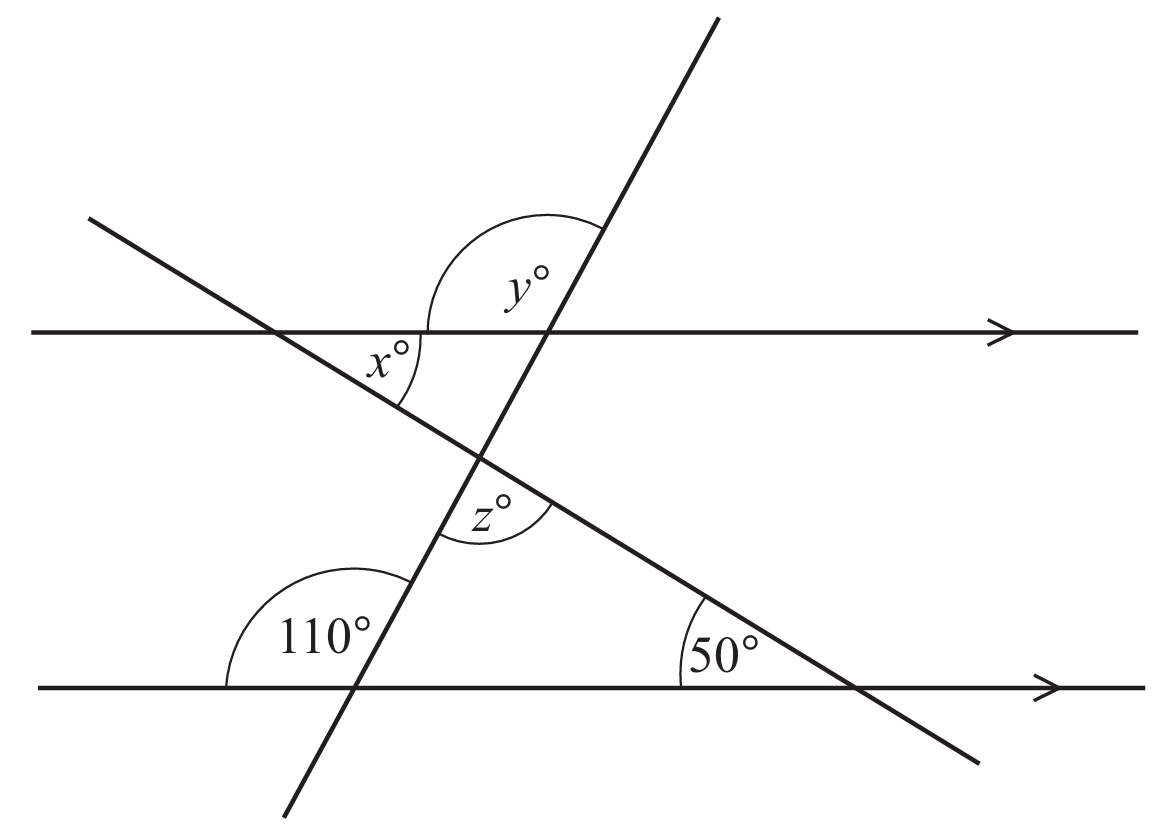
(a) Angle $x^\circ$ and the $50^\circ$ angle are alternate interior angles formed by a transversal line cutting across parallel lines (creating a Z-shape). Therefore, $x = 50$.
(b) The angle alternate to the given $110^\circ$ sits right next to $y^\circ$ on a straight line, meaning $y$ and $110$ are corresponding angles. Thus, $y = 110$.
(c) Look at the central triangle formed by the intersecting lines. The interior angles are $x^\circ$, $z^\circ$, and an angle adjacent to $110^\circ$ which is $180^\circ – 110^\circ = 70^\circ$. Knowing that a triangle’s interior angles always sum to $180^\circ$, we set up the equation: $50 + 70 + z = 180 \rightarrow 120 + z = 180$, which leaves us with $z = 60$.
✅ Answer:
(a) $50$ because alternate angles are equal.
(b) $110$ because corresponding angles are equal.
(c) $60$
(b) The angle alternate to the given $110^\circ$ sits right next to $y^\circ$ on a straight line, meaning $y$ and $110$ are corresponding angles. Thus, $y = 110$.
(c) Look at the central triangle formed by the intersecting lines. The interior angles are $x^\circ$, $z^\circ$, and an angle adjacent to $110^\circ$ which is $180^\circ – 110^\circ = 70^\circ$. Knowing that a triangle’s interior angles always sum to $180^\circ$, we set up the equation: $50 + 70 + z = 180 \rightarrow 120 + z = 180$, which leaves us with $z = 60$.
✅ Answer:
(a) $50$ because alternate angles are equal.
(b) $110$ because corresponding angles are equal.
(c) $60$