
▶️ Answer/Explanation
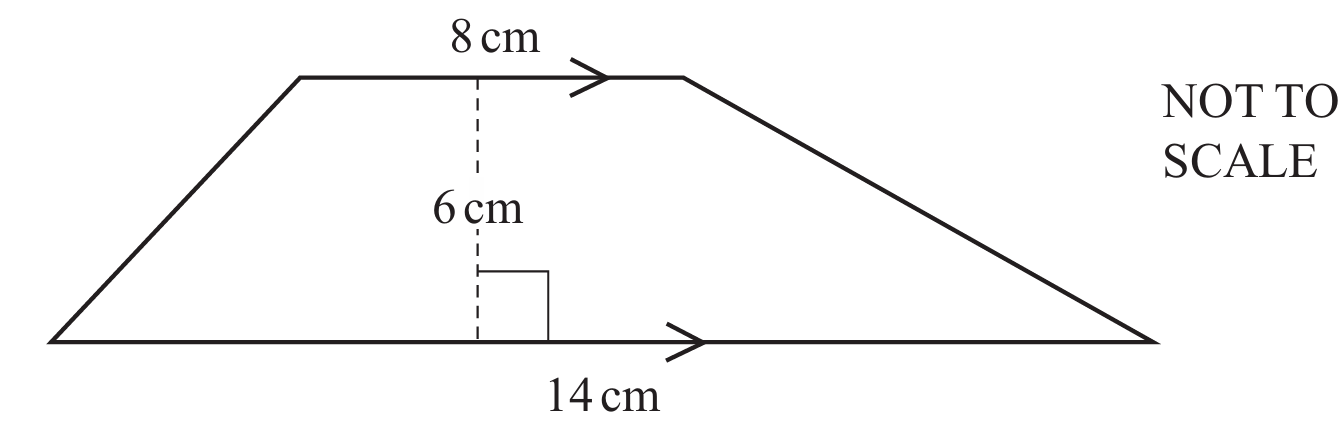
The formula for the area of a trapezium is \(A = \dfrac{1}{2}(a + b) \times h\), where \(a\) and \(b\) are the parallel sides and \(h\) is the perpendicular height.
Substituting the values: \(A = \dfrac{1}{2}(8 + 14) \times 6 = \dfrac{1}{2} \times 22 \times 6 = 11 \times 6 = 66\).
✅ Answer: \(66 \text{ cm}^2\)
▶️ Answer/Explanation
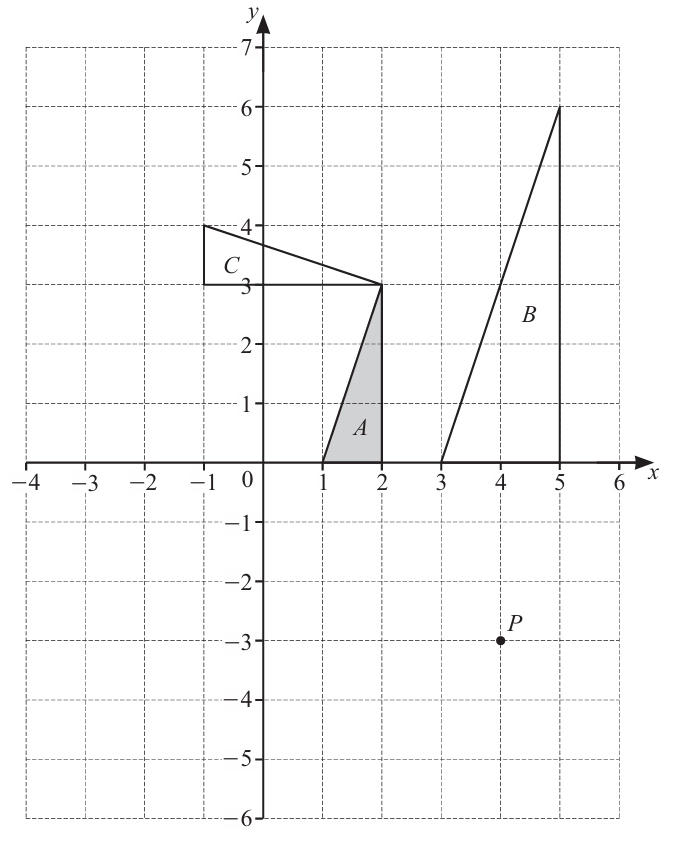
(a) From the grid layout, triangle $B$ has a base width of $2\text{ cm}$ (from $x=3$ to $x=5$) and a vertical height of $6\text{ cm}$ (from $y=0$ to $y=6$). Using $\text{Area} = \frac{1}{2} \times \text{base} \times \text{height} = \frac{1}{2} \times 2 \times 6 = 6\text{ cm}^2$.
(b) (i) Reading directly from the graph axes, point $P$ is at $x = 4$ and $y = -3$, meaning $(4, -3)$. (ii) To translate by vector $\binom{-20}{12}$, add $-20$ to the $x$-coordinate and $12$ to the $y$-coordinate: $(4 – 20, -3 + 12) = (-16, 9)$.
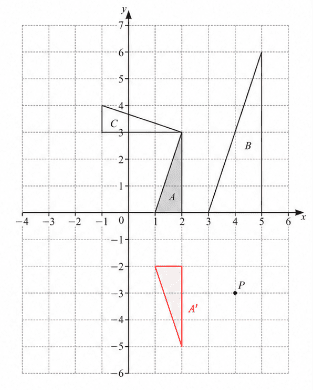
(c) The line $y = -1$ is horizontal. Flipping triangle $A$ down across it produces coordinates at $(1, -2)$, $(2, -2)$, and $(2, -5)$.
(d) (i) Triangle $B$ is twice as large as $A$, and its lines project back through the origin. This is an Enlargement, scale factor 2, centre (0,0).
(ii) Triangle $C$ is turned completely sideways. Tracing its orientation demonstrates a Rotation of $90^\circ$ clockwise, centered around the point (2,3).
✅ Answer: (a) 6 (b)(i) (4,-3) (ii) (-16,9) (c) Drawn reflected image (d)(i) Enlargement, SF 2, centre (0,0) (ii) Rotation, $90^\circ$ clockwise, centre (2,3)
(b) (i) Reading directly from the graph axes, point $P$ is at $x = 4$ and $y = -3$, meaning $(4, -3)$. (ii) To translate by vector $\binom{-20}{12}$, add $-20$ to the $x$-coordinate and $12$ to the $y$-coordinate: $(4 – 20, -3 + 12) = (-16, 9)$.
(c) The line $y = -1$ is horizontal. Flipping triangle $A$ down across it produces coordinates at $(1, -2)$, $(2, -2)$, and $(2, -5)$.
(d) (i) Triangle $B$ is twice as large as $A$, and its lines project back through the origin. This is an Enlargement, scale factor 2, centre (0,0).
(ii) Triangle $C$ is turned completely sideways. Tracing its orientation demonstrates a Rotation of $90^\circ$ clockwise, centered around the point (2,3).
✅ Answer: (a) 6 (b)(i) (4,-3) (ii) (-16,9) (c) Drawn reflected image (d)(i) Enlargement, SF 2, centre (0,0) (ii) Rotation, $90^\circ$ clockwise, centre (2,3)
▶️ Answer/Explanation
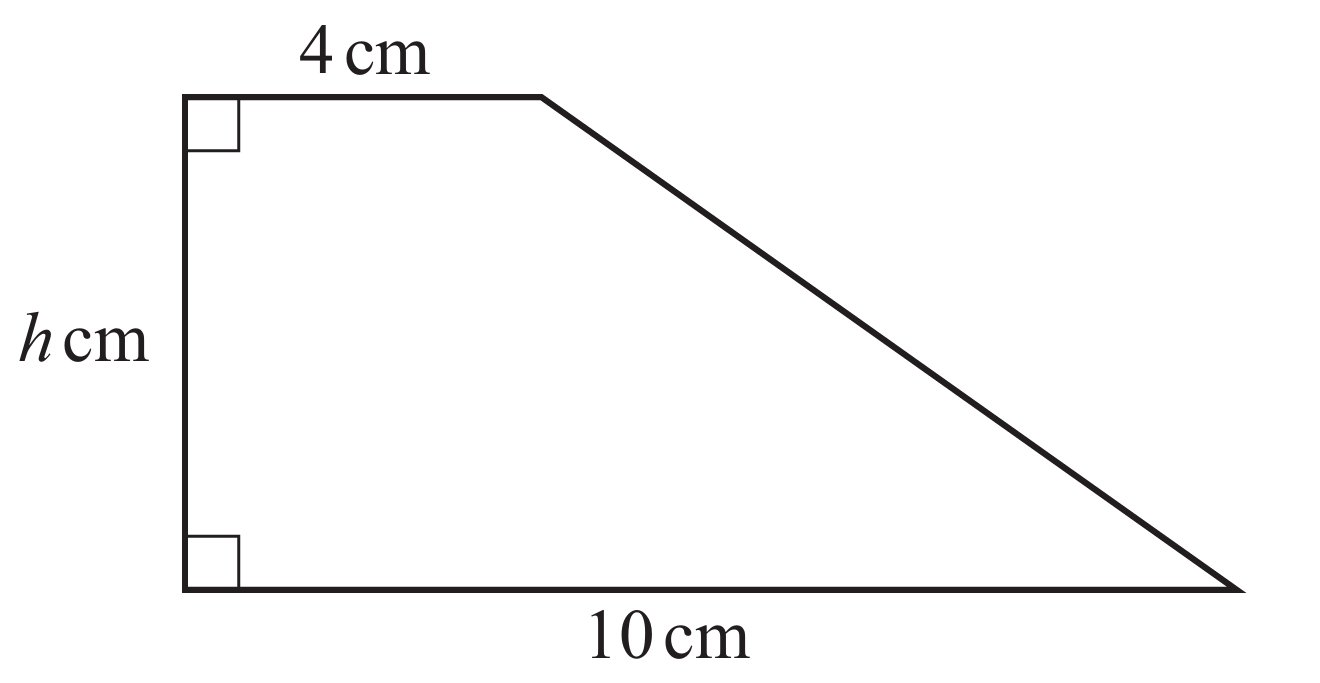
The formula for the area of a trapezium is $A = \frac{1}{2}(a + b)h$, where $a$ and $b$ are the parallel sides. We substitute our known numbers into this equation: $$42 = \frac{1}{2}(4 + 10) \times h$$ $$42 = \frac{1}{2}(14) \times h$$ $$42 = 7h$$ $$h = \frac{42}{7} = 6$$
Answer: $h =$ 6