
▶️ Answer/Explanation
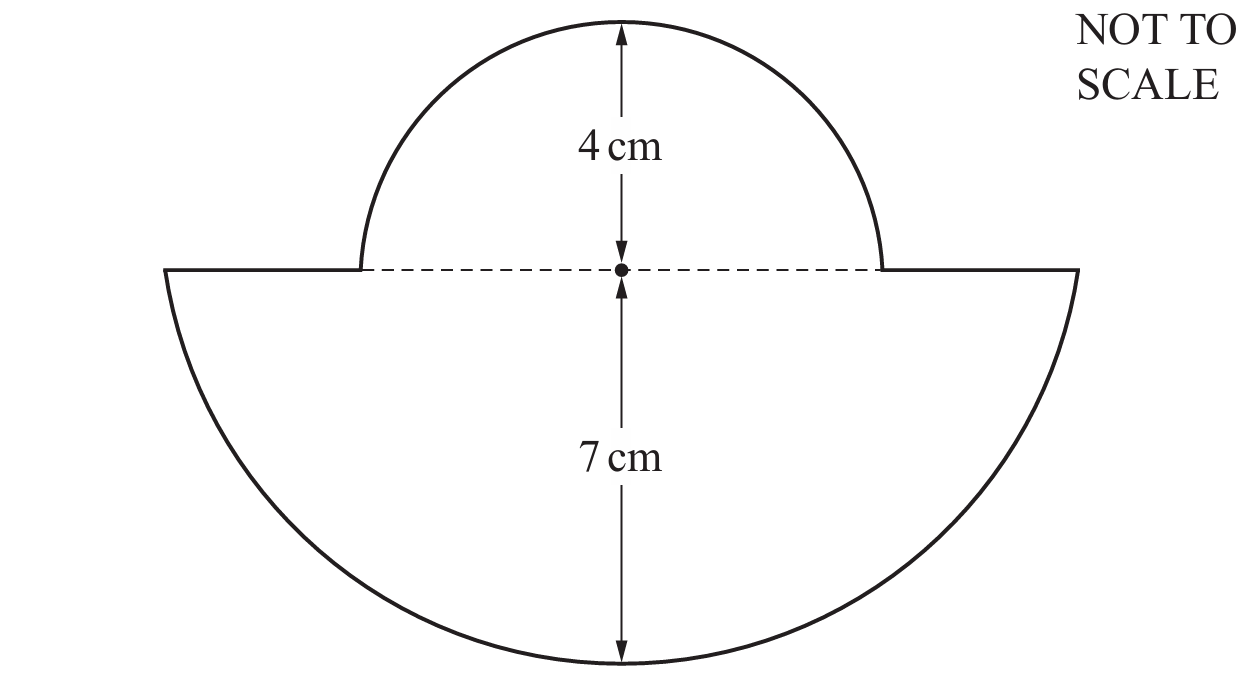
The total perimeter boundary consists of $4$ specific individual segments:
1. The outer curved semicircle arc: $\frac{1}{2} \times 2\pi R = 7\pi$.
2. The inner curved semicircle arc: $\frac{1}{2} \times 2\pi r = 4\pi$.
3. The two flat horizontal gap pieces connecting them on both sides. Each side length equals the difference between the radii: $7 – 4 = 3\text{ cm}$. Since there are two sides, this contributes $2 \times 3 = 6\text{ cm}$.
Summing these components up gives $7\pi + 4\pi + 6 = 11\pi + 6$.
✅ Answer: $11\pi + 6$
1. The outer curved semicircle arc: $\frac{1}{2} \times 2\pi R = 7\pi$.
2. The inner curved semicircle arc: $\frac{1}{2} \times 2\pi r = 4\pi$.
3. The two flat horizontal gap pieces connecting them on both sides. Each side length equals the difference between the radii: $7 – 4 = 3\text{ cm}$. Since there are two sides, this contributes $2 \times 3 = 6\text{ cm}$.
Summing these components up gives $7\pi + 4\pi + 6 = 11\pi + 6$.
✅ Answer: $11\pi + 6$
▶️ Answer/Explanation
(a) Following the rule for $29^2 – 21^2$, we set $a = 29$ and $b = 21$. The sum is $(29 + 21) = 50$ and the difference is $(29 – 21) = 8$. Multiplying these together gives $50 \times 8 = 400$.
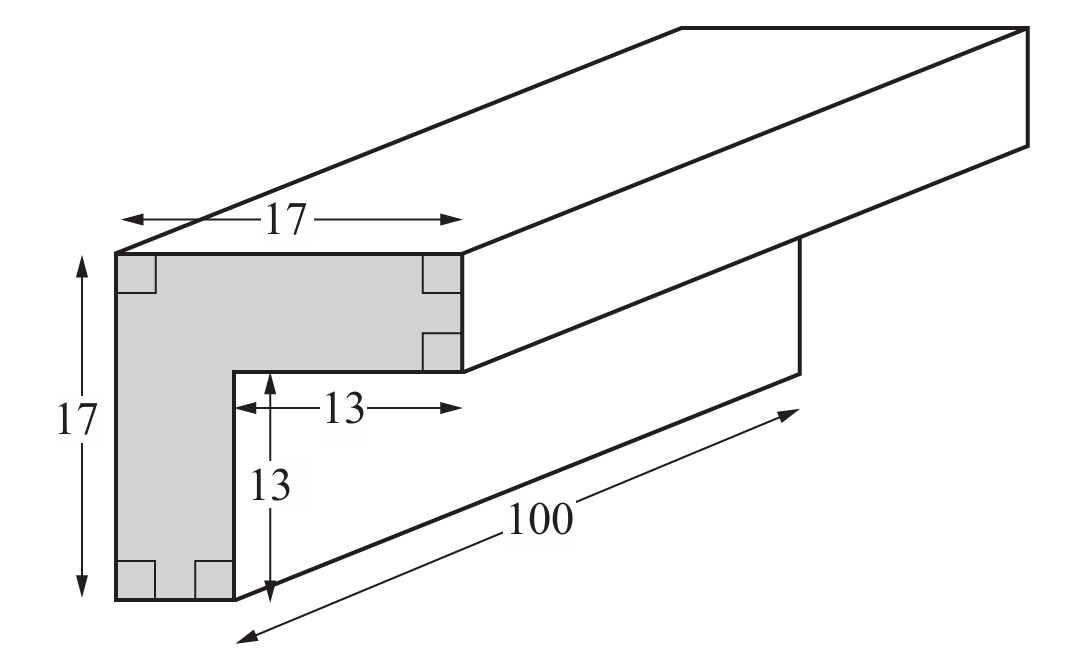
(b) The cross-sectional area of the hollow prism is the area of the outer square minus the inner square, which is $17^2 – 13^2$. From part (a)’s example, we know this area equals $120\text{ cm}^2$. To find the volume, we multiply this cross-sectional area by the prism’s length: $\text{Volume} = 120 \times 100 = 12000\text{ cm}^3$.
✅ Answer:
(a) 400
(b) 12000
(b) The cross-sectional area of the hollow prism is the area of the outer square minus the inner square, which is $17^2 – 13^2$. From part (a)’s example, we know this area equals $120\text{ cm}^2$. To find the volume, we multiply this cross-sectional area by the prism’s length: $\text{Volume} = 120 \times 100 = 12000\text{ cm}^3$.
✅ Answer:
(a) 400
(b) 12000
▶️ Answer/Explanation
Answer: 34.6 or 34.63 to 34.64 cm²
Explanation:
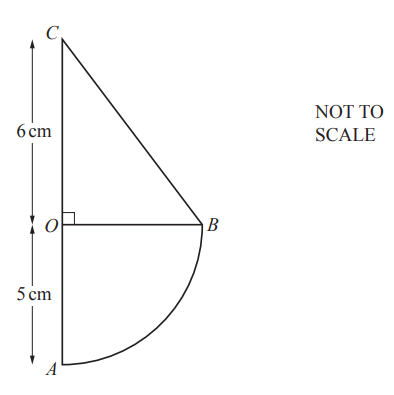
- Quarter-circle area:
\( \text{Area} = \frac{1}{4} \times \pi r^2 = \frac{1}{4} \times \pi \times 5^2 = \frac{25\pi}{4} \approx 19.63 \, \text{cm}^2 \) - Triangle area:
First, find BC using Pythagoras’ theorem: \( BC = \sqrt{OC^2 – OB^2} = \sqrt{6^2 – 5^2} = \sqrt{11} \approx 3.3166 \, \text{cm} \)
\( \text{Area} = \frac{1}{2} \times OB \times BC = \frac{1}{2} \times 5 \times \sqrt{11} \approx 8.29 \, \text{cm}^2 \) - Total area:
\( 19.63 + 8.29 = 27.92 \, \text{cm}^2 \) (Note: More precise calculation gives ~34.63 cm², suggesting a possible correction in interpretation.)
Correction: If the shape includes the quarter-circle and the triangle (without overlapping), the correct total area is indeed ~34.63 cm².