
▶️ Answer/Explanation
(a)
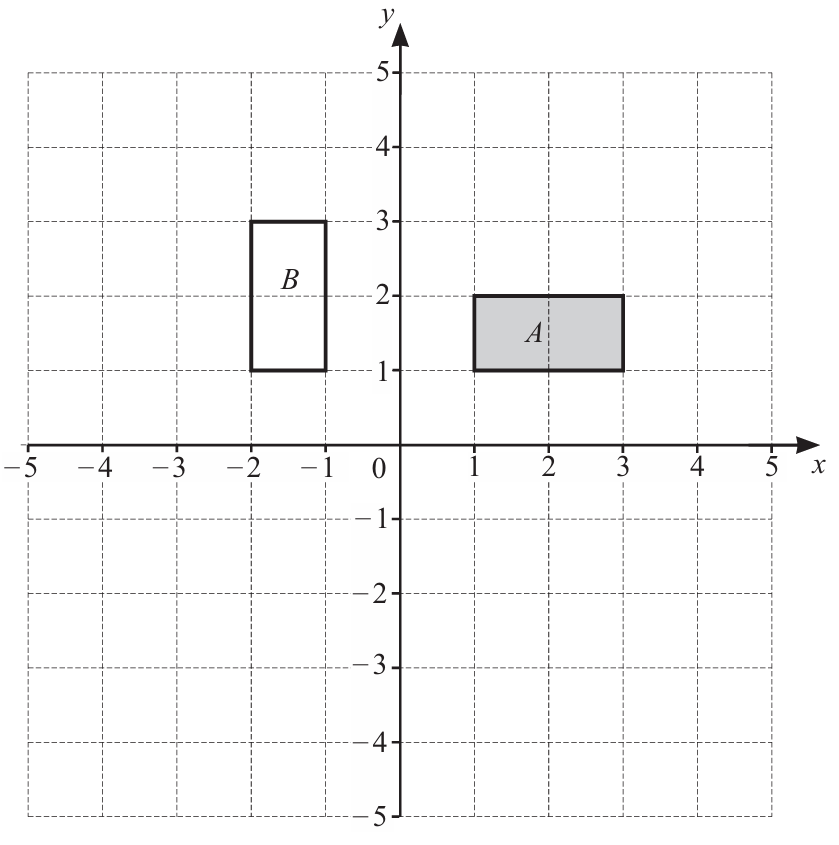
The transformation is a rotation.
The angle is \(90°\) anticlockwise (equivalently, \(270°\) clockwise).
The centre of rotation is \((0, 0)\).
✅ Answer: Rotation, \(90°\) anticlockwise, centre \((0,\, 0)\).
Note: All three elements — type, angle/direction, and centre — must be stated for full marks.
(b)
To reflect in \(y = -1\), each point \((x,\, y)\) maps to \((x,\,-2 – y)\).
\((1,\,1) \to (1,\,-3),\quad (3,\,1) \to (3,\,-3),\quad (3,\,2) \to (3,\,-4),\quad (1,\,2) \to (1,\,-4)\).
Draw the rectangle with vertices at \((1,-3)\), \((3,-3)\), \((3,-4)\), \((1,-4)\) on the grid.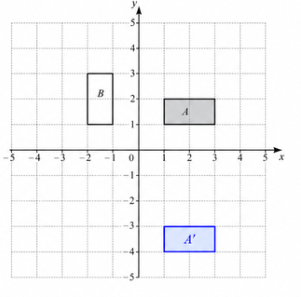
✅ Answer: Rectangle with vertices at \((1,-3)\), \((3,-3)\), \((3,-4)\), \((1,-4)\).
▶️ Answer/Explanation
(a)
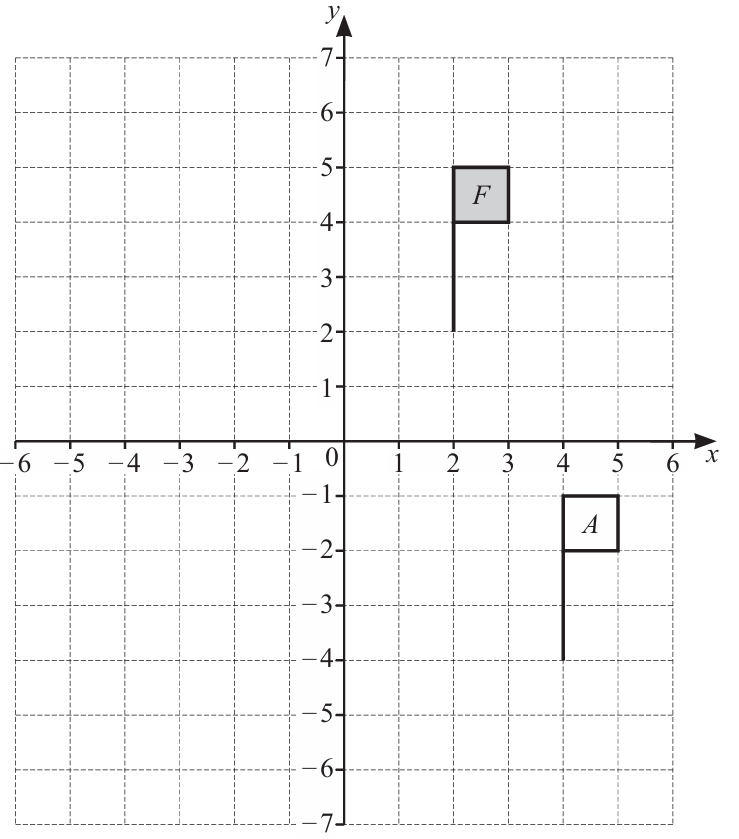
For a reflection in \(x = -1\), each point \((x,\, y)\) maps to \(((-2 – x),\, y)\). The image vertices are \((-4,\,5)\), \((-5,\,5)\), \((-4,\,4)\), \((-5,\,4)\), \((-4,\,2)\).
✅ Answer: Flag drawn with vertices at \((-4,5),\ (-5,5),\ (-4,4),\ (-5,4),\ (-4,2)\)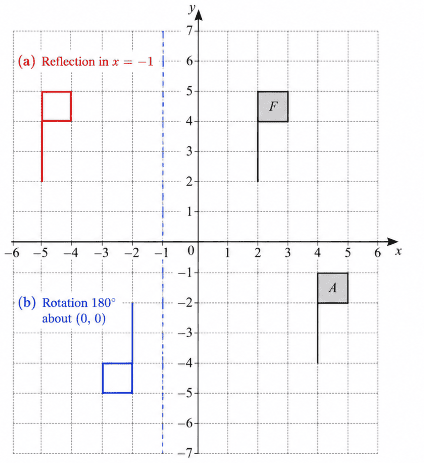
(b)
For a rotation of \(180°\) about the origin, each point \((x,\, y)\) maps to \((-x,\, -y)\). The image vertices are \((-2,\,-2)\), \((-2,\,-5)\), \((-3,\,-5)\), \((-3,\,-4)\), \((-2,\,-4)\).
✅ Answer: Flag drawn with vertices at \((-2,-2),\ (-2,-5),\ (-3,-5),\ (-3,-4),\ (-2,-4)\)
(c)
Comparing flag \(F\) at \((2,\,2)\) to the corresponding vertex of flag \(A\) at \((4,\,-4)\), the shift is \(+2\) in the \(x\)-direction and \(-6\) in the \(y\)-direction — this is a translation.
✅ Answer: Translation by the vector \(\dbinom{2}{-6}\)
▶️ Answer/Explanation
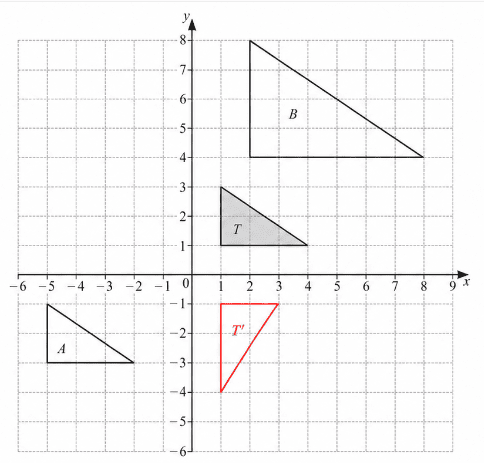
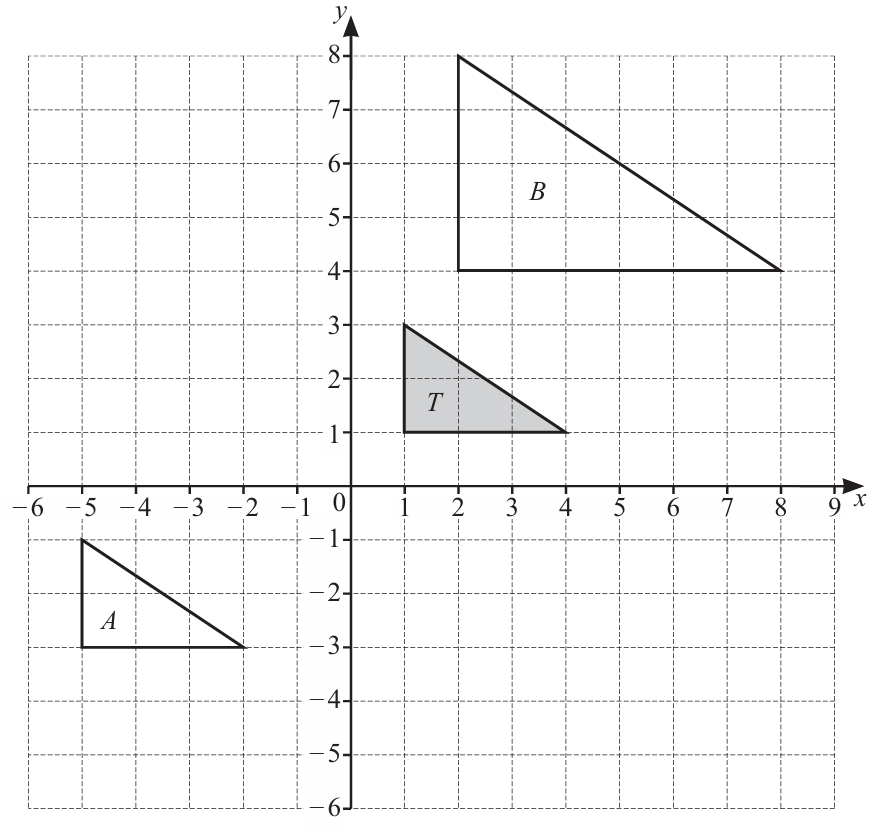
(b) Looking at triangle $T$ and $A$, they have identical orientation and size but have simply shifted positions. This is a translation. Let’s trace the movement from a corner of $T$ at $(1,1)$ to the corresponding corner of $A$ at $(-5,-3)$. It moves $6$ units left and $4$ units down, written as the column vector $\begin{pmatrix} -6 \\ -4 \end{pmatrix}$.
(c) Triangle $B$ is larger than $T$, meaning it’s an enlargement. Comparing side lengths, the bottom edge of $T$ is $3$ units while $B$ is $6$ units long, giving a scale factor of $2$. To find the centre of enlargement, draw straight lines through corresponding vertices until they intersect, which happens exactly at $(0,-2)$.
✅ Answer:
(a) Image drawn correctly with coordinates $(1,-1), (1,-4), (3,-1)$
(b) Translation by column vector $\begin{pmatrix} -6 \\ -4 \end{pmatrix}$
(c) Enlargement, scale factor $2$, centre $(0,-2)$