Home / CIE iGCSE Maths C8.1 Introduction to probability Exam Style Practice Questions- Paper 1

CIE iGCSE Maths C8.1 Introduction to probability Exam Style Practice Questions- Paper 1

Question

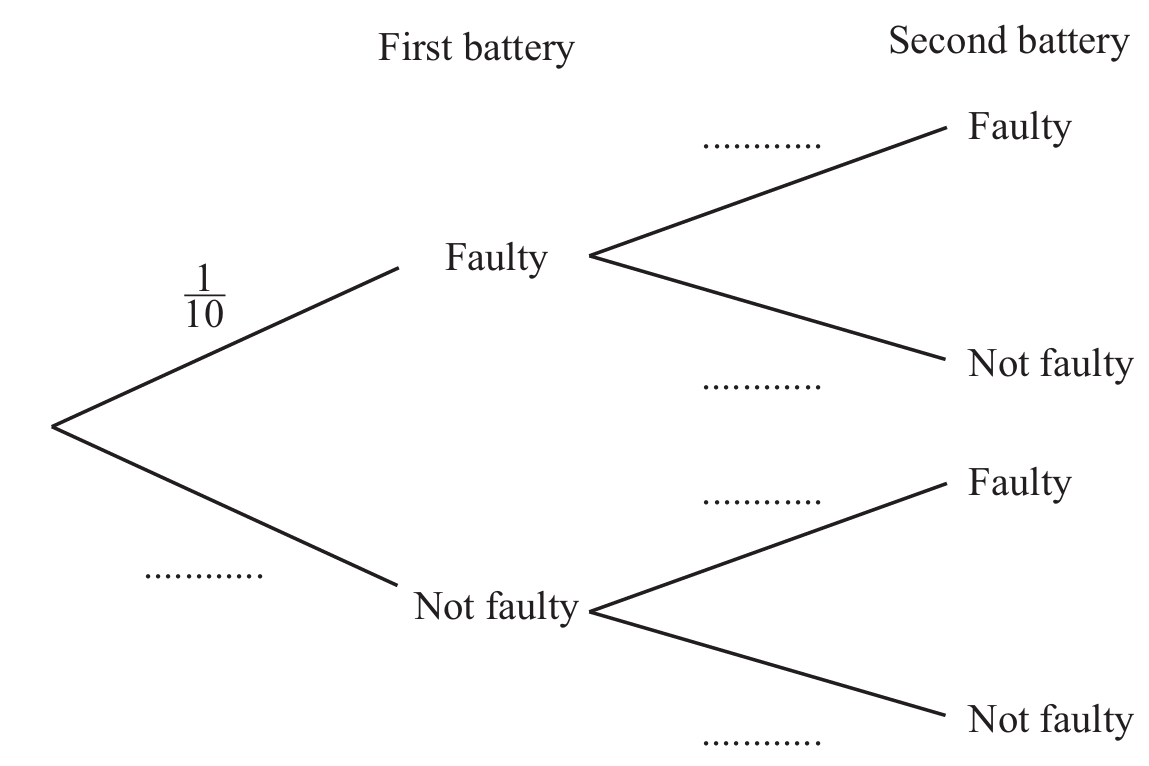
Mai buys two batteries. The probability that a battery is faulty is $\frac{1}{10}$.

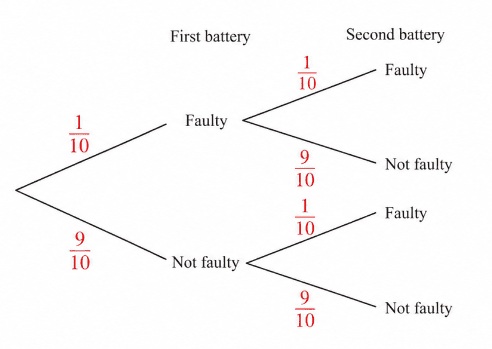
(a) Complete the tree diagram.

(b) Find the probability that Mai buys two faulty batteries.

(c) A shop sells 3000 batteries in one month. Work out the expected number of faulty batteries the shop sells.

Most-appropriate topic codes (Cambridge IGCSE Mathematics 0580):

C8.1 Introduction to probability (a)
• C8.2 Relative and expected frequencies(c)
• C8.3 Probability of combined events (a,b)
▶️ Answer/Explanation
(a) The probabilities on any pair of branches must add up to 1. Since Faulty is $\frac{1}{10}$, Not Faulty must be $1 – \frac{1}{10} = \frac{9}{10}$ for both batteries.

(b) To find the probability of both being faulty, we follow the “Faulty” branch for the first battery and multiply it by the “Faulty” branch for the second: $\frac{1}{10} \times \frac{1}{10} = \frac{1}{100}$.
(c) The expected value is found by multiplying the total number of items by the probability of the event occurring: $3000 \times \frac{1}{10} = 300$.
Answer:
(a) Missing probabilities are $\frac{9}{10}$ and $\frac{1}{10}$ filled in appropriately
(b) $\frac{1}{100}$
(c) 300

Question

A bag contains 8 discs numbered 1 to 8.
A disc is picked at random from the bag.

On the probability scale, draw an arrow (\(\downarrow\)) to show the probability that the number is

(a) an even number, label the arrow A

(b) 9, label the arrow B

(c) less than 3, label the arrow C.

Most-appropriate topic codes (Cambridge IGCSE Mathematics 0580):

TOPIC C8.1 Introduction to probability: Understand and use the probability scale from 0 to 1; calculate the probability of a single event (Core)
▶️ Answer/Explanation

(a)
Even numbers from 1–8 are \(\{2, 4, 6, 8\}\), so 4 out of 8 discs are even: \(P(\text{even}) = \dfrac{4}{8} = \dfrac{1}{2} = 0.5\).
Arrow A placed at \(0.5\) (the midpoint of the scale)

(b)
There is no disc numbered 9 in the bag (discs go from 1 to 8 only), so it is impossible: \(P(9) = 0\).
Arrow B placed at \(0\) (the left end of the scale)

(c)
Numbers less than 3 from 1–8 are \(\{1, 2\}\), giving 2 out of 8 discs: \(P(\text{less than } 3) = \dfrac{2}{8} = \dfrac{1}{4} = 0.25\).
Arrow C placed at \(0.25\) (one quarter of the way along the scale)

Question
8-sided spinner

The diagram shows a fair 8-sided spinner.
The numbers on the spinner are 3, 4, 4, 7, 7, 7, 8 and 9.

(a) The spinner is spun once.
Write down the probability that the spinner lands on
(i) the number 7,
(ii) a number greater than 2.

(b) The spinner is spun 160 times.
Work out the expected number of times the spinner lands on the number 7.

▶️ Answer/Explanation
Answers:

(a)(i) \(\frac{3}{8}\)

(a)(ii) 1

(b) 60

Explanation:

(a)(i) Probability of landing on 7: There are 3 sevens out of 8 possible outcomes → \(\frac{3}{8}\).

(a)(ii) All numbers (3,4,7,8,9) are >2 → Probability = \(\frac{8}{8} = 1\).

(b) Expected number of 7’s in 160 spins: \(160 \times \frac{3}{8} = 60\).

Scroll to Top
