
▶️ Answer/Explanation
Correct Answer: (i) Constant acceleration. (ii) $1.77\text{ m} \approx 1.8\text{ m}$.
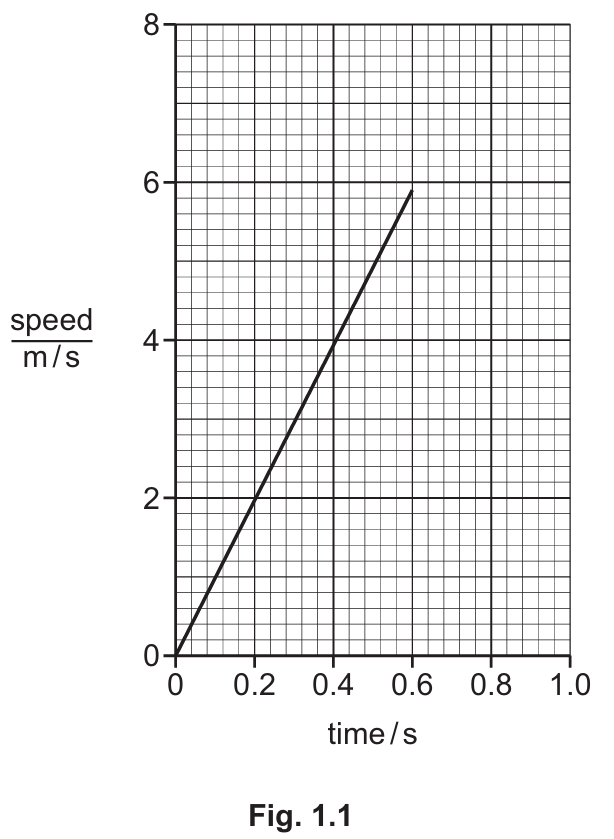
Detailed solution: In Fig. 1.1, the speed-time graph is a straight line passing through the origin, which indicates the ball is moving with constant acceleration. To find the distance, calculate the area under the triangle: $\text{Area} = \frac{1}{2} \times \text{base} \times \text{height}$. Using the graph values at $t = 0.6\text{ s}$ and $v \approx 5.9\text{ m/s}$, the distance is $\frac{1}{2} \times 0.6 \times 5.9 = 1.77\text{ m}$, which rounds to $1.8\text{ m}$.
Correct Answer: (iii) $9.5\text{ J}$. (iv) $4.75\text{ J}$.
Detailed solution: Gravitational potential energy is calculated using $E_p = mgh$. With $m = 0.54\text{ kg}$, $g = 9.8\text{ m/s}^2$, and $h = 1.8\text{ m}$, $E_p = 0.54 \times 9.8 \times 1.8 = 9.5256\text{ J}$, approximately $9.5\text{ J}$. At the halfway point, half of the initial $E_p$ has been converted into kinetic energy ($E_k$) due to the conservation of energy in a vacuum. Thus, $E_k = \frac{1}{2} \times 9.5 = 4.75\text{ J}$.
Detailed solution: Initially, the ball accelerates because the downward force of weight is greater than the upward air resistance. As speed increases, the air resistance also increases, which reduces the resultant force and causes the acceleration to decrease. Eventually, the air resistance becomes equal to the weight, the resultant force becomes zero, and the ball falls at a constant terminal velocity.
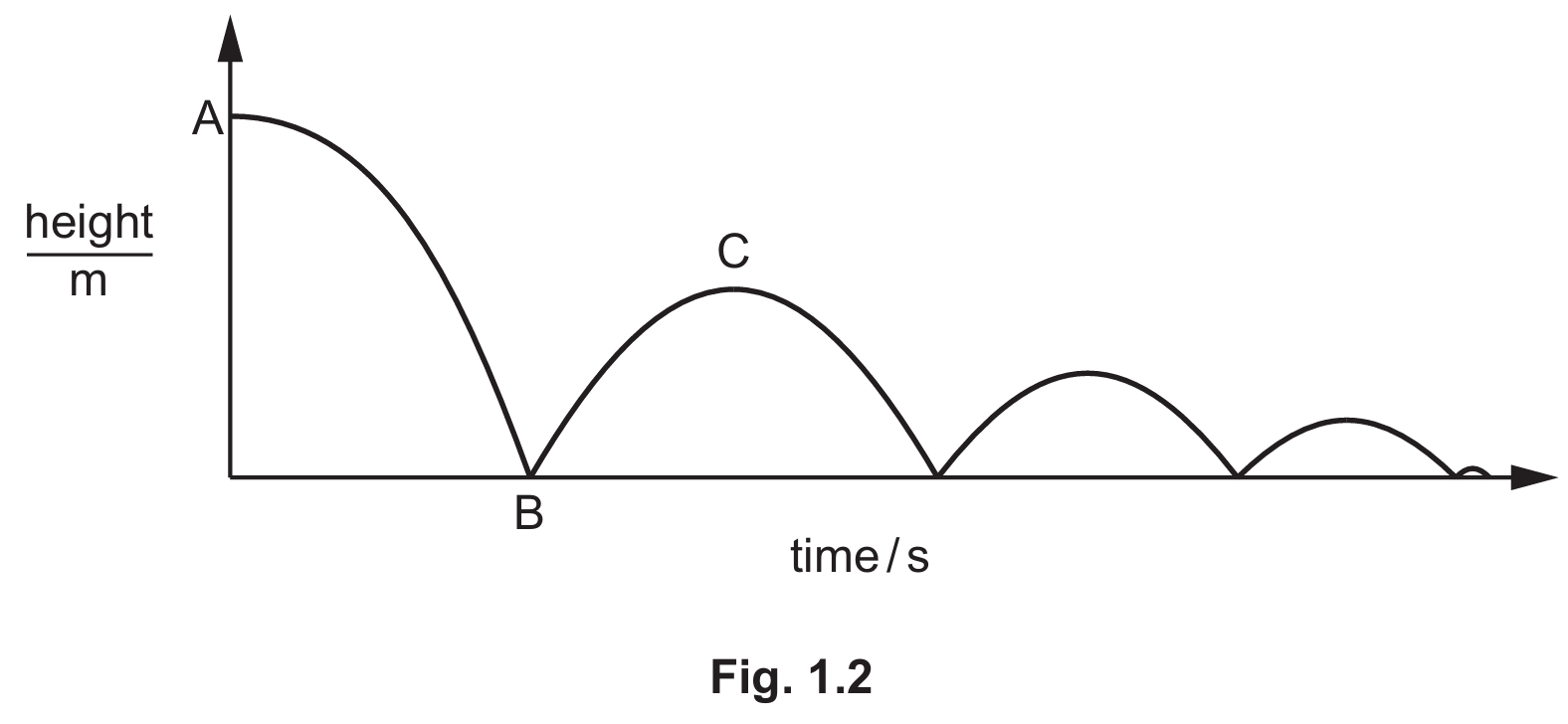
Detailed solution: When the ball hits the ground at point B, some of its kinetic energy is transferred to the surroundings as thermal energy or sound, and some is used to deform the ball (elastic energy). Because energy is “lost” from the ball’s store during the impact, it has less kinetic energy to convert back into gravitational potential energy. Consequently, the ball cannot reach its original height, making height C lower than height A.