
iGCSE Physics (0625) 1.4 Density Paper 3 -Exam Style Questions- New Syllabus
Questions
(a) A student determines the volume of a piece of metal. The student pours \(30cm^3\) of water into a measuring cylinder. The piece of metal is submerged in the water and the new volume reading on the measuring cylinder is \(42cm^3\). Calculate the volume of the piece of metal.
(b) The mass of another piece of metal is 320g. The volume of the piece of metal is \(40cm^3\). Calculate the density of the metal. Give the correct unit.
(c) The student drops the piece of metal into a tank of water. Two vertical forces act on the piece of metal as it falls through the water in the tank. On Fig. 2.1, each arrow represents a vertical force.
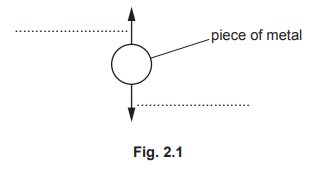
(i) Complete the diagram in Fig. 2.1 by labelling the two forces.
(ii) The upward force is the same size as the downward force. Describe the motion of the piece of metal as it falls through the water.
Most-appropriate topic codes (Cambridge IGCSE Physics 0625):
• Topic 1.4 — Density (Parts (a), (b))
• Topic 1.5.1 — Effects of forces (Parts (c)(i), (c)(ii))
▶️Answer/Explanation
(a)
For the correct answer:
(42 – 30 = ) 12 \(cm^3\)
The volume of an irregularly shaped solid that sinks can be found by the displacement method. The initial volume of water is \(30 cm^3\). After submerging the metal, the new volume is \(42 cm^3\). The volume of the metal is the difference between these two readings.
(b)
For the correct answer:
\(( \rho =)\) 8(.0)
\(( \rho =)\) 320 ÷ 40
(density =) mass ÷ volume OR \(( \rho =)\) m / V in any form
\(g / cm^3\)
Density is defined as mass per unit volume, given by the equation \(\rho = \frac{m}{V}\). Using the values provided, \(\rho = \frac{320g}{40cm^3} = 8.0 g/cm^3\). The unit for density is derived from the units of mass and volume used.
(c)(i)
For the correct answer:
friction / drag (upward arrow)
weight (downward arrow)
As an object falls through a fluid like water, it experiences two main vertical forces. The downward force is its weight, caused by gravity. The upward force opposing the motion is the frictional force, also known as drag or water resistance in this context.
(c)(ii)
For the correct answer:
(falling with) {constant / steady / uniform} speed
When the upward force of drag becomes equal in size to the downward force of weight, the resultant force on the object is zero. According to Newton’s laws of motion, an object with no resultant force acting on it will not accelerate, so it continues to fall at a constant speed, known as its terminal velocity.