
iGCSE Physics (0625) 1.4 Density Paper 4 -Exam Style Questions- New Syllabus
Question
Most-appropriate topic codes (Cambridge IGCSE Physics 0625):
• Topic $1.4$ — Density (Part $\mathrm{(a)(i)}$)
• Topic $1.8$ — Pressure (Part $\mathrm{(a)(ii)}$)
• Topic $2.2.1$ — Thermal expansion of solids, liquids and gases (Part $\mathrm{(b)}$)
• Topic $2.3.1$ — Conduction (Part $\mathrm{(c)}$)
▶️ Answer/Explanation
(a)(i)
For the correct answer:
$930\text{ kg/m}^3$ (to 2 sig. figs) or $933\text{ kg/m}^3$
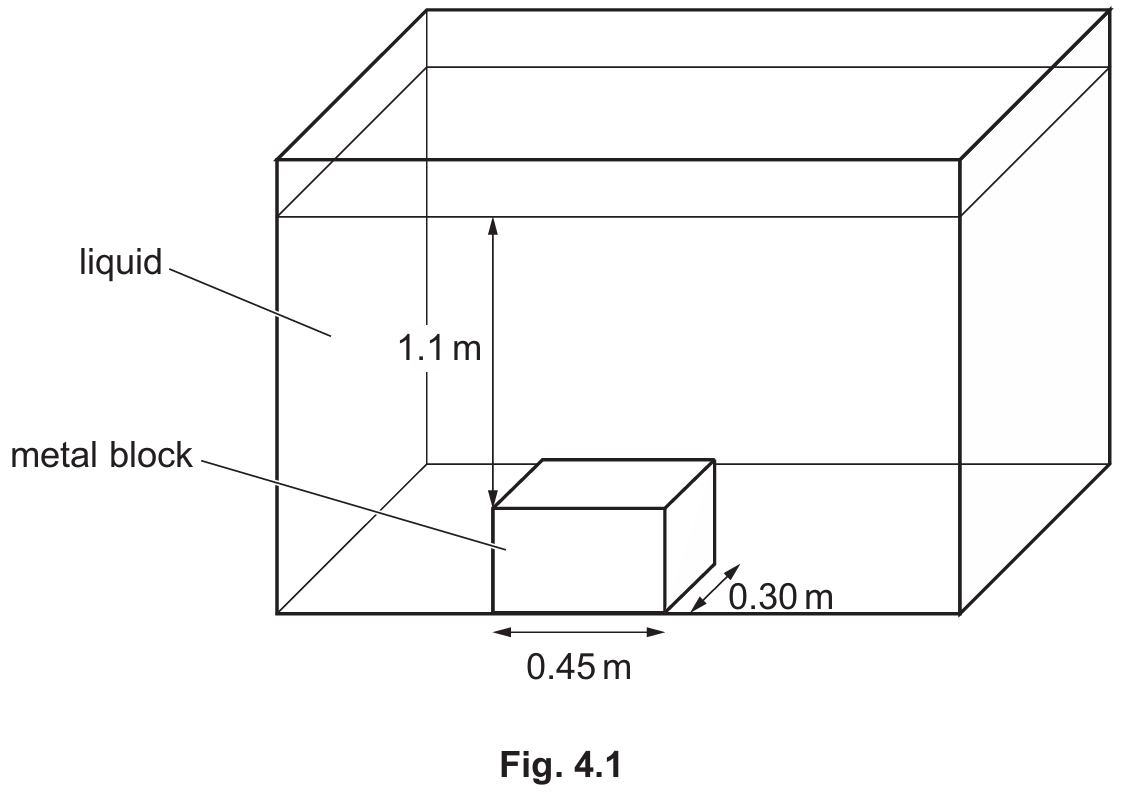
Density is defined as mass per unit volume. Using the formula $\rho = \frac{m}{V}$, we substitute the given mass $m = 2800\text{ kg}$ and volume $V = 3.0\text{ m}^3$. Calculating $2800 / 3.0$ gives $933.33…$, which is rounded to $930\text{ kg/m}^3$ to match the significant figures of the input data.
(a)(ii)
For the correct answer:
$1400\text{ N}$
First, calculate the liquid pressure at depth $h = 1.1\text{ m}$ using $p = \rho gh = 933 \times 9.8 \times 1.1 \approx 10000\text{ Pa}$. Next, determine the area of the block’s top surface: $A = 0.45\text{ m} \times 0.30\text{ m} = 0.135\text{ m}^2$. Finally, find the force using $F = p \times A$, which gives $10000 \times 0.135 \approx 1350\text{ N}$ to $1400\text{ N}$ depending on rounding.
(b)
For the correct answer:
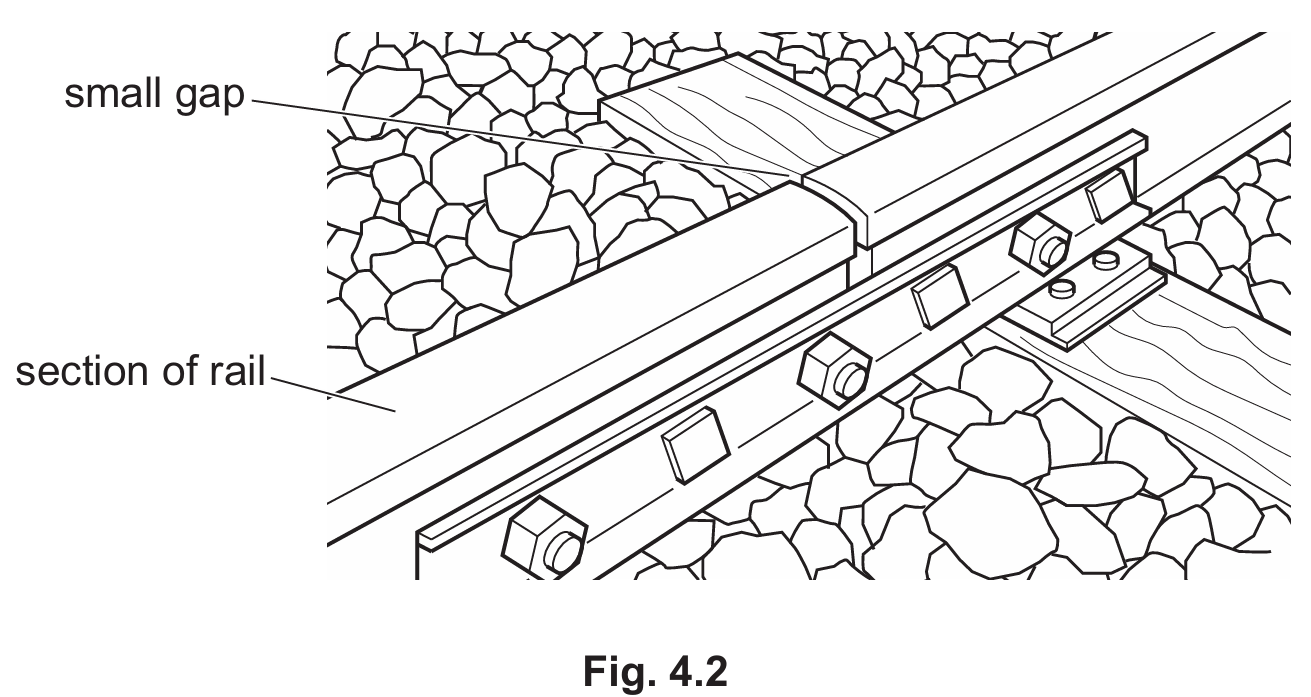
To allow for thermal expansion and prevent buckling.
When temperature increases, steel rails undergo thermal expansion. At a microscopic level, particles gain kinetic energy and vibrate more vigorously, increasing the average separation between particles. Gaps provide space for this increase in length, preventing the tracks from buckling.
(c)
For the correct answer:
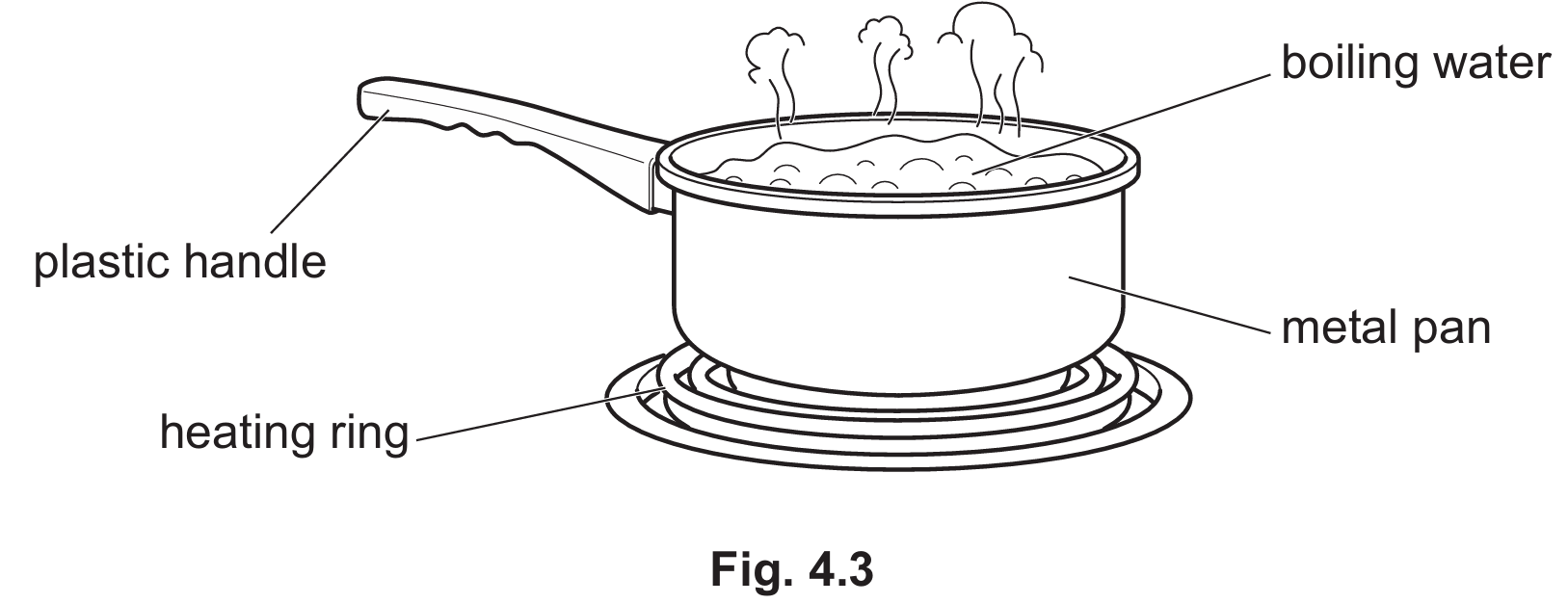
Plastic is a poor conductor (good insulator) of heat.
Plastic has a low thermal conductivity, which reduces the rate at which thermal energy is transferred from the hot metal pan to the user’s hand, keeping the handle at a safe temperature.