
iGCSE Physics (0625) 1.5.2 Turning effect Paper 3 -Exam Style Questions- New Syllabus
Question
Most-appropriate topic codes (Cambridge IGCSE Physics 0625):
• Topic 1.5.2 — Turning effect of forces (Parts (a), (b))
• Topic 1.5.3 — Centre of gravity (Part (b))
▶️ Answer/Explanation
(a)
460 (Ncm)
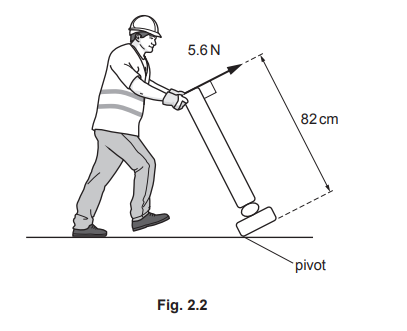
\(5.6 \times 82\)
(moment =) \(force\times (perpendicular)\) distance in any form
Detailed solution: The moment of a force is calculated as the product of the force and the perpendicular distance from the pivot to the line of action of the force. From Fig. 2.2, the perpendicular distance is given as $82\text{ cm}$, and the force applied is $5.6\text{ N}$. Using the equation $\text{moment} = F \times d$, we find $\text{moment} = 5.6\text{ N} \times 82\text{ cm} = 459.2\text{ Ncm}$, which is approximately $460\text{ Ncm}$.
(b)
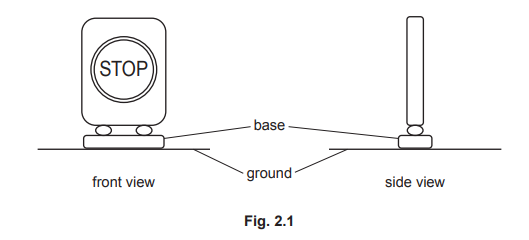
heavier base OR increases area of base lowers centre of mass / gravity
Detailed solution: To make the sign more stable without fixing it to the ground, the base should be made heavier or have a larger area. A heavier base increases the weight, providing a greater restoring moment to counteract the turning effect of the wind. A wider base increases the distance the centre of mass must be tilted before it falls outside the base, thereby lowering the centre of gravity and improving overall stability.