
iGCSE Physics (0625) 1.7.3 Energy resources Paper 3 -Exam Style Questions- New Syllabus
Question
Fig. 3.1 represents a hydroelectric power station transmitting electrical energy to homes and factories far away.
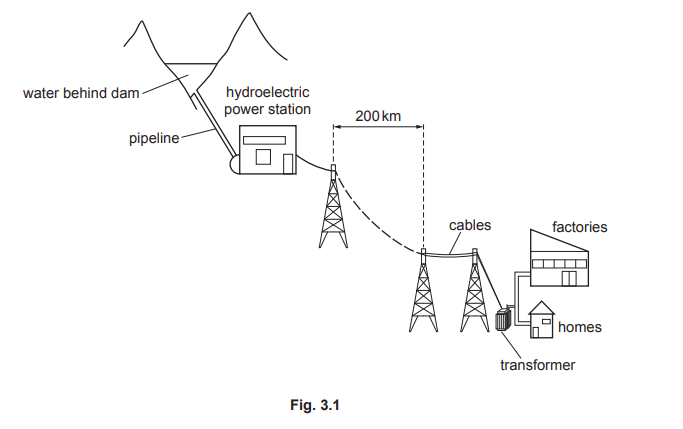
(a) (i) State the energy store for the water behind the dam.
(ii) In the list of equipment, draw a ring around each item that a hydroelectric power station requires.
boiler cooling tower generator solar cell turbine
(b) (i) State the type of transformer shown in Fig. 3.1.
(ii) Give two reasons why the power station uses high voltages to transmit electrical energy over long distances.
(c) Hydroelectric power stations may replace coal‑fired power stations. State two advantages and two disadvantages of using hydroelectric power stations compared with coal‑fired power stations. Do not include building or maintenance costs.
Most-appropriate topic codes (Cambridge IGCSE Physics 0625):
• Topic 1.7.3 — Energy resources (Parts (a)(i), (a)(ii), (c))
• Topic 4.5.6 — The transformer (Parts (b)(i), (b)(ii))
▶️ Answer/Explanation
(a)(i)
For the correct answer:
gravitational OR potential
Water stored behind a dam is at a height, so it possesses gravitational potential energy due to its position in the Earth’s gravitational field.
(a)(ii)
For the correct answer:
generator AND turbine
A hydroelectric station uses falling water to spin a turbine, which is connected to a generator that converts the mechanical energy into electrical energy. Boilers, cooling towers, and solar cells are not used in this process.
(b)(i)
For the correct answer:
step-down
The transformer shown is near the homes and factories, reducing the high transmission voltage to a lower, safer voltage for domestic and industrial use.
(b)(ii)
For the correct answer (any two):
lower current (in cables)
reduced power / energy loss / increased efficiency OR reduced heating losses
thinner / cheaper / lighter cables
pylons can be further apart / not so strong
Transmitting at high voltage allows a lower current for the same power $(P = IV)$. A lower current reduces thermal energy lost as heat in the cables $(P = I^2R)$, improving efficiency and allowing thinner cables.
(c)
For the correct answer (any two advantages from):
no fuel costs
renewable
no air pollution / no $\mathrm{SO}_2$ / no acid rain
no greenhouse gases / $\mathrm{CO}_2$ emissions
no fuel to transport
creates lakes for recreation / tourism
quick start-up time owtte
For the correct answer (any two disadvantages from):
large area of land flooded
damage to wildlife habitats
population displacement
limited number steep sided valleys owtte
changes to water provision (downstream)
(output) can be affected by lack of rain / drought
Hydroelectric power uses a renewable source (water) and produces no direct air pollutants, unlike burning coal. However, building dams floods large areas, displacing communities and damaging ecosystems, and power output depends on seasonal rainfall.