
iGCSE Physics (0625) 1.7.4 Power Paper 3 -Exam Style Questions- New Syllabus
Question

Most-appropriate topic codes (Cambridge IGCSE Physics 0625):
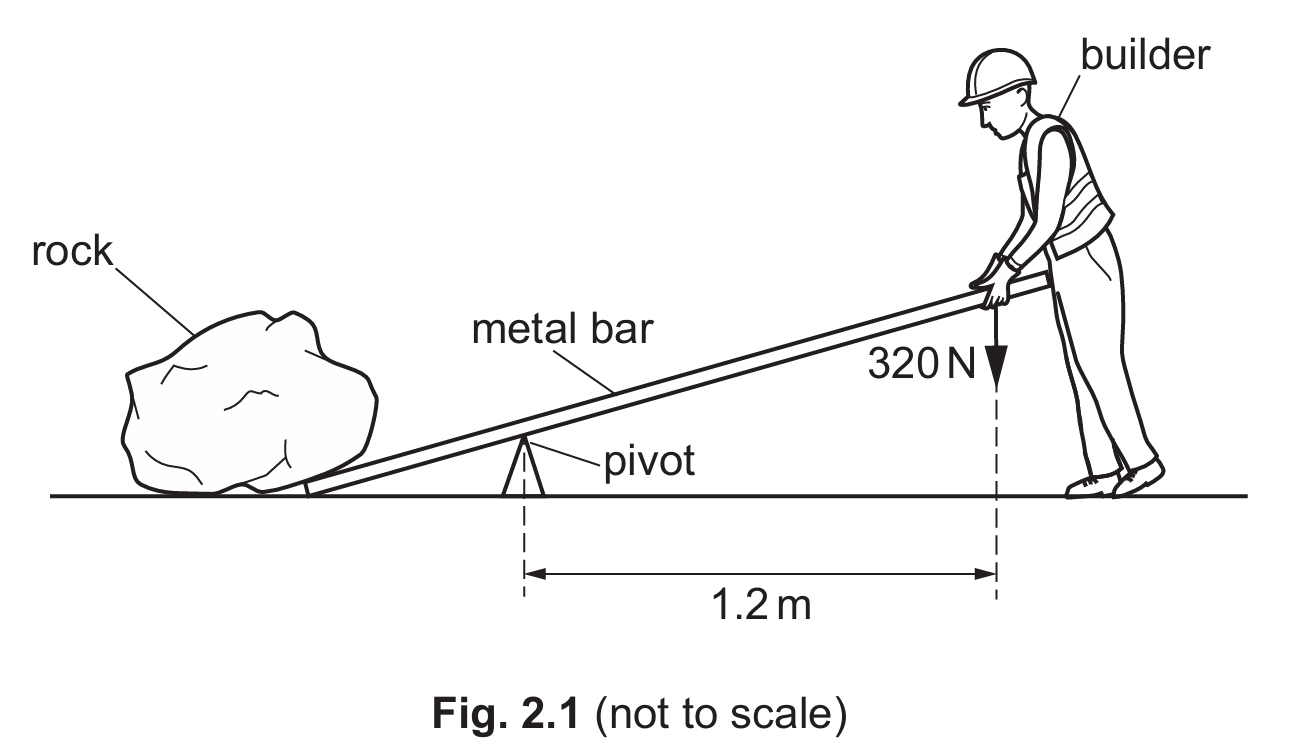
• Topic $1.5.2$ — Turning effect of forces (Part $\mathrm{(a)}$)
• Topic $1.7.2$ — Work (Part $\mathrm{(b)}$)
• Topic $1.7.4$ — Power (Part $\mathrm{(c)}$)
▶️ Answer/Explanation
(a)
For the correct answer:
$380\text{ Nm}$
The moment of a force is defined as the measure of its turning effect around a pivot. It is mathematically given by the formula $\text{Moment} = F \times d$, where $F$ is the applied force and $d$ is the perpendicular distance from the pivot point to the line of action of the force. In this scenario, the applied downward force is $320\text{ N}$ and the perpendicular distance to the pivot is $1.2\text{ m}$. Substituting these values, we get $\text{Moment} = 320\text{ N} \times 1.2\text{ m} = 384\text{ Nm}$. Following standard significant figure rules for this syllabus, rounding to two significant figures gives a final answer of $380\text{ Nm}$.
(b)
For the correct answer:
$2900\text{ J}$
Mechanical work is done when a force causes an object to move, transferring energy in the process. The equation for mechanical work done is $W = F \times d$, where $W$ is the work done, $F$ is the magnitude of the force applied, and $d$ is the distance moved in the direction of the force. Here, the force required to lift the rock at a constant speed is equal to its weight, which is $4800\text{ N}$. The vertical distance moved is $0.60\text{ m}$. Calculating this yields $W = 4800\text{ N} \times 0.60\text{ m} = 2880\text{ J}$. Rounded to two significant figures, the work done is $2900\text{ J}$.
(c)
For the correct answer:
$780\text{ W}$
Power represents the rate at which work is done or the rate at which energy is transferred over a given period. The equation for power is $P = \frac{W}{t}$, where $P$ stands for power, $W$ represents the work done (or energy transferred), and $t$ is the total time taken. For this part of the question, the total work done by the truck is given as $5800\text{ J}$ over a time span of $7.4\text{ s}$. Substituting these inputs gives $P = \frac{5800\text{ J}}{7.4\text{ s}} \approx 783.78\text{ W}$. When rounded to two significant figures, the power developed by the truck is $780\text{ W}$ (Watts).