
iGCSE Physics (0625) 2.3.1 Conduction Paper 3 -Exam Style Questions- New Syllabus
Question
Fig. 5.1 represents an arrangement for heating water. The hot water is stored in the metal container.
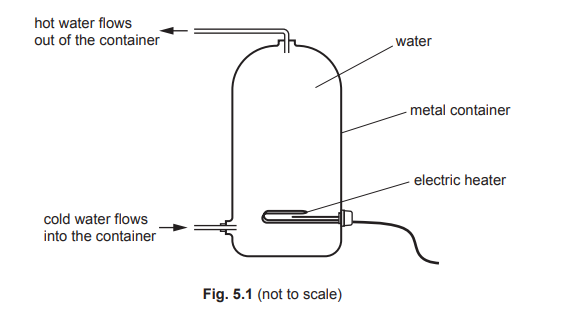
(a) Explain why the hot water is available at the top of the container. Use ideas about density.
(b) The electric heater is switched on for one hour every morning.
(i) State the name of the process that transfers thermal energy through the walls of the metal container.
(ii) Suggest one way of keeping the water hot after the heater is switched off.
Most-appropriate topic codes (Cambridge IGCSE Physics 0625):
• Topic 2.3.2 — Convection (Part (a))
• Topic 2.3.1 — Conduction (Part (b)(i))
• Topic 2.3.4 — Consequences of thermal energy transfer (Part (b)(ii))
▶️ Answer/Explanation
(a)
For the correct answer:
convection (current)
any two from:
(heated water) expands
(becomes) less dense
(less dense) water rises
When the water near the heater is warmed, its particles gain kinetic energy and move further apart, causing the water to expand and become less dense than the cooler water above it. This less dense, warmer water rises to the top of the container, while the denser, cooler water sinks to take its place, setting up a convection current that ensures hot water is available at the top.
(b)(i)
For the correct answer:
conduction
Thermal energy is transferred through the solid metal walls of the container primarily by conduction, a process where vibrating atoms or delocalised electrons pass kinetic energy to adjacent particles without any bulk movement of the material itself.
(b)(ii)
For the correct answer:
insulate / lag container owtte
To reduce the rate of thermal energy loss to the surroundings after the heater is off, the container can be wrapped with an insulating material, such as fibreglass or foam. This insulation traps air, which is a poor thermal conductor, thereby slowing down the transfer of heat and keeping the water hot for a longer period.