
iGCSE Physics (0625) 2.3.3 Radiation Paper 4 -Exam Style Questions- New Syllabus
Question
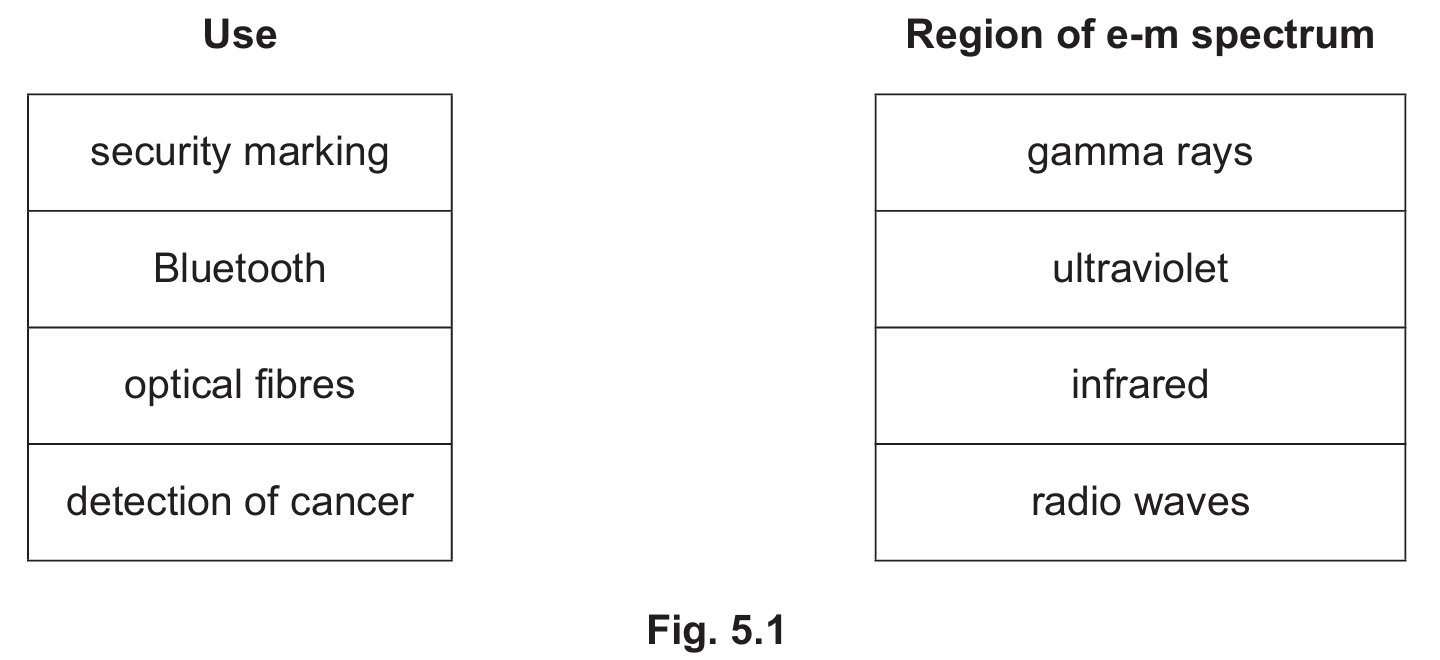
(a) (i) Electromagnetic waves have many uses. On Fig. 5.1 draw one line from each use to the region of the electromagnetic (e-m) spectrum it uses.
(c) Fig. 5.2 shows a simplified diagram of seismic P-waves travelling through the Earth.
The paths of the waves are curved.
Seismic waves are produced by rock movements in earthquakes.
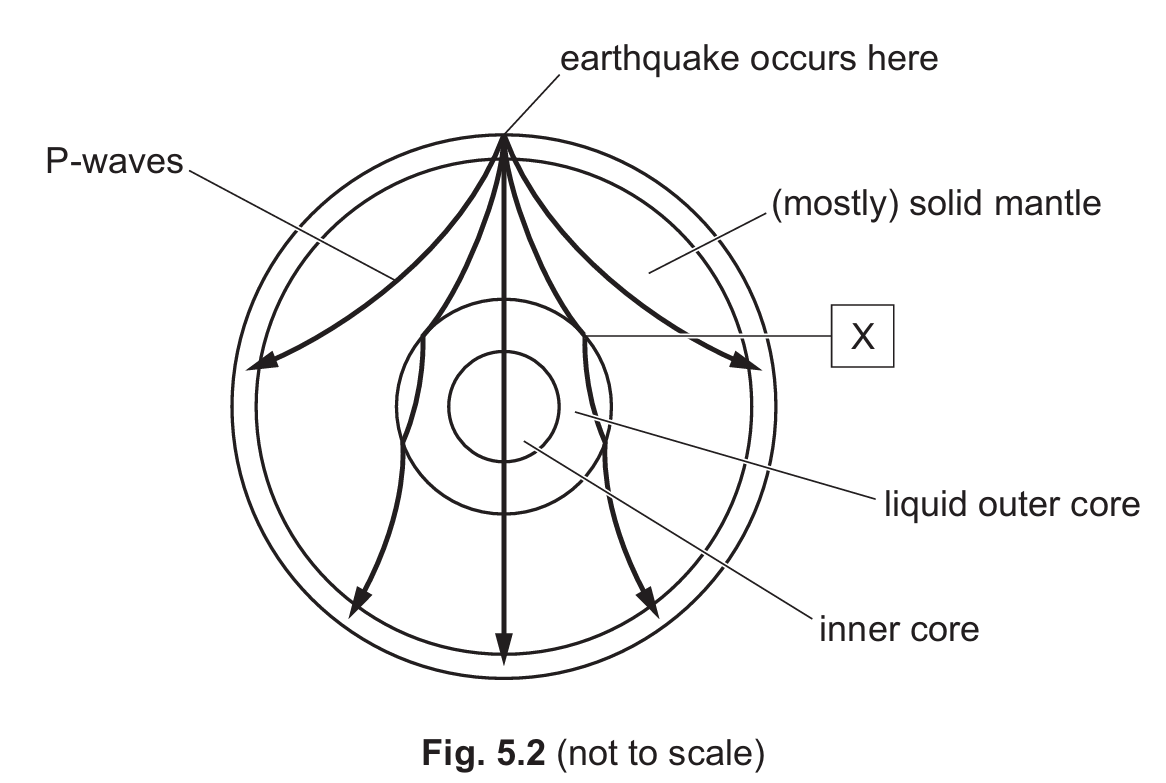
(i) State the type of wave that P-waves can be modelled as.
(ii) At point X, the P-wave travels from the solid mantle to the liquid core. There is a sudden change in direction of the path of the wave. Explain the change in direction of the P-wave at point X.
Most-appropriate topic codes (Cambridge IGCSE Physics 0625):
• Topic $3.3$ — Electromagnetic spectrum (Part $\mathrm{(a)}$)
• Topic $3.1$ — General properties of waves (Part $\mathrm{(b)}$)
• Topic $3.4$ — Sound (Part $\mathrm{(c)}$)
• Topic $2.3 .3$ — Radiation (Part $\mathrm{(d)}$)
▶️ Answer/Explanation
Correct Answer:
(i) 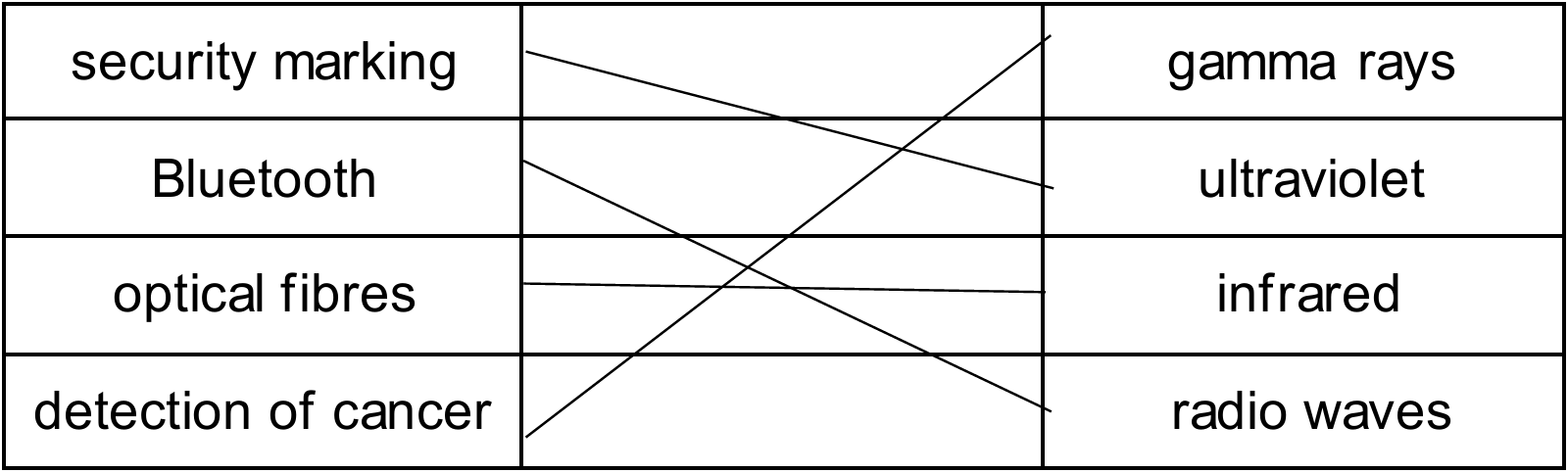
(ii) Microwaves can transmit large amounts of data at high speeds.
Detailed solution: Ultraviolet light causes certain materials to fluoresce, making it ideal for security marking. Bluetooth technology utilizes short-wavelength radio waves. Infrared is used in optical fibres because glass is transparent to certain infrared wavelengths. High-energy gamma rays are used in medicine to detect and treat cancer. Microwaves are preferred for cell signals because they have higher frequencies than standard radio waves, allowing for a much higher rate of data transmission.
Correct Answer: Transverse: vibrations are at $90$° to propagation. Longitudinal: vibrations are parallel to propagation.
Detailed solution: In a transverse wave, the particles of the medium oscillate in a direction perpendicular to the direction in which the wave travels (e.g., light waves). In a longitudinal wave, the oscillations occur back and forth along the same line as the direction of energy transfer (e.g., sound waves). Consequently, transverse waves have peaks and troughs, while longitudinal waves consist of compressions and rarefactions.
Correct Answer: (i) Longitudinal. (ii) Refraction due to a change in wave speed.
Detailed solution: Primary (P) waves are pressure waves that move through the Earth’s interior by compressing and expanding the material, thus they are longitudinal. When these waves pass from the solid mantle into the liquid outer core at point X, their speed changes significantly because the density and state of the medium are different. This change in speed causes the wave to bend, a process known in physics as refraction.
Correct Answer: Increase in greenhouse gases (like $CO_2$) trapping re-emitted radiation.
Detailed solution: The temperature rise is primarily caused by an increased concentration of greenhouse gases, such as carbon dioxide ($CO_2$) and methane, in the atmosphere. These gases allow short-wavelength radiation from the Sun to pass through but absorb the long-wavelength infrared radiation re-emitted by the Earth’s surface. This process prevents heat from escaping into space, shifting the thermal balance so that energy absorbed is greater than energy leaving the atmosphere.