
iGCSE Physics (0625) 3.1 General properties of waves Paper 3 -Exam Style Questions- New Syllabus
Question
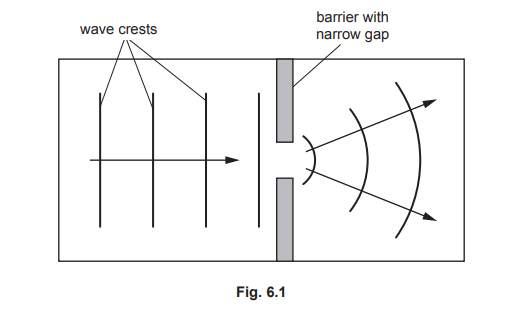
Choose one word from the list.
diffraction dispersion reflection refraction
The wave property demonstrated in Fig. 6.1 is …………….
Most-appropriate topic codes (Cambridge IGCSE Physics 0625):
• Topic 3.1 — General properties of waves (Parts (a), (b)(i), (b)(ii), (c))
▶️ Answer/Explanation
(a)
transverse
A transverse wave is defined by particle oscillation occurring perpendicular to the direction of energy propagation. Examples include electromagnetic radiation, water ripples, and seismic S-waves, where the vibrational movement is at a right angle to the wave’s forward travel path.
(b)(i)
diffraction
The image shows plane waves encountering a narrow aperture and subsequently spreading out in a curved, circular pattern beyond the opening. This characteristic bending and spreading of wavefronts around an obstacle or through a gap is known as diffraction.
(b)(ii)
correct wavelength indicated
The wavelength is the spatial period of a wave, measured as the distance between two successive identical points in phase, such as from crest to adjacent crest or trough to adjacent trough. Marking this distance on the diagram and labeling it ‘w’ correctly identifies the wavelength.
(c)
\(8.2 \, (\text{Hz})\)
\(42 \div 5.1\)
\(v = f \times \lambda\) OR \((\text{frequency} =) \frac{\text{speed}}{\text{wavelength}}\) in any form
The frequency of a wave is calculated using the general wave equation that relates speed (\(v\)), frequency (\(f\)), and wavelength (\(\lambda\)). Rearranging the equation \(v = f \times \lambda\) to solve for frequency yields \(f = \frac{v}{\lambda}\). Substituting the known values: \(f = \frac{42 \, \text{cm/s}}{5.1 \, \text{cm}}\), which results in an approximate frequency of \(8.2 \, \text{Hz}\).