
iGCSE Physics (0625) 3.1 General wave properties Paper 4 -Exam Style Questions- New Syllabus
Question
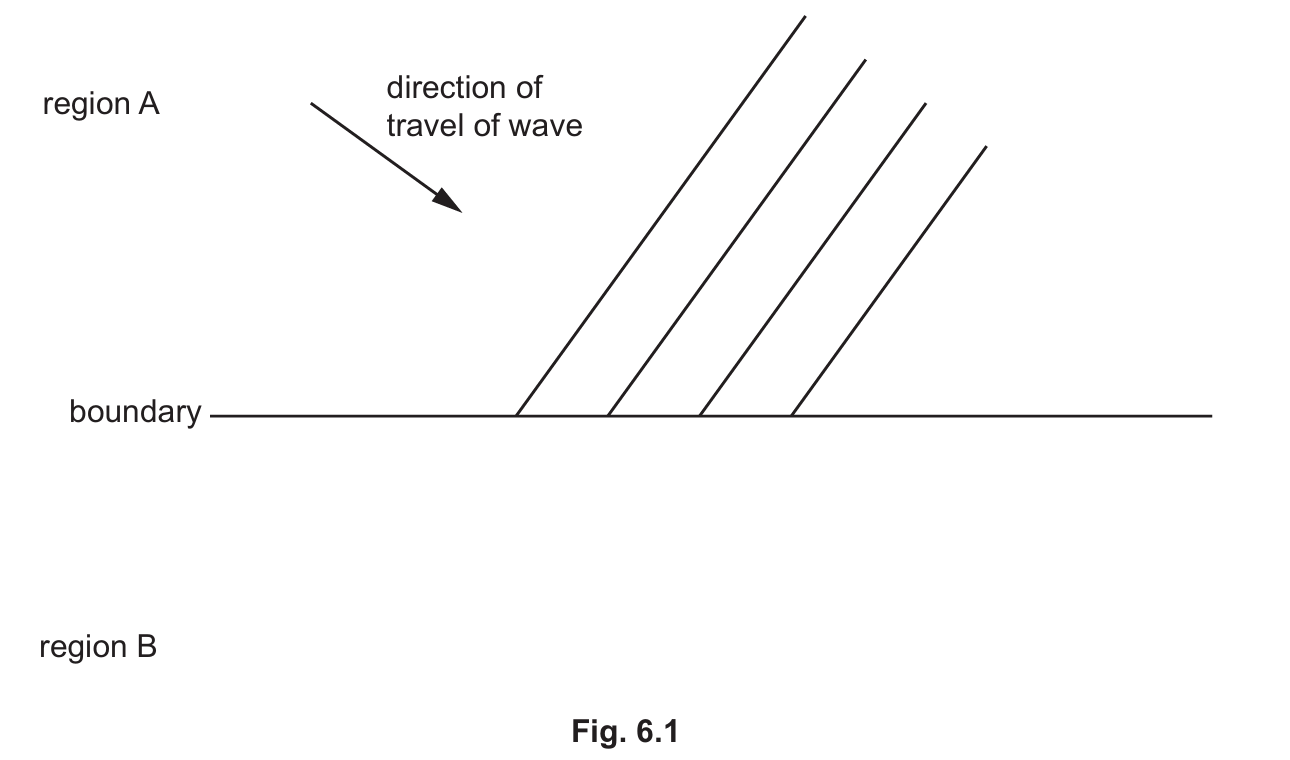
(ii) State the wave effect that occurs as the wave crosses the boundary between region A and region B.
(ii) State two advantages of using optical fibres for transmitting high speed broadband.
Most-appropriate topic codes (Cambridge IGCSE Physics 0625):
• Topic $3.1$ — General properties of waves (Part $\mathrm{(a)}$)
• Topic $3.2.2$ — Refraction of light (Part $\mathrm{(b)(i)}$)
• Topic $3.3$ — Electromagnetic spectrum (Part $\mathrm{(b)(ii)}$)
▶️ Answer/Explanation
Correct Answer: Drawing of refracted wavefronts joined at the boundary, with a smaller wavelength and smaller angle to the boundary.
Detailed solution: When a wave enters a region where its speed decreases, the frequency remains constant, so according to $v = f\lambda$, the wavelength $\lambda$ must also decrease. The crests in region B should be closer together than in region A. Furthermore, the waves change direction and “bend” toward the normal, meaning the angle between the wavefront and the boundary becomes smaller than the original angle.
Correct Answer: Refraction
Detailed solution: Refraction is the change in direction of a wave passed from one medium to another, caused by its change in speed. In this scenario, the water waves slow down as they cross into region B (likely due to a change in water depth), which causes the observed change in the angle of the wavefronts and the shortening of the distance between crests.
Correct Answer: 1. Light must travel from a more dense to a less dense medium. 2. The angle of incidence must be greater than the critical angle $c$.
Detailed solution: For total internal reflection (TIR) to occur, the light must be inside a medium with a higher refractive index $n$ and attempting to enter one with a lower $n$ (where it would speed up). Additionally, the angle of incidence $i$ at the boundary must exceed the specific critical angle $c$ for that material pair, which is defined by the relationship $n = \frac{1}{\sin c}$.
Correct Answer: Any two: Higher data transmission rates, less signal/data loss, or increased security/range.
Detailed solution: Optical fibres are superior to traditional copper wires for broadband because visible light and short-wavelength infrared radiation can carry much higher rates of data. They also benefit from low signal attenuation (loss), allowing for longer transmission distances. Because the signal is contained within the fibre by total internal reflection, they are also more secure and resistant to electromagnetic interference.