
iGCSE Physics (0625) 3.2.2 Refraction of light Paper 4 -Exam Style Questions- New Syllabus
Question
Most-appropriate topic codes (Cambridge IGCSE Physics 0625):
• Topic $3.3$ — Electromagnetic spectrum (Part $\mathrm{(a)}$)
• Topic $3.2.2$ — Refraction of light (Parts $\mathrm{(b)(i)}$, $\mathrm{(b)(ii)}$, $\mathrm{(b)(iii)}$)
▶️ Answer/Explanation
Correct Answer: Faster data transmission (higher rates) and less data/signal loss.
Detailed solution: Optical fibres utilize visible light or infrared radiation for transmission. These electromagnetic waves have much higher frequencies compared to electrical signals in copper wires, allowing them to carry significantly larger amounts of data at faster rates. Furthermore, optical fibres suffer from very little signal loss (attenuation) over long distances and offer a more secure means of data transmission since they do not leak electromagnetic interference.
Correct Answer: $46^\circ$
Detailed solution: The critical angle $c$ is directly related to the refractive index $n$ of the material by the equation $n = \frac{1}{\sin c}$. Rearranging this formula to solve for the critical angle gives $\sin c = \frac{1}{n}$. Substituting the given refractive index of $1.4$, we obtain $\sin c = \frac{1}{1.4}$. Taking the inverse sine yields $c = \sin^{-1}\left(\frac{1}{1.4}\right)$, which calculates to approximately $45.6^\circ$, rounding up to $46^\circ$.
Correct Answer: The angle of incidence at which the angle of refraction is exactly $90^\circ$.
Detailed solution: When a light ray travels from an optically denser medium (like the glass fibre) to a less dense medium (like the air cladding), it bends away from the normal. The critical angle is defined as the specific angle of incidence that results in an angle of refraction of exactly $90^\circ$ running along the boundary. If the angle of incidence exceeds this critical value, the light undergoes total internal reflection instead of refracting out.
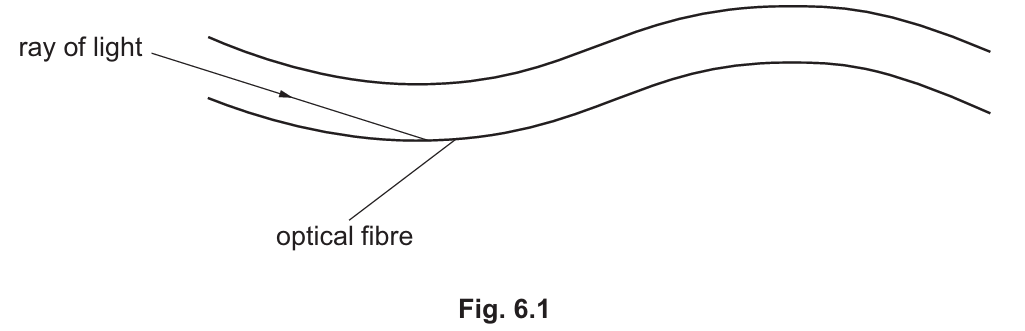
Correct Answer: Angle of incidence marked between the drawn normal and the incident ray; total internal reflection drawn with two or three bounces until exiting the fibre.
Detailed solution: To accurately label the angle of incidence, you must first draw a normal (a line perfectly perpendicular to the boundary surface) at the exact point where the incident light ray strikes the inner wall of the fibre. The angle between the incident ray and this normal is the angle of incidence. Because this angle is larger than the critical angle, the ray undergoes total internal reflection, continuing to zigzag down the length of the fibre reflecting at identical angles off the boundaries until it exits the far end.