
iGCSE Physics (0625) 3.2.3 Thin lens Paper 3 -Exam Style Questions- New Syllabus
Question
Most-appropriate topic codes (Cambridge IGCSE Physics 0625):
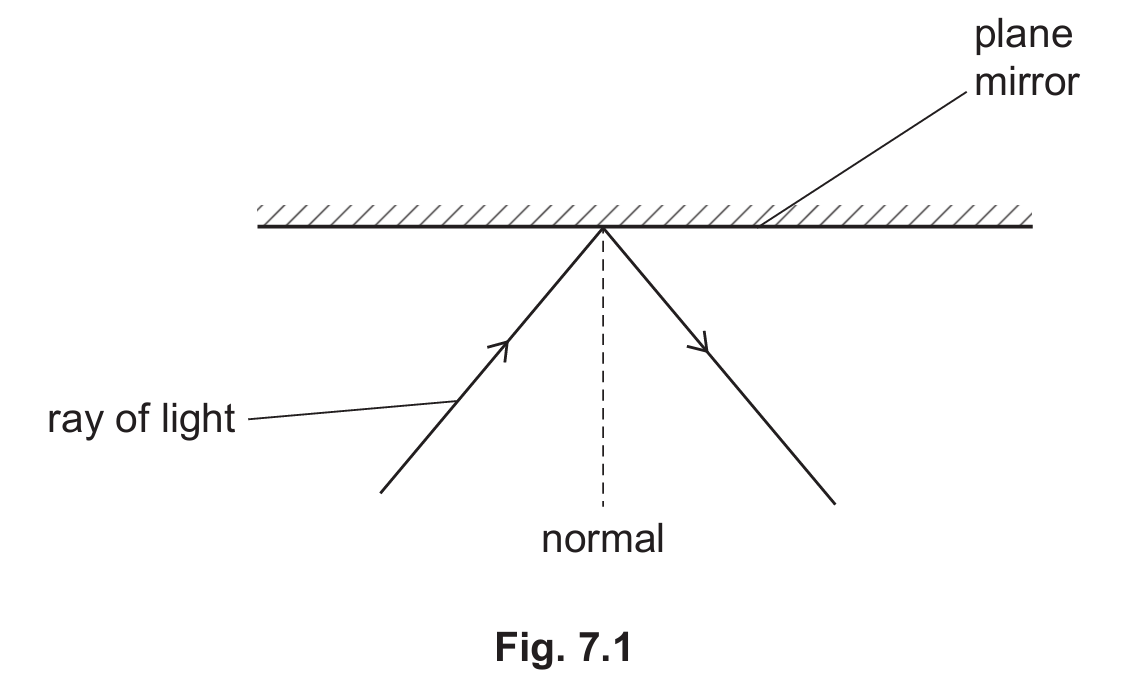
• Topic 3.2.1 — Reflection of light (Parts (a))
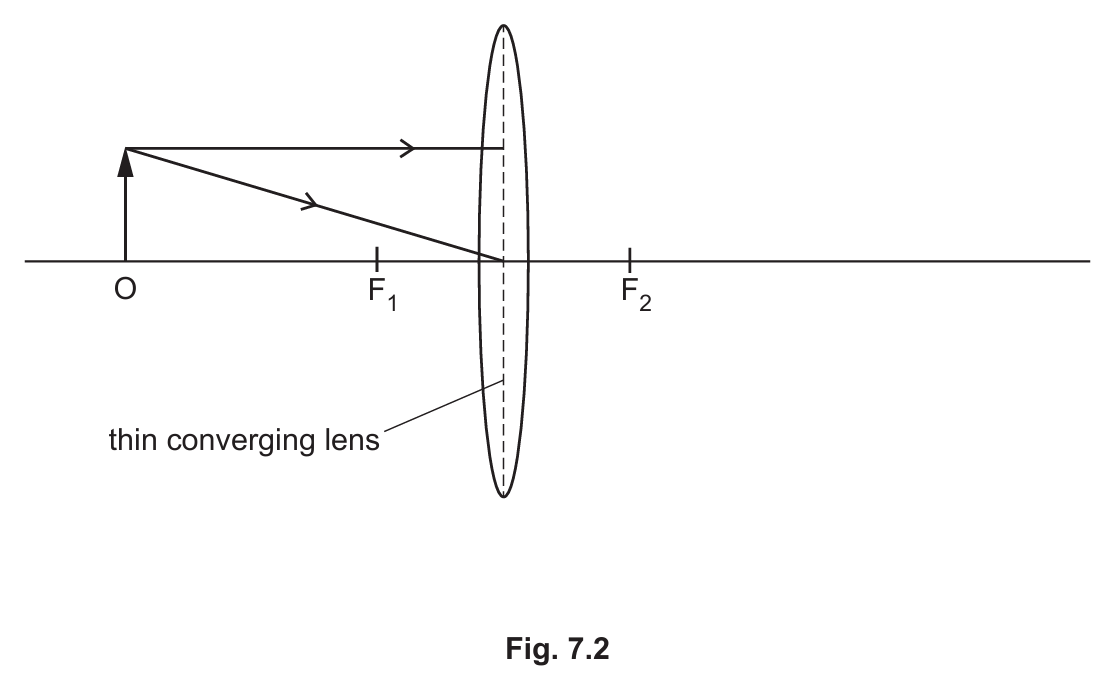
• Topic 3.2.3 — Thin lenses (Parts (b))
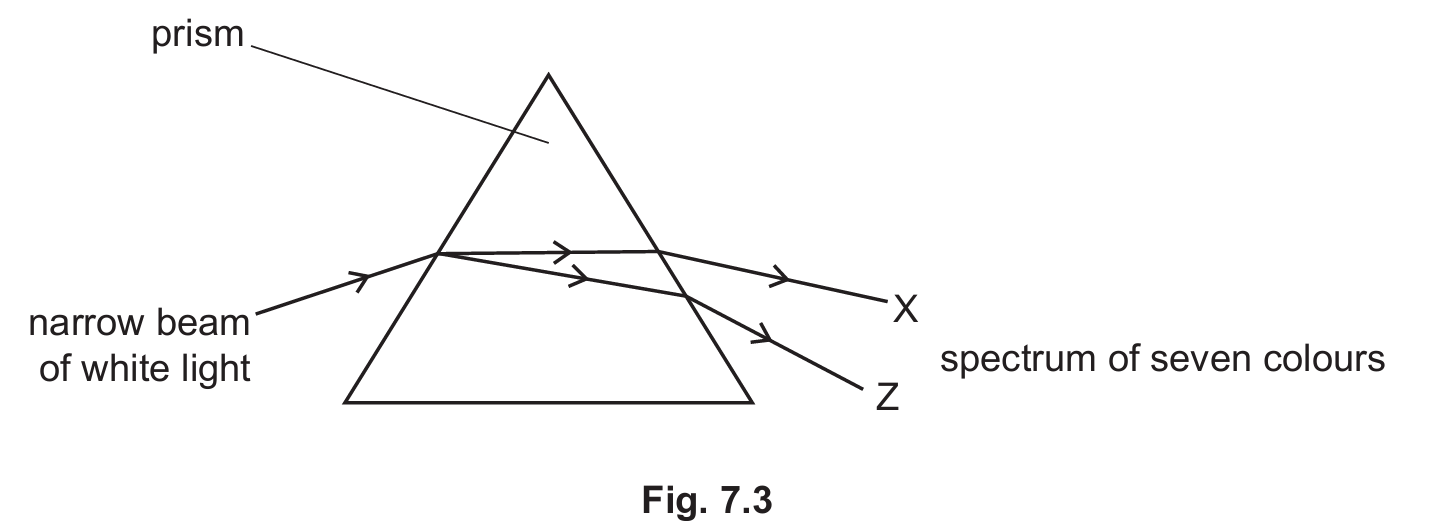
• Topic 3.2.4 — Dispersion of light (Parts (c))
▶️ Answer/Explanation
(a)(i)
For the correct answer:
The angle between the normal (dashed line) and the reflected ray is identified.
The normal is the imaginary dashed line drawn perpendicular to the mirror’s surface at the exact point of incidence. By definition, the angle of reflection is the angle formed strictly between this normal line and the reflected ray, not the angle with the mirror’s surface.
(a)(ii)
For the correct answer:
40°
The fundamental law of reflection states that the angle of incidence is always equal to the angle of reflection. Because the problem states the incident angle is 40°, the reflected angle must also be exactly 40°.
(b)(i)
For the correct answer:
The horizontal ray is drawn to continue through $F_2$, and the ray to the centre is drawn to continue undeviated.
In optics, a ray traveling parallel to the principal axis of a converging lens will always refract to pass through the principal focus ($F_2$) on the opposite side. Conversely, a ray passing directly through the optical centre of a thin lens does not bend and continues in a straight line.
(b)(ii)
For the correct answer:
An image is drawn or identified at the point where the two rays cross.
The top of the real image is located exactly where the refracted rays intersect. To represent this image, you draw a vertical arrow starting from the principal axis and ending at the intersection point, which will point downwards indicating the image is inverted.
(c)(i)
For the correct answer:
Dispersion
As the narrow beam of white light enters the denser glass prism, the different frequencies of light slow down by different amounts. This differential refraction causes the white light to separate into its constituent colours, a physical phenomenon known as dispersion.
(c)(ii)
For the correct answer:
Red, orange, yellow, green, blue, indigo, violet (in the exact order).
Red light has the lowest frequency and is refracted the least, meaning it appears at the top of the spectrum ($X$). Violet light has the highest frequency and is refracted the most, appearing at the bottom ($Z$). The rest of the spectrum naturally falls between them in sequence.