
iGCSE Physics (0625) 3.2.3 Thin lenses Paper 4 -Exam Style Questions- New Syllabus
Question


Most-appropriate topic codes (Cambridge IGCSE Physics 0625):
• Topic $3.2.3$ — Thin lenses (Parts $\mathrm{(a)(i)}$, $\mathrm{(a)(ii)}$, $\mathrm{(a)(iii)}$)
• Topic $3.2.3$ — Thin lenses: correction of long-sightedness (Parts $\mathrm{(b)(i)}$, $\mathrm{(b)(ii)}$)
▶️ Answer/Explanation
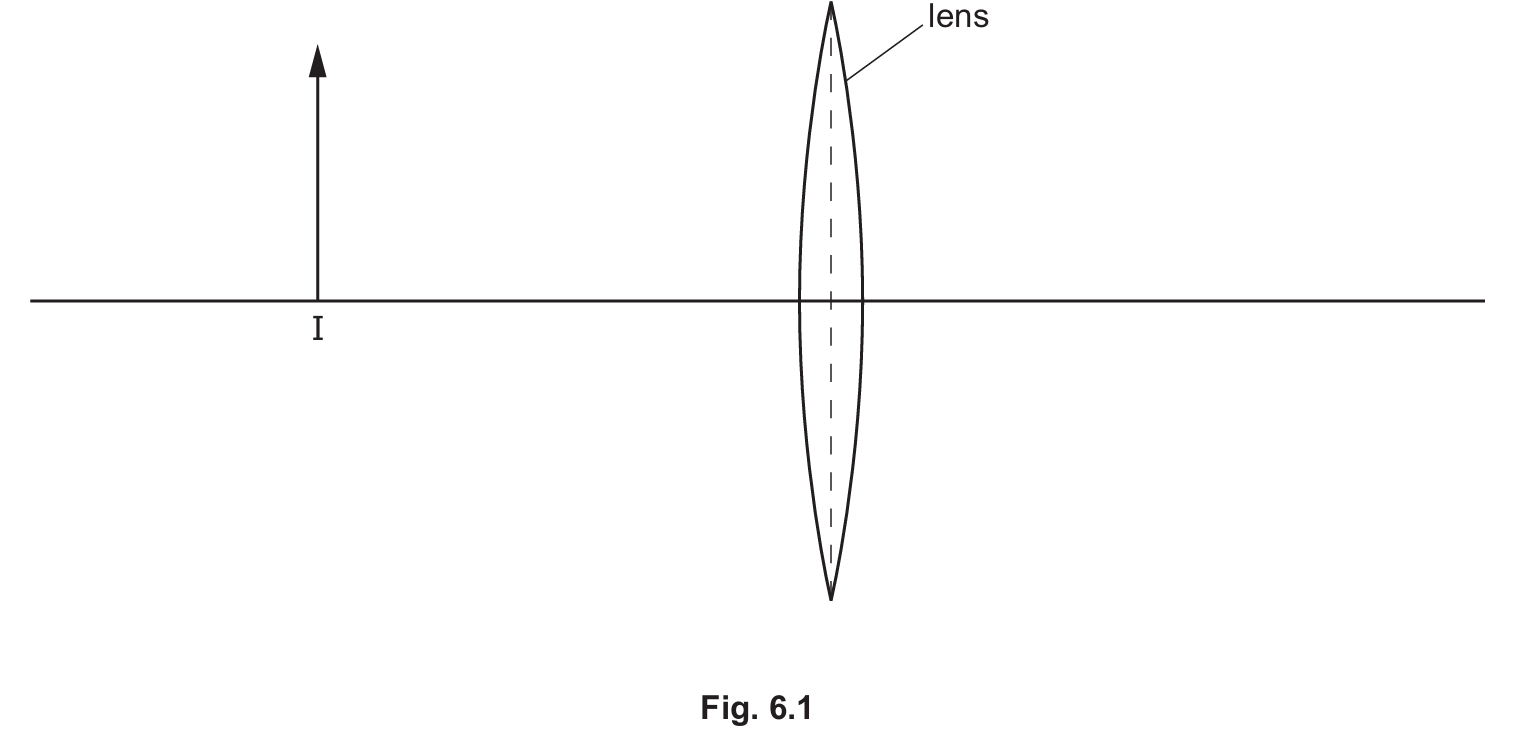
Correct Answer: Mark two points $F$ on the principal axis, both $3.0\text{ cm}$ from the optical centre of the lens.
Detailed solution: The principal focus ($F$) is defined by the focal length. Since the lens is symmetrical, there is a focal point on both the left and right sides. You must use a ruler to measure exactly $3.0\text{ cm}$ from the vertical centreline of the lens along the horizontal principal axis in both directions and mark these points with the letter $F$.
Correct Answer: Object $O$ drawn at the intersection of rays to the right of the lens (Method 1) or left (Method 2).
Detailed solution: To locate the object from the image $I$, trace rays backward. One ray passes from the top of $I$ straight through the centre of the lens (undeviated). A second ray travels from the top of $I$ parallel to the principal axis until the lens, then refracts through the focal point $F$. The intersection of these rays identifies the top of the object $O$. Since the image shown is upright and on the same side as the object, it is a virtual image formed by a magnifying glass arrangement.
Correct Answer: Real (or Inverted, or Same Size).
Detailed solution: The focal length is $f = 3.0\text{ cm}$. Moving the object to $6\text{ cm}$ places it at exactly $2f$. For a converging lens, when the object is at $2f$, the image formed is real, inverted, and the same size as the object, located at $2f$ on the opposite side of the lens. Any of these three characteristics is a valid answer.
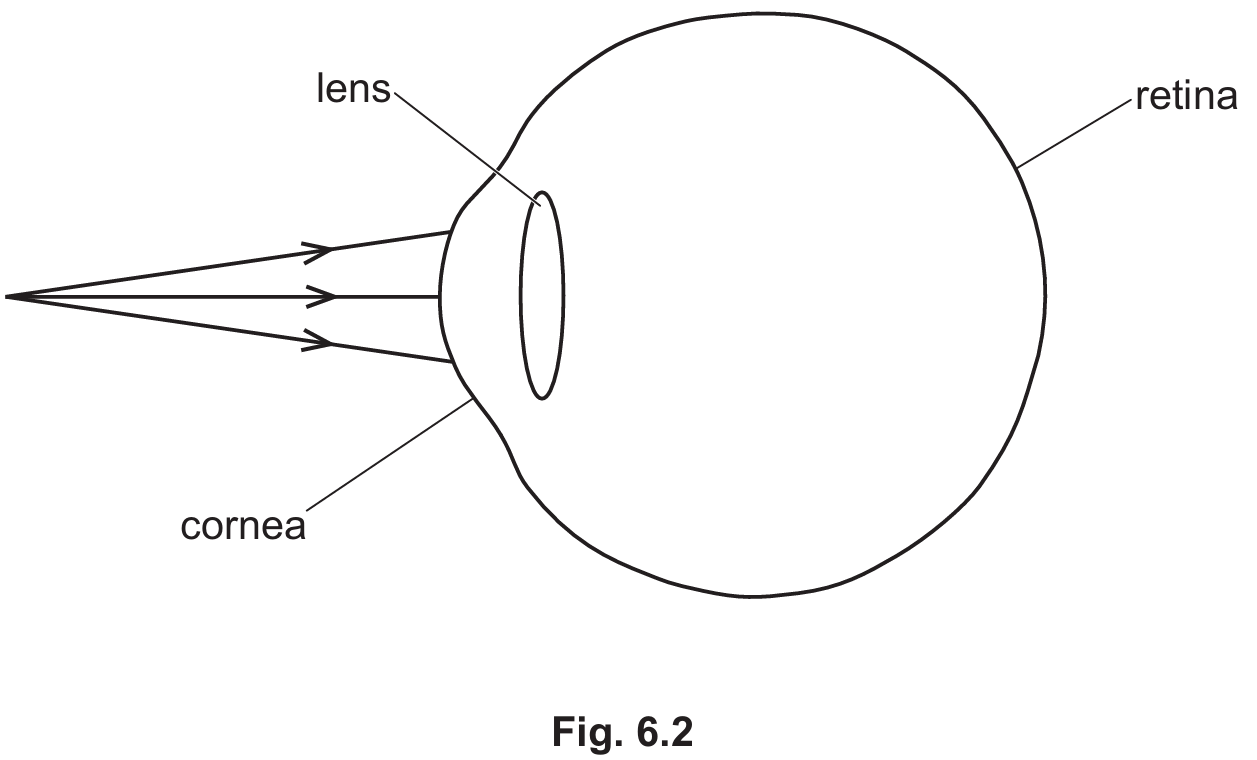
Correct Answer: Rays meeting (converging) at a point behind the retina.
Detailed solution: Long-sightedness (hyperopia) occurs when the eye’s lens is too weak or the eyeball is too short. In this condition, the light rays from a near object are not bent sufficiently by the cornea and lens, causing them to reach the retina before they have finished converging. On the diagram, continue the rays from the lens until they meet at a point located to the right of the retina wall.
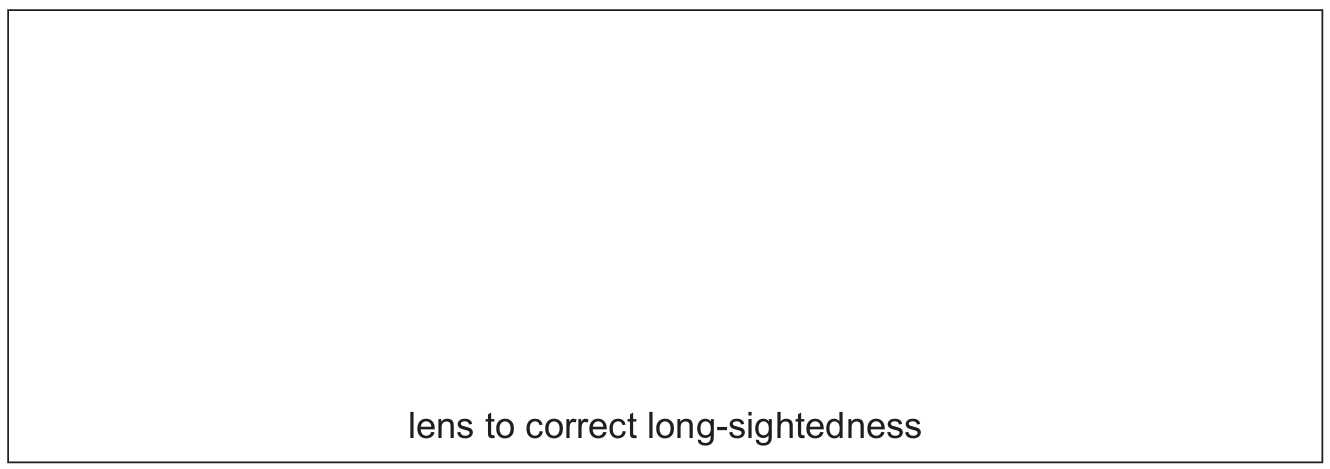
Correct Answer: A converging (convex) lens.
Detailed solution: To correct long-sightedness, an additional converging lens is placed in front of the eye. This lens provides extra refractive power to help “pre-bend” the light rays so that they converge sooner, allowing them to focus exactly on the retina. The lens should be drawn with a biconvex shape (thicker in the middle than at the edges).