
iGCSE Physics (0625) 3.3 Electromagnetic spectrum Paper 4 -Exam Style Questions- New Syllabus
Question
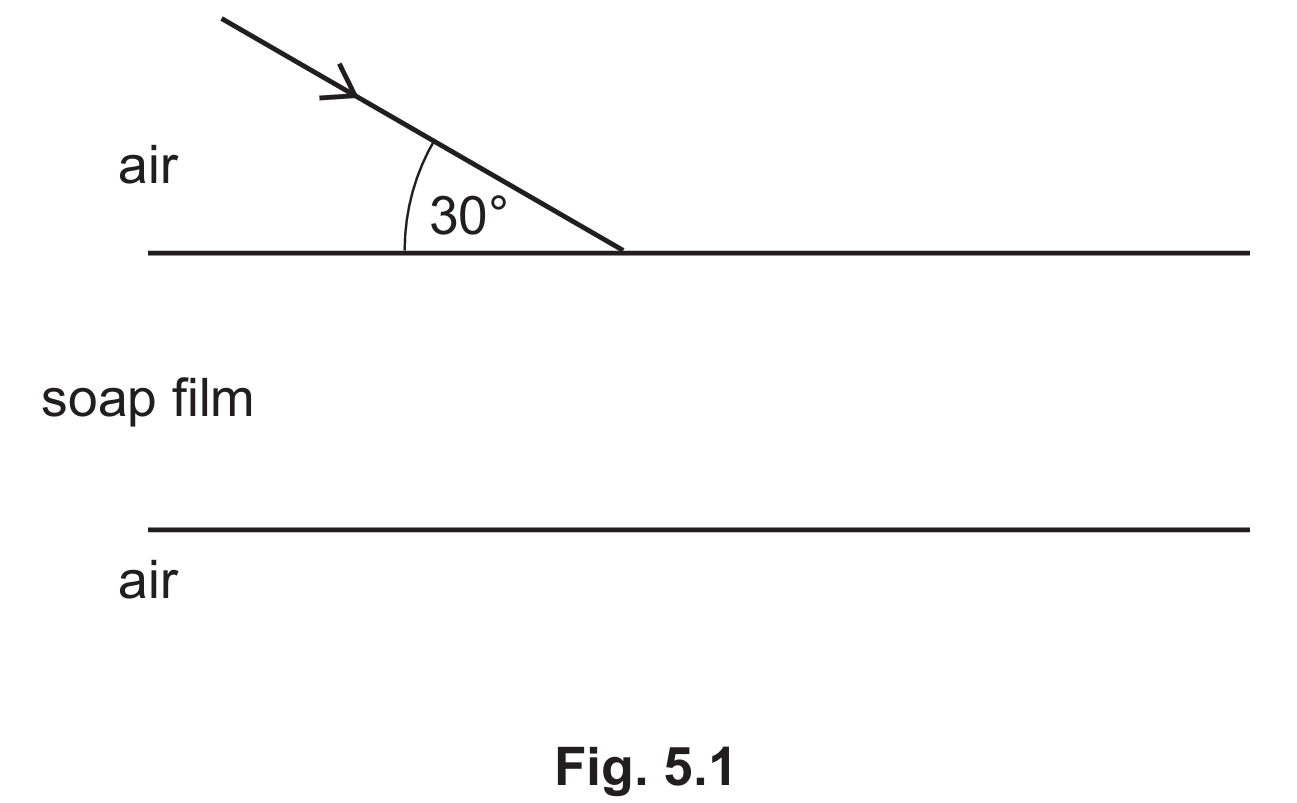
The refractive index of the soap film is $1.28$.
(a) Define refractive index in terms of the speed of light.
(ii) On Fig. 5.1, carefully draw the refracted light ray in the soap film and label the angle of refraction.
(i) Define monochromatic.
(ii) Calculate the frequency of the light.
Most-appropriate topic codes (Cambridge IGCSE Physics 0625):
• Topic $3.2.2$ — Refraction of light (Parts $\mathrm{(a)}$, $\mathrm{(b)}$)
• Topic $3.2.4$ — Dispersion of light (Part $\mathrm{(c)(i)}$)
• Topic $3.1$ — General properties of waves (Part $\mathrm{(c)(ii)}$)
• Topic $3.3$ — Electromagnetic spectrum (Part $\mathrm{(c)(ii)}$)
▶️ Answer/Explanation
Correct Answer: The ratio of the speed of light in air (or vacuum) to the speed of light in the soap film.
Detailed solution: The refractive index ($n$) is a dimensionless measure that describes how fast light travels through a material. It is formally defined as the ratio of the speed of light in a vacuum (approximated as the speed of light in air) to the speed of light in the specified medium. This relationship shows how much the light is slowed down when entering the optically denser medium.
Correct Answer: $i = 60^{\circ}$, $1.28 = \frac{\sin 60^{\circ}}{\sin r}$, $r = 42.6^{\circ} \approx 43^{\circ}$
Detailed solution: First, find the angle of incidence ($i$), which is measured from the normal. Since the ray makes a $30^{\circ}$ angle with the boundary, $i = 90^{\circ} – 30^{\circ} = 60^{\circ}$. Applying Snell’s Law, $n = \frac{\sin i}{\sin r}$, we rearrange the formula to find $\sin r = \frac{\sin i}{n}$. Substituting the given values gives $\sin r = \frac{\sin 60^{\circ}}{1.28} \approx \frac{0.866}{1.28} \approx 0.676$. Taking the inverse sine of $0.676$ yields $r \approx 42.6^{\circ}$, which correctly rounds to $43^{\circ}$.
Correct Answer: A normal drawn at the incidence point; a refracted ray drawn bending towards the normal with the angle $r$ labeled.
Detailed solution: To correctly complete the diagram, first draw a dashed line perpendicular to the soap film surface exactly at the point where the incident ray hits the boundary (this is the normal). Then, draw the refracted ray inside the soap film so that it bends towards the normal line, reflecting the calculated angle of approximately $43^{\circ}$. Finally, clearly label the angle between the newly drawn normal and the refracted ray as the angle of refraction.
Correct Answer: Light of a single frequency.
Detailed solution: The term “monochromatic” translates literally to “single color.” In physics, this refers to an electromagnetic wave (such as visible light) that consists of exactly one single frequency. Because frequency remains constant across mediums and determines the color we see, a single frequency corresponds to a single, pure color in the visible spectrum.
Correct Answer: $4.4 \times 10^{14}\text{ Hz}$
Detailed solution: The speed of electromagnetic waves in air is approximately $v = 3.0 \times 10^8\text{ m/s}$. The given wavelength must be converted to meters: $\lambda = 680\text{ nm} = 680 \times 10^{-9}\text{ m}$. Using the universal wave equation $v = f\lambda$, we can isolate frequency by rearranging to $f = \frac{v}{\lambda}$. Substituting the known values gives $f = \frac{3.0 \times 10^8}{680 \times 10^{-9}}$, which evaluates to approximately $4.41 \times 10^{14}\text{ Hz}$.