
iGCSE Physics (0625) 3.4 Sound Paper 4 -Exam Style Questions- New Syllabus
Question
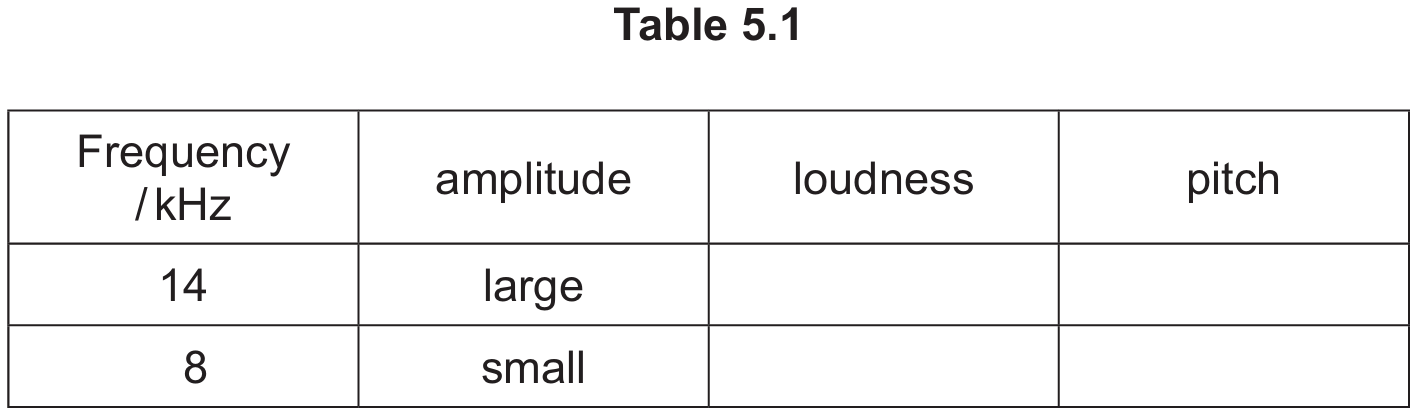
(c) Complete Table 5.1 to describe differences in loudness and pitch of two different dolphin sounds.
(d) Complete the sentences to describe how sound is transmitted through water.
Sound waves are made of vibrating ……………………………………………….. which produce compressions and rarefactions. A compression is a region of ……………………………………………….. and a rarefaction is a region of ……………………………………………….. . The sound waves travel ……………………………………………….. to the direction of the vibrations.
Most-appropriate topic codes (Cambridge IGCSE Physics 0625):
• Topic $3.4$ — Sound (Parts $\mathrm{(a)}$, $\mathrm{(b)}$, $\mathrm{(c)}$)
• Topic $3.1$ — General properties of waves (Part $\mathrm{(d)}$)
▶️ Answer/Explanation
Correct Answer: The speed of sound in air is typically accepted as any value between $330\text{ m/s}$ and $350\text{ m/s}$. The speed of sound in water is faster than in air.
Detailed solution: The speed of sound in air depends on conditions like temperature but is universally estimated between $330\text{ m/s}$ and $350\text{ m/s}$ in standard environments. Sound is a mechanical wave that relies on particle interaction to travel. Because particles in liquids (water) are packed much more densely than in gases (air), acoustic energy transfers between particles more rapidly. Therefore, sound propagates significantly faster in water.
Correct Answer: Yes, humans can hear the sounds. The normal human hearing range is $20\text{ Hz}$ to $20\text{ kHz}$, and all the dolphin sounds fall within this range.
Detailed solution: A human with a healthy, normal auditory system is capable of detecting sound frequencies ranging from $20\text{ Hz}$ up to $20000\text{ Hz}$ (which is $20\text{ kHz}$). The dolphin in this scenario is emitting communicative sounds between $7\text{ kHz}$ and $15\text{ kHz}$. Because this entire $7–15\text{ kHz}$ emission range is completely enclosed within the $20\text{ Hz}$ to $20\text{ kHz}$ human threshold, every sound produced by the dolphin will be audible to a normal human listener.
Correct Answer:
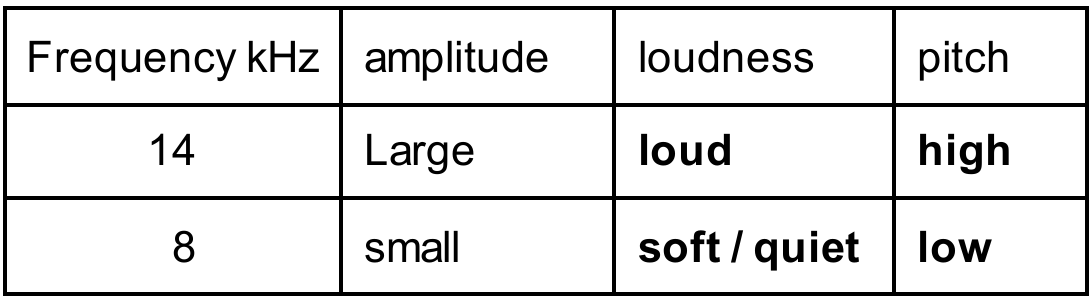
Detailed solution: In sound waves, amplitude directly dictates the volume or loudness of the sound; a larger amplitude displaces particles further, resulting in a loud sound, whereas a small amplitude yields a soft or quiet sound. Frequency determines the pitch of the sound. Therefore, the higher frequency of $14\text{ kHz}$ correlates to a higher pitch, while the comparatively lower frequency of $8\text{ kHz}$ produces a lower pitch.
Correct Answer: particles, high pressure, low pressure, parallel.
Detailed solution: Sound propagates through water as a longitudinal wave, which is fundamentally driven by the physical vibration of local particles. As these particles oscillate back and forth, they bunch together to form areas of high pressure, known as compressions. They then spread apart to create areas of low pressure, referred to as rarefactions. The defining characteristic of a longitudinal wave is that the wave’s overall direction of travel is entirely parallel to the direction in which the particles are vibrating.