
iGCSE Physics (0625) 4.2.2 Electric Current Paper 3 -Exam Style Questions- New Syllabus
Question
The student uses the circuit shown in Fig. 9.1.
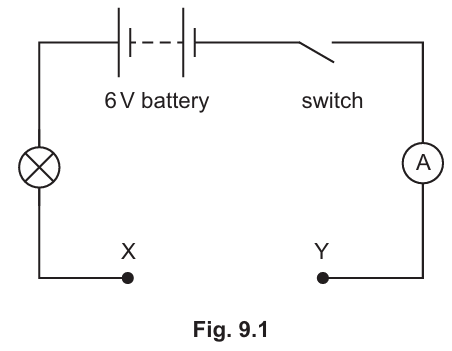
Describe how the student can determine whether tin is an electrical conductor.
Use your ideas about electrons in your answer.
Most-appropriate topic codes (Cambridge IGCSE Physics 0625):
• Topic 4.2.2 — Electric current (Parts (a), (b))
▶️ Answer/Explanation
(a)
For the correct answer:
either: close switch (see if) lamp lights OR reading on ammeter OR lamp lights OR reading on ammeter (so material is (a)) conductor OR lamp lights OR reading on ammeter (so must have electric) current in tin
To determine if tin is an electrical conductor, the student should close the switch to complete the circuit. The tin piece acts as a bridge between points X and Y. If tin conducts electricity, charge will flow, causing the lamp to light up or the ammeter to show a non-zero reading. This observation confirms that tin allows an electric current to pass through it.
(b)
For the correct answer:
mention of free OR de-localised electrons (in the metal) able to move from one atom / ion / particle to another when p.d. OR voltage (applied across the metal / material)
Electrical conduction in a metal is due to the presence of free or de-localised electrons within its structure. These electrons are not bound to any specific atom and can move randomly throughout the metal lattice. When a potential difference (voltage) is applied across the metal, these free electrons drift in a net direction, forming an electric current.