
iGCSE Physics (0625) 4.2.1 Electic charge Paper 3 -Exam Style Questions- New Syllabus
Question
(a) Fig. 8.1 represents charges on an acetate strip and on a dry cloth.
Both the acetate strip and the dry cloth are electrically neutral.
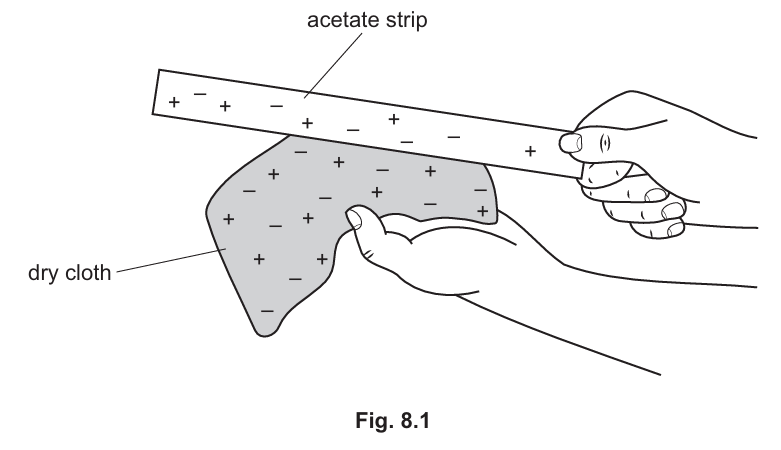
The student charges the acetate strip by using the dry cloth. The acetate strip becomes positively charged.
Explain how the acetate strip becomes positively charged.
(b) The student brings the positively charged acetate strip close to another positively charged acetate strip. Fig. 8.2 shows this situation.
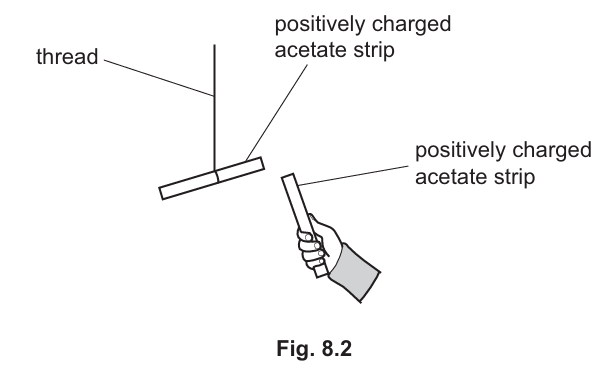
Describe and explain what happens when the two positively charged acetate strips are close to each other.
Most-appropriate topic codes (Cambridge IGCSE Physics 0625):
• Topic 4.2.1 — Electric charge (Parts (a), (b))
▶️ Answer/Explanation
(a)
For the correct answer:
friction OR rubbing (with cloth) owtte electrons / negative charges move / transfer from the acetate OR to the cloth
When the acetate strip is rubbed with the dry cloth, friction causes a transfer of charge. Electrons (negative charges) are transferred from the surface of the acetate strip to the cloth. Since the acetate loses electrons, it is left with a deficit of negative charge, making it positively charged.
(b)
For the correct answer:
(strips) repel / move away (from each other) owtte same charge (on both strips) / both / they have positive charge
When two positively charged objects are brought close together, they exert a force of repulsion on each other. This is because like charges repel according to the laws of electrostatics. Since both acetate strips have the same positive charge, they will move away from each other.