
iGCSE Physics (0625) 4.2.2 Electric current Paper 4 -Exam Style Questions- New Syllabus
Question
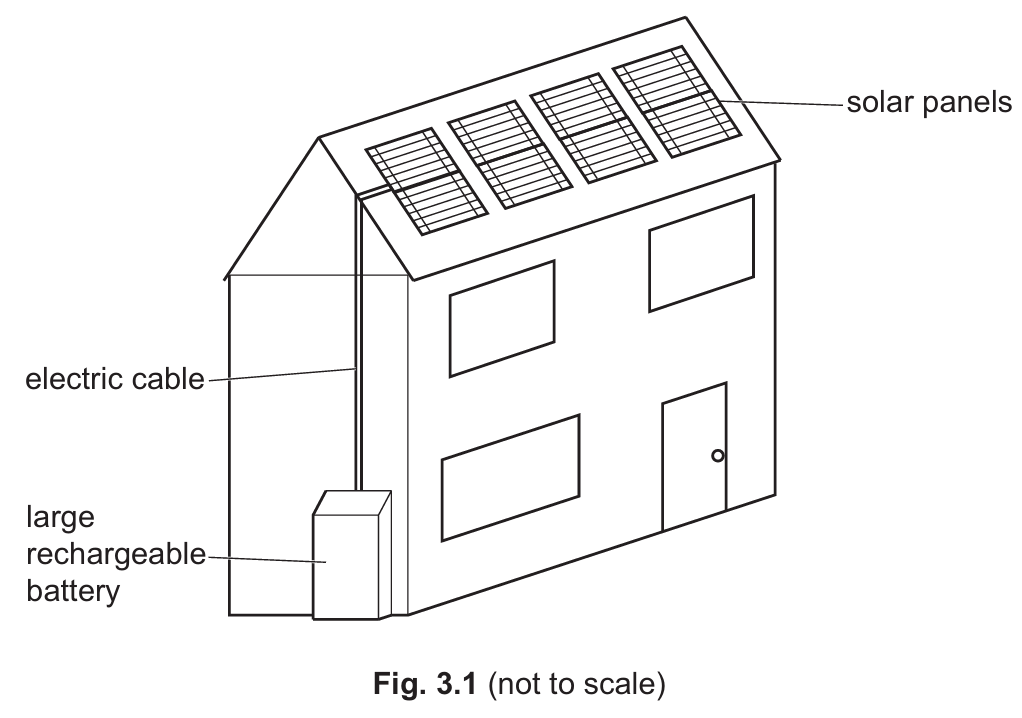
Most-appropriate topic codes (Cambridge IGCSE Physics 0625):
• Topic $2.3 .3$ — Radiation (Part $\mathrm{(a)}$)
• Topic $1.7 .3$ — Energy resources (Part $\mathrm{(b)}$)
• Topic $4.2 .2$ — Electric current (Parts $\mathrm{(c)}$, $\mathrm{(e)}$)
• Topic $1.7 .2$ — Energy resources (Part $\mathrm{(d)}$)
▶️ Answer/Explanation
(a)
For the correct answer:
Black is a good absorber of radiation, leading to more electricity generation.
Dark, dull surfaces are significantly better absorbers of infrared radiation compared to light or shiny surfaces. By using black panels, the system absorbs a higher percentage of the incident solar energy and reflects less away.
(b)
For the correct answer:
$22\text{ kW}$ (or $22000\text{ W}$)
Efficiency is defined as $\text{Efficiency} = \frac{\text{Useful Power Output}}{\text{Total Power Input}}$. Rearranging for input gives $\text{Input} = \frac{3.5\text{ kW}}{0.16} = 21.875\text{ kW}$. To two significant figures, this is $22\text{ kW}$.
(c)
For the correct answer:
Alternating current reverses direction, while direct current flows in only one direction.
Direct current (d.c.) is characterized by a constant direction of charge flow. In contrast, alternating current (a.c.) periodically reverses its direction and changes its magnitude continuously with time.
(d)
For the correct answer:
Electricity can be used when there is no Sun (e.g., at night or during cloudy weather).
Solar energy is an intermittent resource. A rechargeable battery acts as an energy store, allowing the excess electricity produced during peak sunlight to be saved for later use, ensuring a reliable power supply.
(e)
For the correct answer:
$29000\text{ C}$
Charge $Q$ is calculated using $Q = I \times t$. Converting time to seconds: $2.0\text{ h} = 7200\text{ s}$. Therefore, $Q = 4.0\text{ A} \times 7200\text{ s} = 28800\text{ C}$, which rounds to $29000\text{ C}$.