
iGCSE Physics (0625) 4.2.4 Resistance Paper 4 -Exam Style Questions- New Syllabus
Question
Most-appropriate topic codes (Cambridge IGCSE Physics 0625):
• Topic $4.2.4$ — Resistance (Part $\mathrm{a(i)}$)
• Topic $4.3.2$ — Series and parallel circuits (Parts $\mathrm{a(ii)}$, $\mathrm{b(i)}$)
• Topic $4.3.1$ — Circuit diagrams and circuit components (Part $\mathrm{b(ii)}$)
▶️ Answer/Explanation
Part a(i)
For the correct answer:
$0.008\text{ A}$ (or $8.0\text{ mA}$)
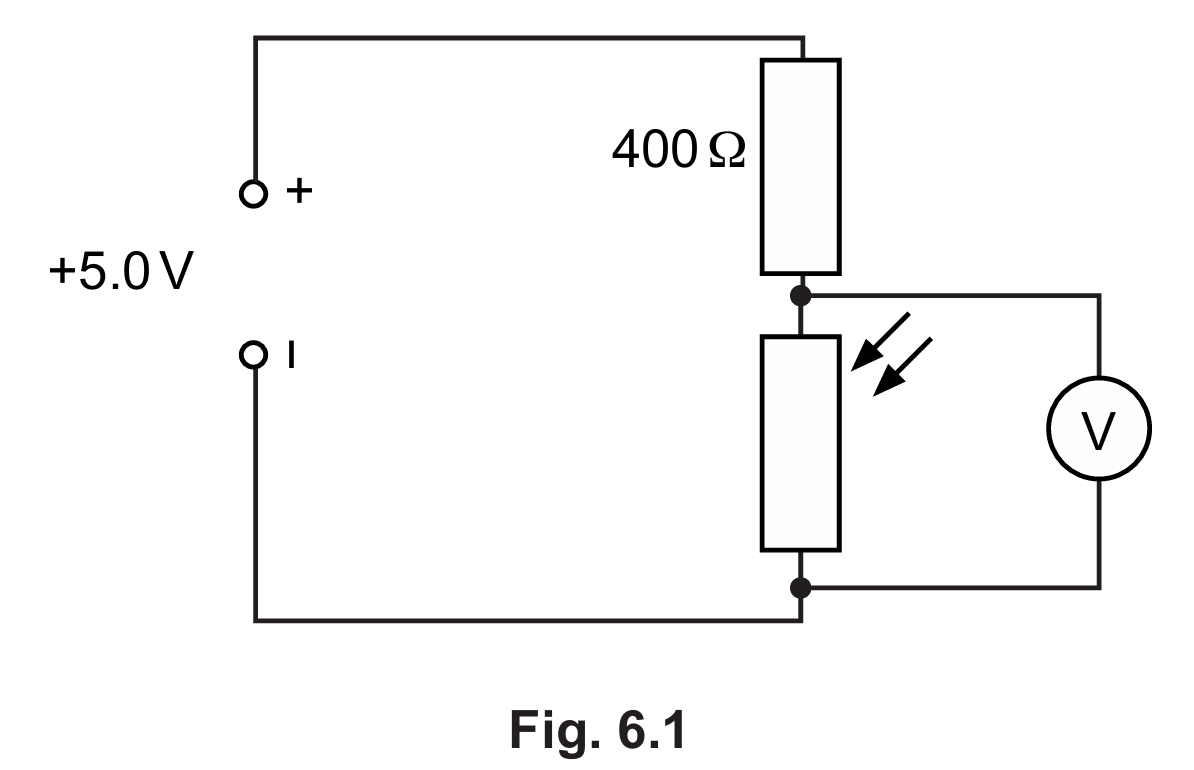
In a series circuit, the supply voltage is shared. The p.d. across the $400\text{ }\Omega$ resistor is $V = 5.0\text{ V} – 1.8\text{ V} = 3.2\text{ V}$. Using Ohm’s Law, $I = \frac{V}{R} = \frac{3.2\text{ V}}{400\text{ }\Omega} = 0.008\text{ A}$.
Part a(ii)
For the correct answer:
Voltmeter reading increases; because the resistance of the LDR increases in the dark.
When the room becomes dark, the LDR’s resistance increases. In a potential divider, the component with the higher resistance takes a larger share of the total supply voltage, thus increasing the reading across the LDR.
Part b(i)
For the correct answer:
$56\text{ mA}$ (or $0.056\text{ A}$)
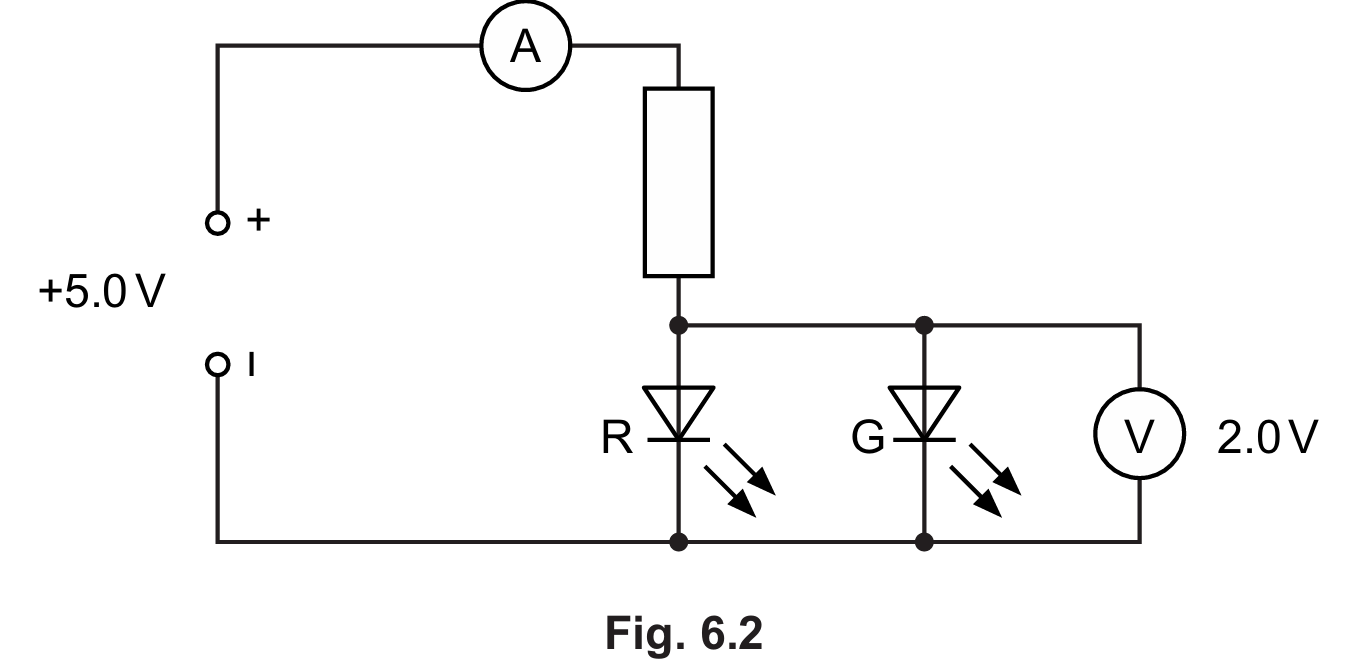
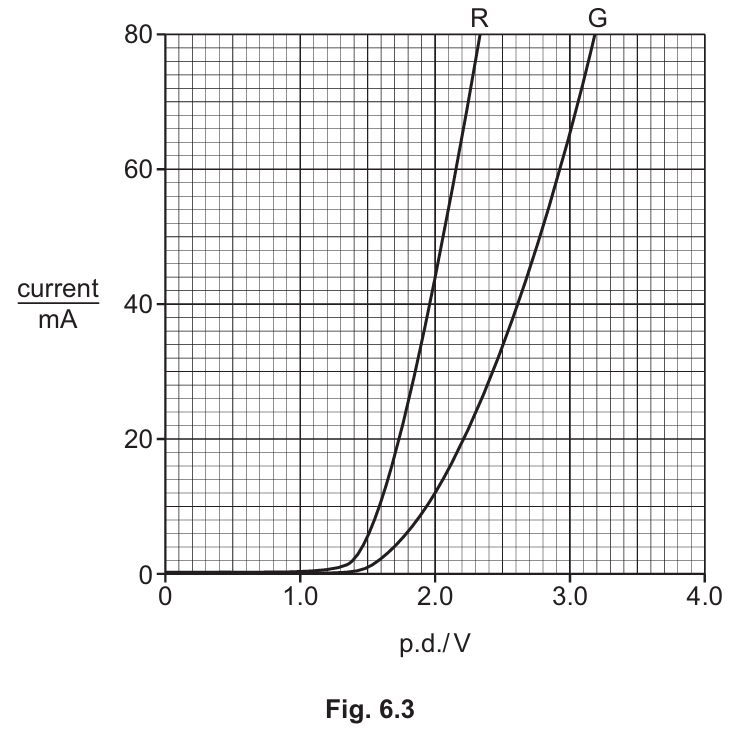
From the graph at $2.0\text{ V}$, $I_R = 44\text{ mA}$ and $I_G = 12\text{ mA}$. In parallel, total current is the sum: $I_{total} = 44 + 12 = 56\text{ mA}$.
Part b(ii)
For the correct answer:
$0\text{ A}$
LEDs only allow current to flow in forward bias. Reversing the power supply makes them reverse-biased, meaning they will not conduct any current.