
iGCSE Physics (0625) 4.2.5 Electrical energy and electrical power Paper 4 -Exam Style Questions- New Syllabus
Question
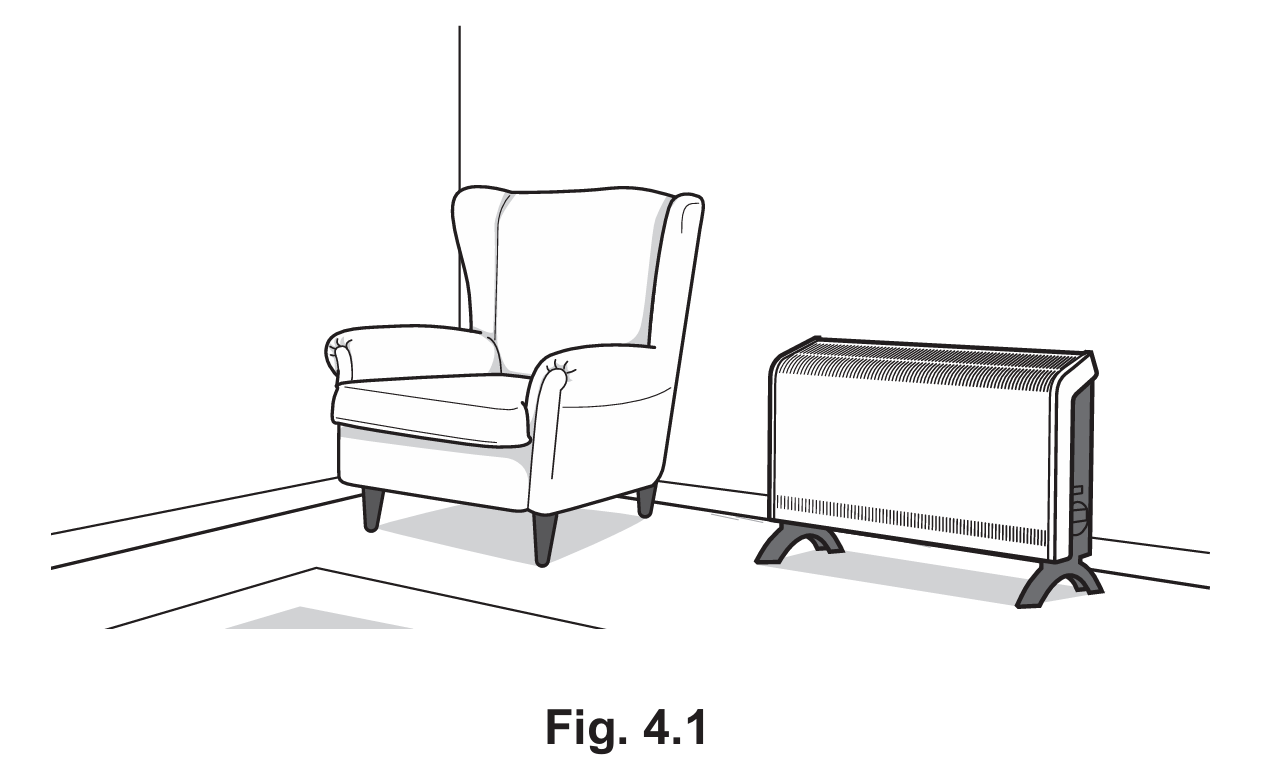
(ii) Explain how the heater warms all the air in the room.
(i) Show that the current in the heater is approximately $8.7\text{ A}$.
(ii) The plug connecting the heater to the mains supply is fitted with a fuse. Fuse ratings of $3\text{ A}$, $5\text{ A}$, $10\text{ A}$ and $13\text{ A}$ are available. State which fuse is used. Explain your answer.
Most-appropriate topic codes (Cambridge IGCSE Physics 0625):
• Topic $2.3.2$ — Convection (Parts $\mathrm{(a)(i)}$, $\mathrm{(a)(ii)}$)
• Topic $4.2 .5$ — Electrical energy and electrical power (Part $\mathrm{(b)(i)}$)
• Topic $4.4$ — Electrical safety (Part $\mathrm{(b)(ii)}$)
▶️ Answer/Explanation
Correct Answer: Convection.
Detailed solution: The primary mechanism for thermal energy transfer in fluids, such as the air in a room or water in a kettle, is convection. This process involves the macroscopic movement of the fluid itself, carrying thermal energy away from the heat source to cooler regions.
Correct Answer: Warm air expands and becomes less dense, causing it to rise. Cooler, denser air falls to replace it, creating a convection current.
Detailed solution: When the heater warms the adjacent air, the air molecules gain kinetic energy and spread further apart. This expansion causes the warm air to become less dense than the surrounding cooler air, prompting it to rise towards the ceiling. Concurrently, cooler, denser air descends to take its place near the heater, establishing a continuous circulation known as a convection current that eventually warms the entire room.
Correct Answer: $I = 8.7\text{ A}$
Detailed solution: The electrical power $P$ is related to current $I$ and voltage $V$ by the equation $P = IV$. First, convert the power from kilowatts to watts: $P = 2.0\text{ kW} = 2000\text{ W}$. Rearranging the power equation to solve for current gives $I = \frac{P}{V}$. Substituting the given values yields $I = \frac{2000}{230}$, which calculates to approximately $8.696\text{ A}$, rounding to the specified $8.7\text{ A}$.
Correct Answer: $10\text{ A}$ fuse. The fuse rating must be slightly higher than the normal operating current.
Detailed solution: A fuse is a safety device designed to melt and break the circuit if the current exceeds a safe threshold. The fuse rating must be slightly higher than the normal operating current of $8.7\text{ A}$ to allow the heater to function without the fuse melting during normal use. Therefore, a $10\text{ A}$ fuse is chosen; smaller fuses like $3\text{ A}$ or $5\text{ A}$ would melt immediately, while a $13\text{ A}$ fuse might allow dangerously high currents during a fault before blowing.