
iGCSE Physics (0625) 4.3.3 Action and use of circuit components Paper 4 -Exam Style Questions- New Syllabus
Question
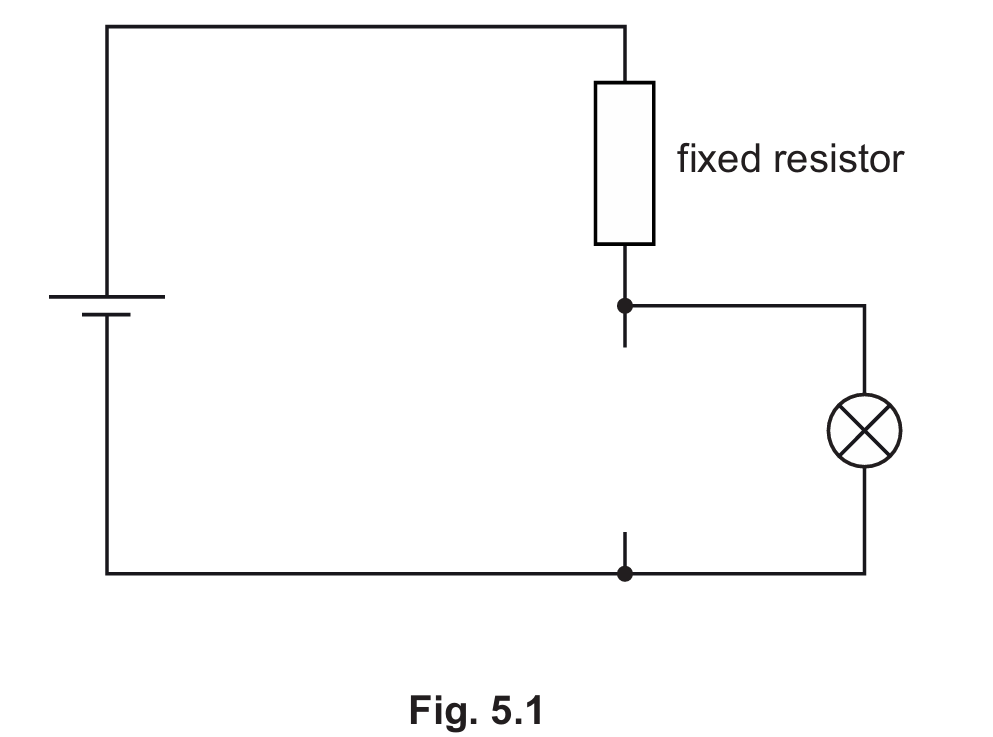
Most-appropriate topic codes (Cambridge IGCSE Physics 0625):
• Topic $4.3.1$ — Circuit diagrams and circuit components (Part $\mathrm{(a)}$, $\mathrm{(b)(i)}$)
• Topic $4.3.3$ — Action and use of circuit components (Part $\mathrm{(b)(ii)}$)
• Topic $4.3.2$ — Series and parallel circuits (Part $\mathrm{(b)(ii)}$)
▶️ Answer/Explanation
Correct Answer: Axes are correctly labelled (resistance on the y-axis, light intensity on the x-axis) and the graph shows a straight line or smooth curve with a negative gradient.
Detailed solution: Based on the problem description, the resistance is low when light intensity is high, and high when light intensity is low. This indicates an inverse relationship between the two variables. Plotting resistance $R$ on the y-axis against light intensity on the x-axis yields a line or curve with a negative gradient, visually demonstrating that resistance decreases as light intensity increases.
Correct Answer: The standard symbol for an LDR (a rectangle with two arrows pointing diagonally downwards towards it) is drawn in the gap.
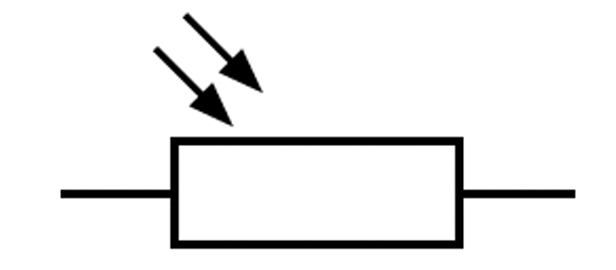
Detailed solution: To complete the circuit diagram accurately, the standard electronic symbol for a Light-Dependent Resistor must be drawn between the open terminals. This symbol is constructed by drawing a standard resistor rectangle and adding two parallel arrows pointing towards the rectangle, representing incoming light rays hitting the component.
Correct Answer: In the dark, the LDR’s resistance is high, meaning it takes a larger proportion of the e.m.f. Because the lamp is in parallel with the LDR, the p.d. across the lamp is also high, turning it on.
Detailed solution: The circuit acts as a potential divider where the total electromotive force (e.m.f.) is constant and shared between the fixed resistor and the parallel LDR-lamp combination. In the dark, the LDR’s resistance $R_{\text{LDR}}$ increases significantly, meaning the potential difference across it, $V_{\text{LDR}}$, becomes a much larger fraction of the total e.m.f. Since the lamp is connected in parallel with the LDR, the p.d. across the lamp $V_{\text{LAMP}}$ is equal to $V_{\text{LDR}}$. This high $V_{\text{LAMP}}$ provides sufficient energy to turn the lamp on, whereas in bright light, the low $R_{\text{LDR}}$ drops the voltage, keeping the lamp off.