
iGCSE Physics (0625) 4.4 Electrical safety Paper 4 -Exam Style Questions- New Syllabus
Question
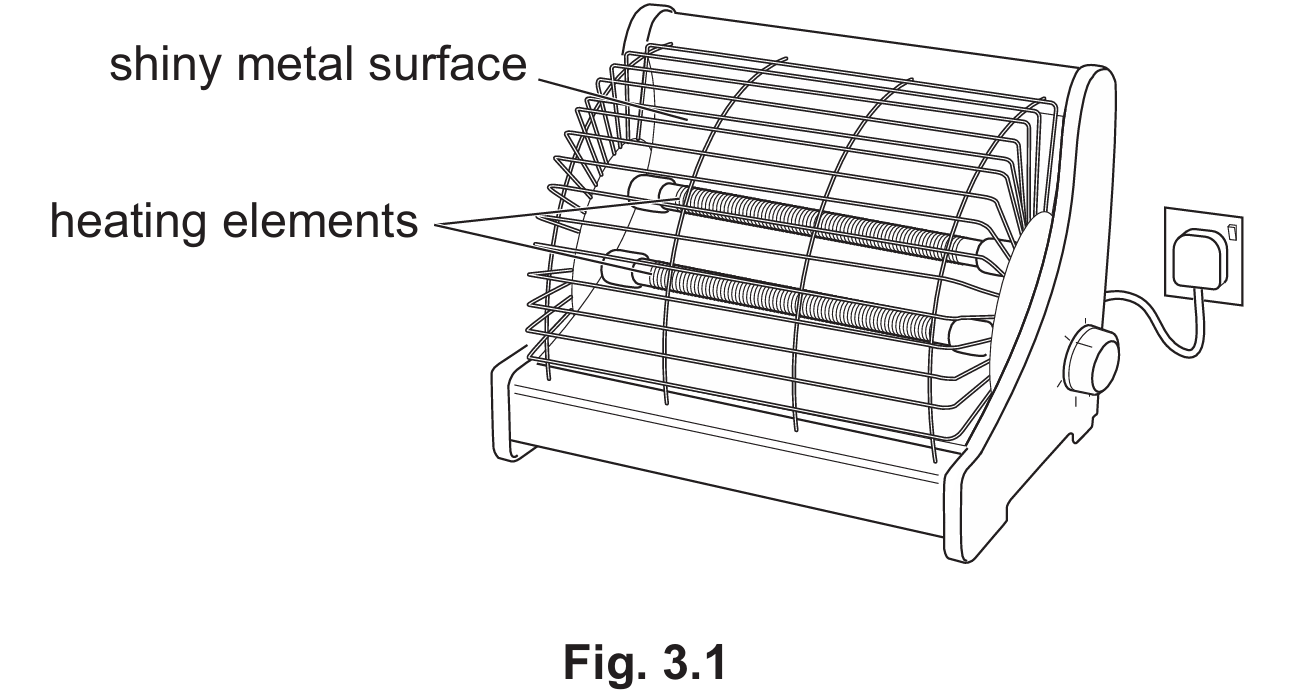
Most-appropriate topic codes (Cambridge IGCSE Physics 0625):
• Topic 2.3.3 — Radiation (Parts (a), (b))
• Topic 4.4 — Electrical safety (Part (c))
• Topic 4.2.4 — Resistance (Part (d)(i))
• Topic 4.2.5 — Electrical energy and electrical power (Part (d)(ii))
• Topic 1.7.3 — Energy resources (Part (d)(iii))
▶️ Answer/Explanation
(a)
For the correct answer:
infrared
Thermal energy is transferred by electromagnetic radiation primarily in the infrared region. All objects emit infrared radiation, and a heating element specifically uses this part of the electromagnetic spectrum to radiate heat into the surrounding environment.
(b)
For the correct answer:
A shiny surface is a good reflector of radiation.
Shiny metal surfaces are excellent reflectors and very poor absorbers of infrared radiation. By placing a shiny surface behind the heating elements, the infrared radiation emitted backwards is reflected forward. This prevents the heater’s casing from unnecessarily absorbing the heat and ensures maximum thermal energy is directed outward into the room.
(c)
For the correct answer:
It prevents electric shock if the live wire touches the metal casing.
If a fault occurs and the live wire comes into contact with the metal outer casing, the casing would become live. The earth wire provides a low-resistance path for the current to flow safely to the ground rather than passing through a person touching the heater, thereby preventing a severe electric shock.
(d) (i)
For the correct answer:
2.6 A
We use the rearranged resistance formula I= R V to find the current. Since the components are connected in parallel, the full mains voltage of 230 V acts across each individual element. Substituting the given values, we get I= 89Ω 230 V =2.584 A. This rounds up to 2.6 A for one heating element.
(d) (ii)
For the correct calculation:
P=IV (or P= R V 2 ), producing ≈1189 W which is approx 1200 W
The electrical power for one element can be calculated using P= R V 2 = 89Ω (230 V) 2 ≈594.4 W. Because there are two identical heating elements operating in parallel, the total power is double this amount: 2×594.4 W=1188.8 W. Alternatively, using the total current I total =2×2.584 A=5.168 A, the formula P=IV gives 230 V×5.168 A≈1189 W. Both methods show the power is approximately 1200 W.
(d) (iii)
For the correct answer:
68000 J (or 68 kJ)
First, we find the total electrical energy input over t=60 s using the formula E=Pt. Using the nominal power of 1200 W provided in the previous part, the total energy input is 1200 W×60 s=72000 J. Because the heater is only 95% efficient, the useful thermal energy output is 0.95×72000 J=68400 J. To present the final answer to strictly two significant figures, this correctly rounds down to 68000 J.