
iGCSE Physics (0625) 4.5.2 The a.c. generator Paper 4 -Exam Style Questions- New Syllabus
Question
Most-appropriate topic codes (Cambridge IGCSE Physics 0625):
• Topic $4.5.2$ — The a.c. generator (Part $\mathrm{a(i)}$)
• Topic $4.5.1$ — Electromagnetic induction (Parts $\mathrm{a(ii)}$, $\mathrm{a(iii)}$)
• Topic $4.3 .2$ — Series and parallel circuits (Parts $\mathrm{b(i)}$, $\mathrm{b(ii)}$)
• Topic $4.2 .4$ — Resistance (Part $\mathrm{b(iii)}$)
▶️ Answer/Explanation
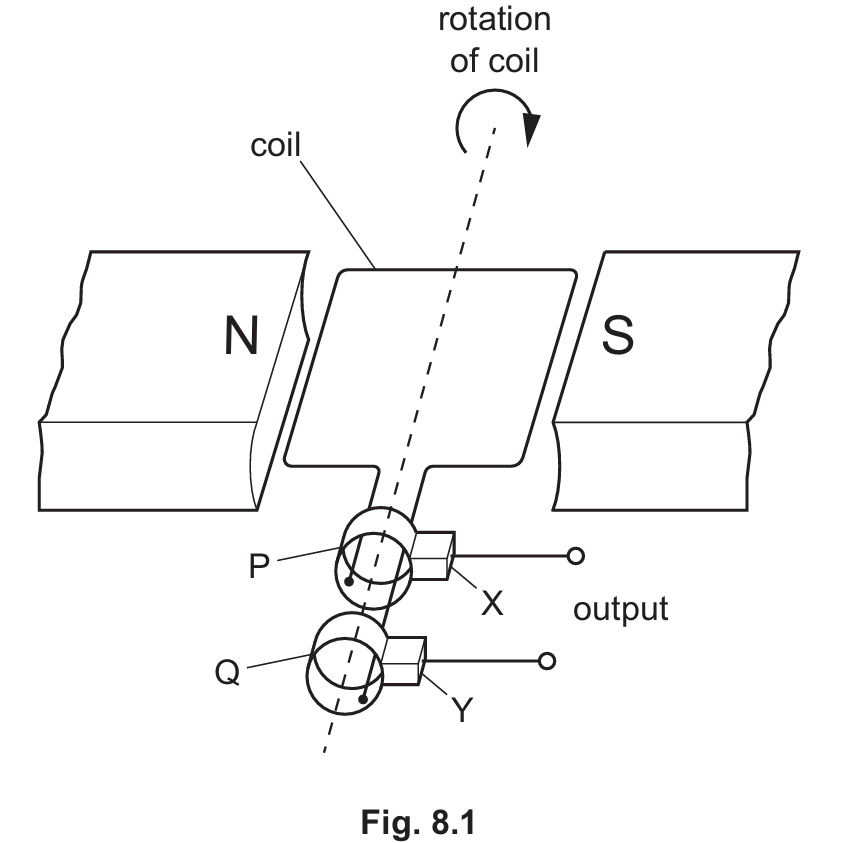
(i) P and Q: slip rings; X and Y: brushes
(ii) Detailed solution: An electromotive force (e.m.f.) is induced only when there is a change in the magnetic flux linkage. When the coil turns, its sides cut through the magnetic field lines between the North and South poles. This relative motion between the conductor and the magnetic field is essential to drive the flow of electrons; if the coil is stationary, no field lines are cut, and the e.m.f. is zero.
(iii) Detailed solution: To increase the induced e.m.f., one can increase the strength of the magnetic field (using stronger magnets), increase the speed of rotation of the coil (cutting lines faster), or increase the number of turns of wire in the coil. Each of these changes increases the rate at which magnetic flux is cut by the conductor.
Correct Answer: $1.2\text{ A}$
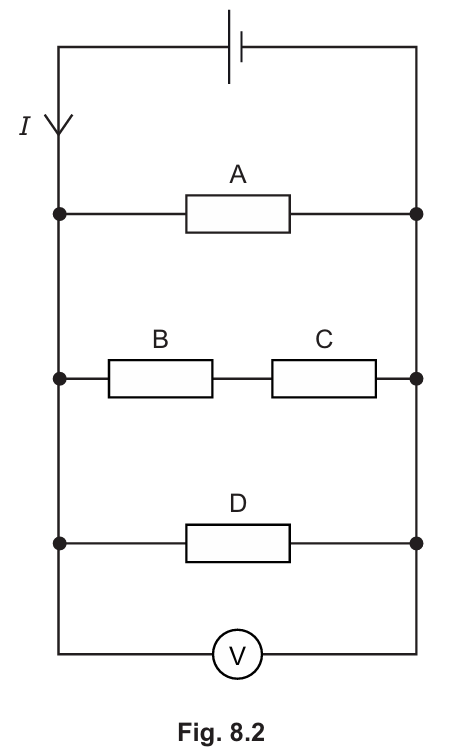
Detailed solution: Resistors B and C are in series, and since they are identical, the total resistance of that branch is twice that of the branch containing only resistor A ($R_{BC} = 2R$). Because the branches are in parallel, they share the same potential difference. Since $V = IR$, doubling the resistance in a branch with the same voltage results in the current being halved: $\frac{2.4\text{ A}}{2} = 1.2\text{ A}$.
Correct Answer: $6.0\text{ A}$
Detailed solution: The total current $I$ is the sum of the currents in the three parallel branches. The top branch (A) has $2.4\text{ A}$. The middle branch (B and C) has $1.2\text{ A}$. The bottom branch (D) is identical to branch A and thus also has $2.4\text{ A}$. Summing these gives $I = 2.4 + 1.2 + 2.4 = 6.0\text{ A}$.
Correct Answer: $2.1\text{ }\Omega$
Detailed solution: The resistance $R$ is calculated using Ohm’s Law, $R = \frac{V}{I}$. The voltmeter is connected in parallel across the resistors, so the potential difference across resistor A is $5.0\text{ V}$. Using the given current for resistor A ($2.4\text{ A}$), the resistance is $R_A = \frac{5.0}{2.4}$, which equals approximately $2.083\text{ }\Omega$, rounded to $2.1\text{ }\Omega$ for significant figures.