
iGCSE Physics (0625) 4.5.6 The transformer Paper 4 -Exam Style Questions- New Syllabus
Question
Most-appropriate topic codes (Cambridge IGCSE Physics 0625):
• Topic $4.5.6$ — The transformer (Parts $\mathrm{(a)}$, $\mathrm{(b)}$, $\mathrm{(c)}$)
▶️ Answer/Explanation
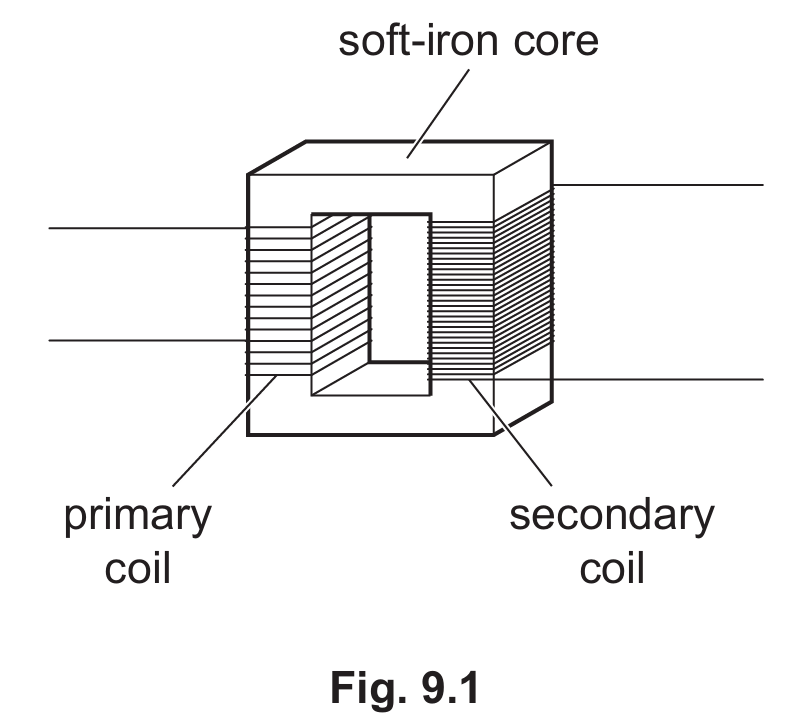
When an alternating current flows through the primary coil, it generates a continuously changing magnetic field. The soft-iron core acts as a medium to transfer this changing magnetic field to the secondary coil. As the secondary coil is exposed to this varying magnetic flux, it cuts the magnetic field lines, which induces an alternating electromotive force (e.m.f.) across it. Because the original magnetic field continuously changes direction, the induced current in the secondary coil also changes direction, resulting in an alternating current.
For the correct answer:
$240\text{ V}$
For a transformer, the ratio of the secondary voltage to primary voltage equals the turns ratio: $\frac{V_s}{V_p} = \frac{N_s}{N_p}$. Given a step-up ratio of $1:20$, we have $\frac{N_s}{N_p} = 20$. Substituting the primary voltage $V_p = 12\text{ V}$ yields $\frac{V_s}{12} = 20$. Multiplying both sides by $12$ gives the secondary voltage $V_s = 240\text{ V}$.
For the correct answer:
$0.16\text{ A}$
The electrical power lost as heat in a transmission cable is calculated using the formula $P = I^2R$, where $P$ is power loss, $I$ is current, and $R$ is resistance. Rearranging this to solve for the current squared gives $I^2 = \frac{P}{R}$. Substituting the given values results in $I^2 = \frac{1.25 \times 10^{-3}}{0.050} = 0.025\text{ A}^2$. Taking the square root of $0.025$ yields a current of $I = 0.16\text{ A}$.
For the correct answer:
Less power/energy losses and thinner/cheaper cables can be used.
Transmitting electrical energy at high voltages allows the same amount of power to be transferred using a much lower current ($P = VI$). A lower current significantly reduces the energy lost as heat in the cables, as power loss is proportional to the square of the current ($P = I^2R$). Furthermore, lower currents allow for the use of thinner, less expensive cables and enable efficient energy transfer over longer distances.