
iGCSE Physics (0625) 4.5.3 Magnetic effect of a current Paper 4 -Exam Style Questions- New Syllabus
Question
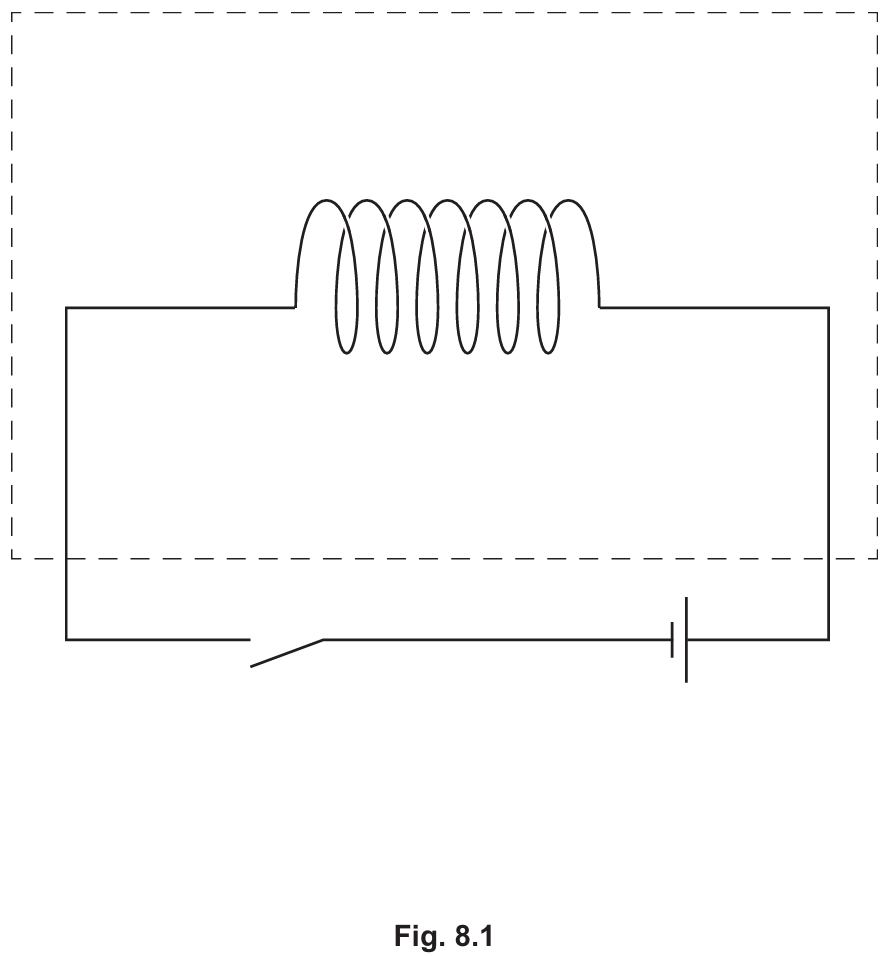
Explain how the diagram shows that the magnetic field is strong at B.
Most-appropriate topic codes (Cambridge IGCSE Physics 0625):
• Topic $4.5.3$ — Magnetic effect of a current (Part $\mathrm{(a)(i)}$)
• Topic $4.1$ — Simple phenomena of magnetism (Parts $\mathrm{(a)(ii)}$, $\mathrm{(b)(ii)}$, $\mathrm{(b)(iii)}$)
• Topic $4.3 .1$ — Circuit diagrams and circuit components (Part $\mathrm{(b)(i)}$)
▶️ Answer/Explanation
(a)(i)
For the correct drawing: Four parallel lines inside the solenoid, curving symmetrically outside without crossing. Arrows point away from the left end and towards the right end.
Inside the solenoid, the magnetic field is uniform, represented by parallel lines. Outside, lines curve from North to South. Using the right-hand grip rule, the left end is the North pole, so arrows point away from the left.
(a)(ii)
For the correct answer: Point B marked inside the solenoid or near the poles.
Explanation: The magnetic field lines are closest together at these locations.
(b)(i)
The symbol for a d.c. supply (long line for positive, short thick line for negative) should be used to complete the circuit gaps.
(b)(ii)
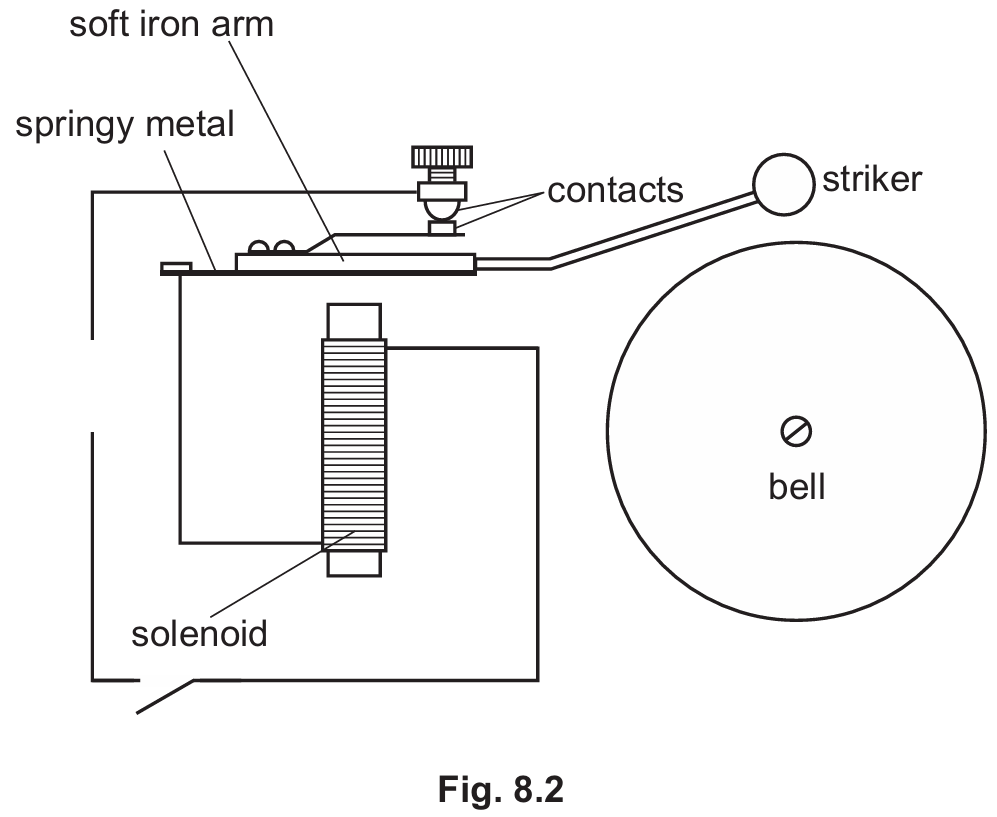
For the correct answer: The solenoid becomes an electromagnet and attracts the soft iron arm.
Closing the switch allows current to flow, creating a magnetic field in the solenoid. This electromagnet attracts the soft iron arm, pulling it to strike the bell.
(b)(iii)
For the correct answer: The contacts break, stopping the current; the electromagnet loses its magnetism, and the springy metal pulls the arm back.