
iGCSE Physics (0625) 4.5.5 The d.c. motor Paper 4 -Exam Style Questions- New Syllabus
Question
Most-appropriate topic codes (Cambridge IGCSE Physics 0625):
• Topic 4.5.4 — Force on a current-carrying conductor (Parts (a), (b))
• Topic 4.5.5 — The d.c. motor (Part (c))
▶️ Answer/Explanation
(a)
For the correct answer:
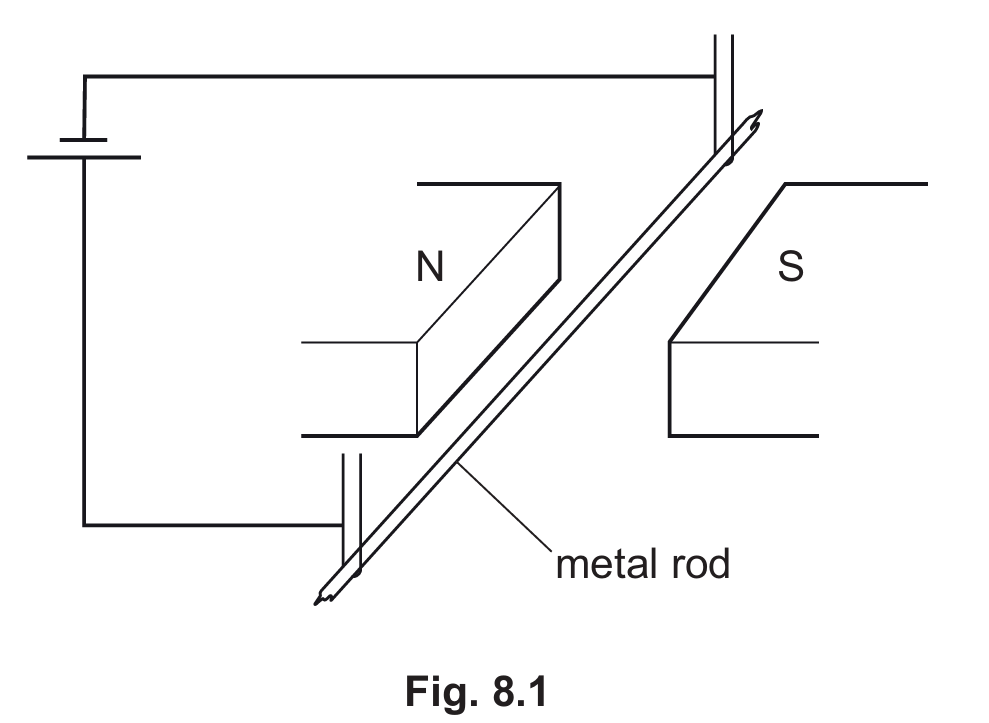
Downwards. The magnetic field direction, current direction, and force are mutually perpendicular.
By applying Fleming’s Left-Hand Rule, we can determine the direction of the magnetic force. The magnetic field B points from the North pole to the South pole (left to right). Conventional current I flows from the positive terminal to the negative terminal of the cell, meaning it travels into the plane of the paper along the rod. Aligning your first finger with the field and second finger with the current results in your thumb pointing downwards, indicating the force F.
(b)
For the correct answer:
The direction of the force reverses (changes by 180 ∘ ).
The direction of the force on a current-carrying conductor in a magnetic field depends on both the direction of the field and the direction of the current. Reversing the connections to the cell reverses the direction of the conventional current I flowing through the metal rod. According to Fleming’s Left-Hand Rule, reversing the current while keeping the magnetic field B constant will cause the resulting force F to act in the exact opposite direction.
(c)
For the correct answer:
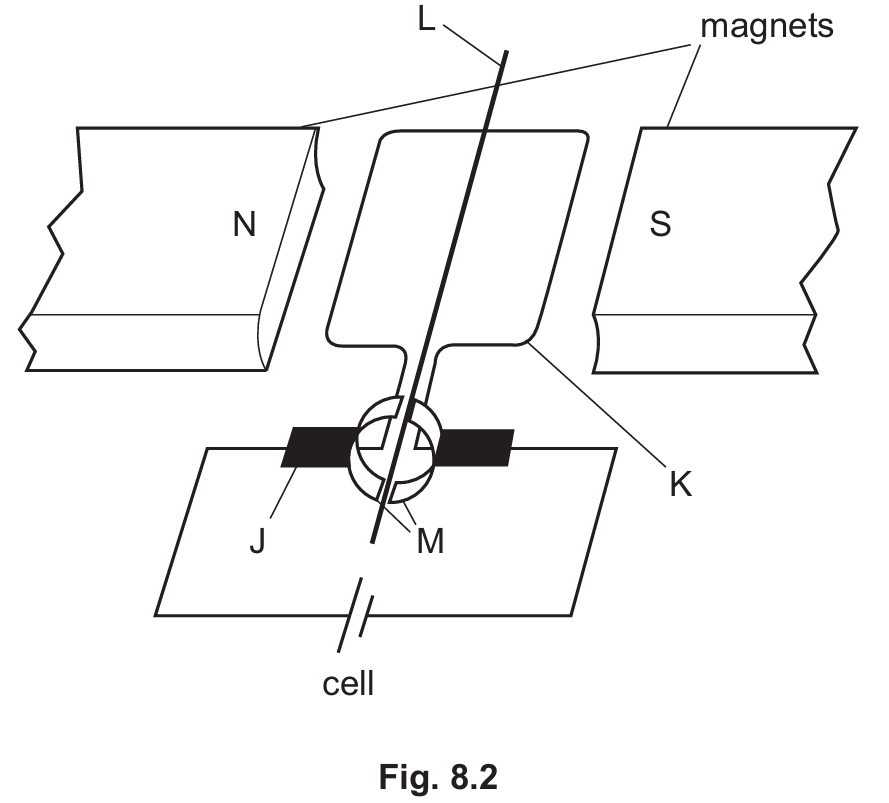
J (brushes): maintain connection to the coil. K (coil): conducts current and rotates. L (axle): allows the coil to turn. M (commutator): reverses coil connections every half-turn to keep rotation unidirectional.
In a simple d.c. motor, the carbon brushes (J) maintain a continuous sliding electrical connection between the stationary circuit and the rotating components without tangling wires. The coil (K) carries the current I and experiences a turning effect due to the magnetic field. The axle (L) provides a central axis that allows the coil to rotate freely. The split-ring commutator (M) automatically reverses the current direction in the coil every half-turn, ensuring the magnetic force always pushes the coil in the same rotational direction.