
iGCSE Physics (0625) 5.1.2 Nucleus Paper 3 -Exam Style Questions- New Syllabus
Question
(a) The nuclide notation for an atom of protactinium‑234 is:

(i) State the number of protons in an atom of protactinium‑234.
(ii) State the number of nucleons in an atom of protactinium‑234.
(b) Three forms of the element protactinium are: protactinium‑234, protactinium‑230 and protactinium‑233. State the name given to these different forms of the same element.
(c) A teacher demonstrates radioactive decay by using a sample of protactinium‑234m.
(i) The sample emits beta (β)‑particles. State the nature of a beta (β)‑particle.
(ii) The teacher obtains data for a decay curve. Fig. 10.1 shows the decay curve for the sample of protactinium‑234m
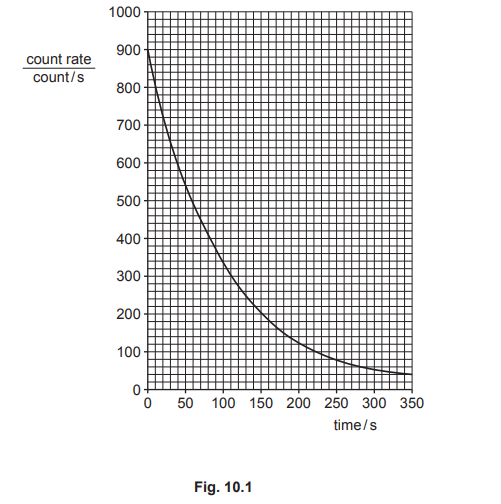
Calculate the half‑life of protactinium‑234m using the information in Fig. 10.1. Clearly show your working on the graph or in the space provided.
(iii) Suggest a reason why the half‑life of protactinium‑234m makes it suitable for this demonstration in a lesson.
Most-appropriate topic codes (Cambridge IGCSE Physics 0625):
• Topic 5.1.2 — The nucleus (Parts (a)(i), (a)(ii), (b))
• Topic 5.2.2 — The three types of nuclear emission (Part (c)(i))
• Topic 5.2.4 — Half-life (Parts (c)(ii), (c)(iii))
▶️ Answer/Explanation
(a)(i) 91
(a)(ii) 234
(b) isotopes
(c)(i) electron
(c)(ii) range 65–75 (s) / range 55–85 (s) / 2 associated values (e.g. 900 and 450 or 800 and 400 etc) seen / indicated
(c)(iii) small half-life / time in a lesson to collect enough data for a decay curve owtte
Detailed solution:
(a)(i) The bottom number (91) in nuclide notation $\frac{234}{91}\text{Pa}$ is the proton number (atomic number) $Z$. (ii) The top number (234) is the nucleon number (mass number) $A$. (b) Atoms of the same element with different nucleon numbers are called isotopes. (c)(i) A beta particle is a fast-moving electron emitted from the nucleus. (ii) Half-life is the time for the count rate to halve; e.g., from 800 to 400 counts/s takes approximately 70 s. (iii) Its short half-life allows a complete decay curve to be observed within a single lesson.