
iGCSE Physics (0625) 6.1.1 The Earth -Exam Style Questions Paper 4 - New Syllabus
Question
(a) Fig. 10.1 represents different positions A–H of the Moon as it rotates around the Earth.
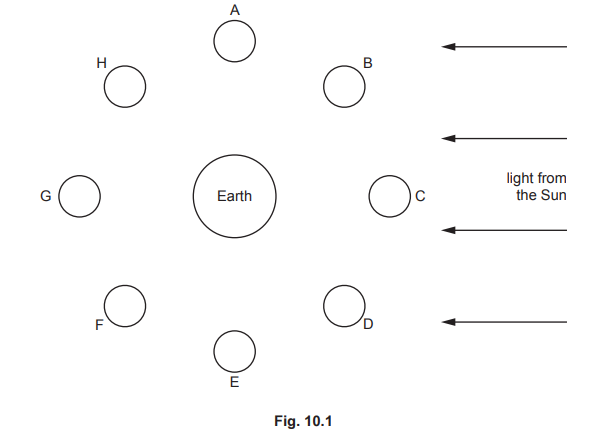
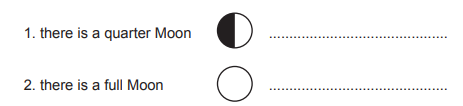
(i) State a position of the Moon where an observer on Earth sees:
(ii) State the approximate time taken for the Moon to orbit the Earth.
(b) The average distance of the Earth from the Sun is \(1.5 × 10^8 \text{ km}\).
(i) Calculate the average orbital speed of the Earth in km/h.
(ii) The speed of light in a vacuum is \(3.0 × 10^8 \text{ m/s}\). Calculate the time taken for light from the Sun to reach the Earth.
▶️ Answer/Explanation
Correct Answer: position A and / or E ; position G
Detailed solution: Position A or E shows the Moon in alignment with the Earth and Sun, producing a New Moon phase where the illuminated half faces away from Earth. Position G represents a Full Moon, with the Moon on the opposite side of Earth so its fully illuminated face is visible to an observer.
Correct Answer: 1 month
Detailed solution: The Moon completes one full revolution around the Earth in approximately 27.3 days, but due to the Earth’s simultaneous motion around the Sun, the lunar phase cycle (synodic month) is about 29.5 days, commonly approximated as one month.
Correct Answer: 110 000 (km / h)
Detailed solution: Orbital speed \(v = \frac{2\pi r}{T}\). Using \(r = 1.5 \times 10^8\text{ km}\) and \(T = 365 \times 24\text{ h}\), the calculation yields \(v = \frac{2\pi \times 1.5 \times 10^8}{8760} \approx 1.1 \times 10^5\text{ km/h}\).
Correct Answer: 500 s
Detailed solution: Using \(t = \frac{s}{v}\), convert distance to metres: \(1.5 \times 10^{11}\text{ m}\). Then \(t = \frac{1.5 \times 10^{11}}{3.0 \times 10^8} = 500\text{ s}\), which is the approximate light travel time from the Sun to Earth.