
iGCSE Physics (0625) 6.1.1 The Earth Paper 3 -Exam Style Questions- New Syllabus
Question
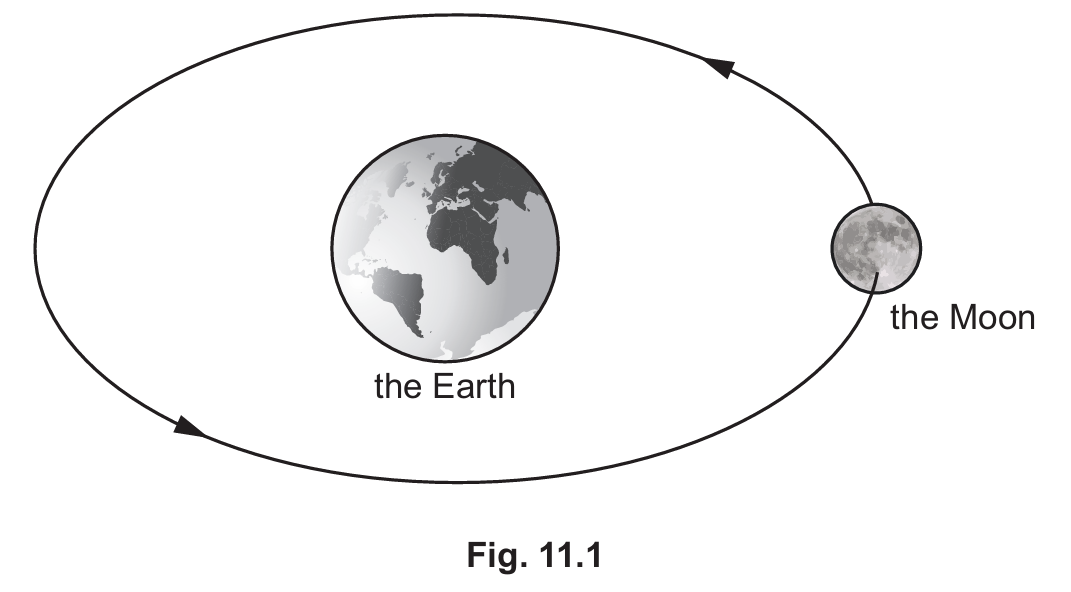
The distance from the Moon to the Earth is $3.8 \times 10^{8}\text{ m}$.
The speed of a radio wave is $3.0 \times 10^{8}\text{ m/s}$.
Calculate the time the radio signal takes to travel from the Moon to the Earth.
She writes this conclusion:
Most-appropriate topic codes (Cambridge IGCSE Physics 0625):
• Topic $6.1.1$ — The Earth (Part $\mathrm{(a)}$)
• Topic $6.1.2$ — The Solar System (Part $\mathrm{(a)}$)
• Topic $6.2.3$ — The Universe (Part $\mathrm{(b)}$)
▶️ Answer/Explanation
(a) (i)
For the correct answer:
gravity
Explanation: The gravitational force is the fundamental attractive force between any two objects with mass. The Earth’s large mass exerts a continuous gravitational pull on the Moon, which provides the centripetal force necessary to keep the Moon continuously falling toward Earth in its orbital path.
(a) (ii)
For the correct answer:
$1\text{ month}$ OR $4\text{ weeks}$ OR $27$ to $31\text{ days}$
Explanation: Astronomical observations dictate that it takes approximately $27.3\text{ days}$ for the Moon to complete one full sidereal orbit around the Earth. Within the context of this syllabus, this duration is generally approximated and accepted as $1\text{ month}$ or $4\text{ weeks}$.
(a) (iii)
For the correct calculated value:
$1.3\text{ s}$
Explanation: To find the travel time of the radio signal, we use the standard kinematic formula relating distance, speed, and time: $t = \frac{d}{s}$. Substituting the given values yields $t = \frac{3.8 \times 10^{8}\text{ m}}{3.0 \times 10^{8}\text{ m/s}}$. Evaluating this expression gives $t = 1.266…\text{ s}$, which correctly rounds to $1.3\text{ s}$ using two significant figures.
(b)
For the correct answer:
Any three from: redshift (of light), (galaxy is) moving away / receding, Universe is expanding, Big Bang theory predicts expanding Universe.
Explanation: An increase in the observed wavelength of light compared to its emitted wavelength is scientifically termed as “redshift”. Redshift signifies that the light source (the distant galaxy) is moving away or receding from the observer. The widespread observation that distant galaxies are receding in all directions serves as primary evidence that the Universe is continuously expanding, which is a fundamental prediction of the Big Bang Theory.