
iGCSE Physics (0625) 6.1.2 The Solar System -Exam Style Questions Paper 4 - New Syllabus
Question
(a) The Solar System includes the Sun and planets. State two other types of natural object that orbit the Sun.
▶️ Answer/Explanation
Correct Answer: Any two from: minor planets OR dwarf planets; comets; asteroids.
Detailed solution: The Solar System contains the Sun, eight planets, and numerous smaller bodies. Objects such as dwarf planets (e.g., Pluto), comets, and asteroids all have natural orbits around the Sun and are distinct from planets and moons.
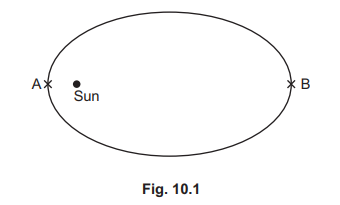
Correct Answer: Elliptical.
Detailed solution: According to Kepler’s First Law of Planetary Motion, the orbit of a planet around the Sun is an ellipse with the Sun located at one of the two foci. This applies to all planets, minor planets, and comets in the Solar System.
Correct Answer: Kinetic energy (store) decreases AND potential energy (store) increases. Energy is conserved.
Detailed solution: As the object moves from A (closest) to B (furthest), it moves against the Sun’s gravitational pull. This causes its speed and therefore kinetic energy to decrease, while its gravitational potential energy increases. The total energy remains constant due to conservation of energy.
Correct Answer: \(2.6 \times 10^3\text{ s}\).
Detailed solution: Using the speed equation \(t = \frac{s}{v}\), the time is calculated as \(\frac{7.8 \times 10^{11}\text{ m}}{3.0 \times 10^8\text{ m/s}}\). Performing the division yields \(2600\text{ s}\), which is written in standard form as \(2.6 \times 10^3\text{ s}\).