iGCSE Physics (0625) 6.1.2 The Solar System-Exam Style Questions- New Syllabus

Question

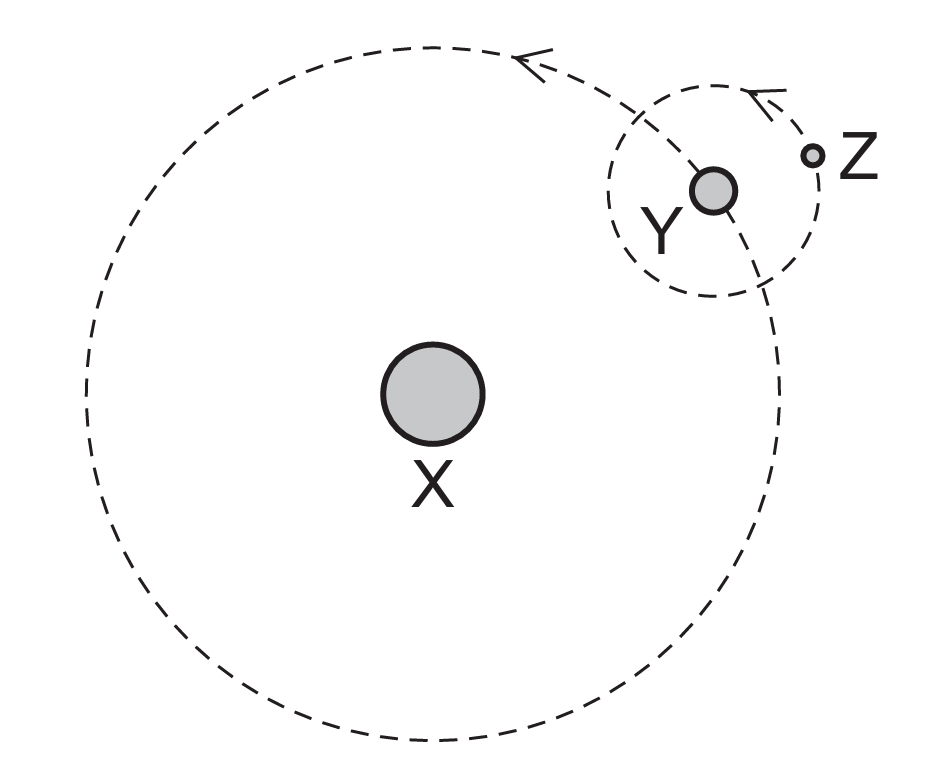
The diagram represents three objects, $X$, $Y$ and $Z$, in space.
Object $Y$ orbits object $X$.
Object $Z$ orbits object $Y$.
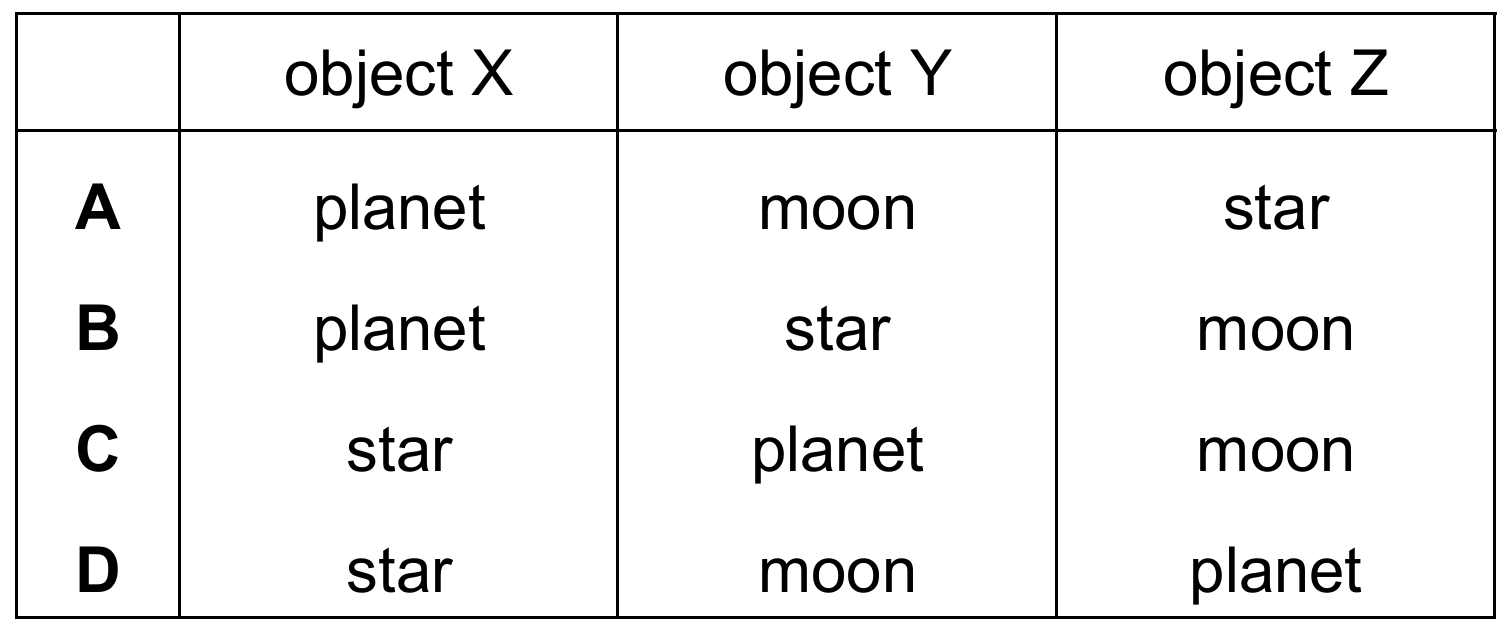
Which types of object are $X$, $Y$ and $Z$?
▶️ Answer/Explanation
Correct Option: C

Detailed solution:

In a standard celestial hierarchy, a star sits at the center of a planetary system.
Object $X$ is the central body around which others orbit, identifying it as a star (e.g., the Sun).
Object $Y$ orbits the star, which defines it as a planet according to the Solar System model.
Object $Z$ orbits object $Y$ (the planet), which identifies it as a moon or natural satellite.
Therefore, the correct sequence for $X$, $Y$, and $Z$ is star, planet, and moon.
This corresponds exactly to the configuration shown in Row C.
Question

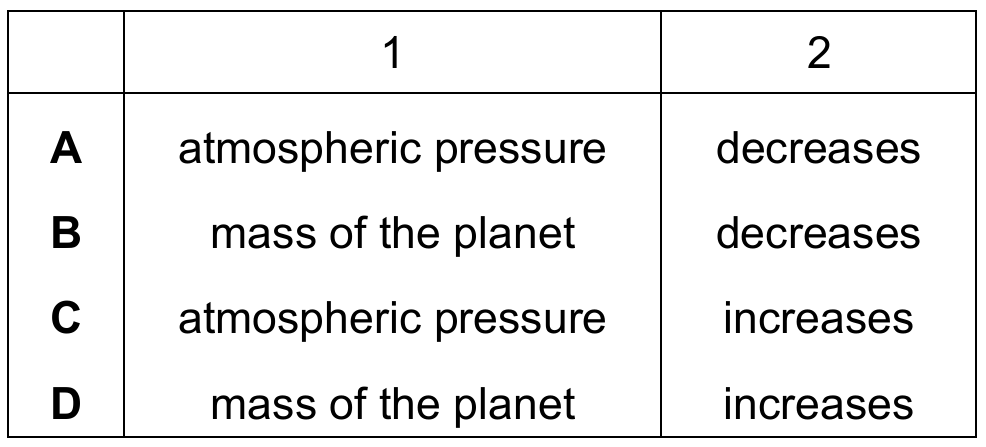
The strength of the gravitational field at the surface of a planet depends on the ……1…… .

The strength of the gravitational field ……2…… as the distance from the planet increases.

Which words correctly complete the sentences?

▶️ Answer/Explanation
Correct Option: B

Detailed solution:

The gravitational field strength g at the surface of a celestial body is directly proportional to its mass M.
Larger, more massive planets exert a stronger gravitational pull on objects at their surface compared to smaller ones.
As an observer moves away from the planet, the distance r from the center of the mass increases.
According to physical principles, the strength of the gravitational field follows an inverse relationship with distance.
Therefore, the field strength g decreases as the distance from the planet increases.
Combining these facts, the correct words for the blanks are “mass of the planet” and “decreases,” as shown in Row B.

Question

Four rocky planets orbit the Sun. Which list shows these planets in order of increasing distance from the Sun?
A. Earth $\rightarrow$ Mars $\rightarrow$ Mercury $\rightarrow$ Venus
B. Venus $\rightarrow$ Earth $\rightarrow$ Mars $\rightarrow$ Mercury
C. Mercury $\rightarrow$ Venus $\rightarrow$ Earth $\rightarrow$ Mars
D. Mars $\rightarrow$ Mercury $\rightarrow$ Venus $\rightarrow$ Earth
▶️ Answer/Explanation
Correct Option: C

Detailed solution:

The Solar System consists of $8$ planets orbiting the Sun. The four inner planets are rocky and small, while the four outer planets are gaseous and large. The correct sequence of the rocky planets starting from the one closest to the Sun is Mercury, followed by Venus, then Earth, and finally Mars. To list them in order of increasing distance, we must follow this specific $1 \rightarrow 2 \rightarrow 3 \rightarrow 4$ arrangement. Option C correctly identifies this progression: Mercury $\rightarrow$ Venus $\rightarrow$ Earth $\rightarrow$ Mars.

Scroll to Top