iGCSE Physics (0625) 6.2.1 The Sun as a star -Exam Style Questions Paper 2 - New Syllabus
Question

▶️ Answer/Explanation
Detailed solution:
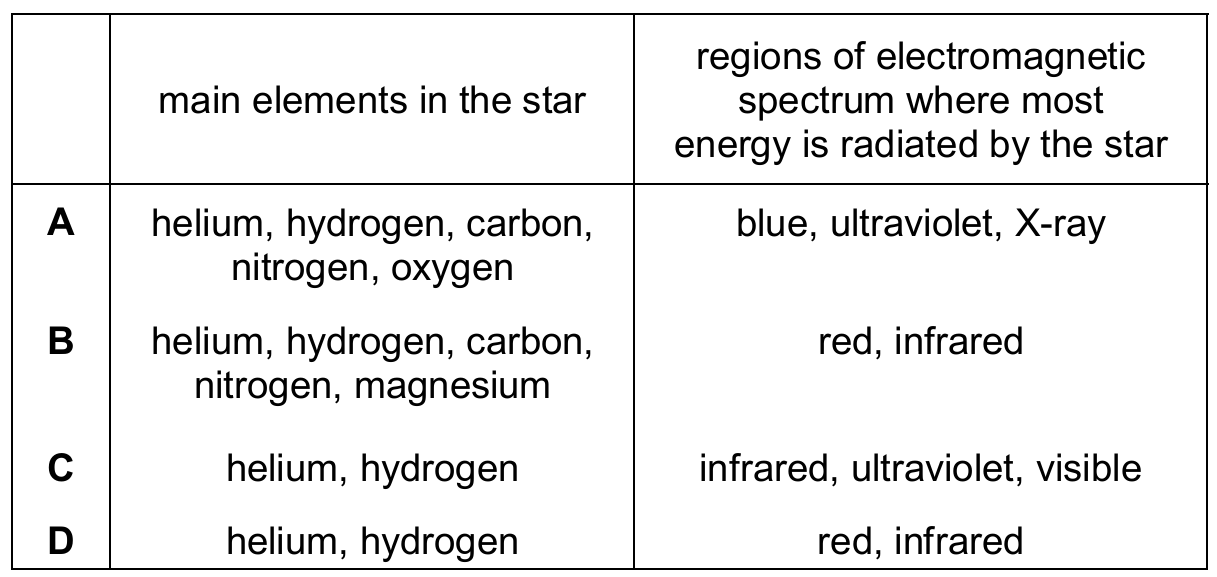
The Sun is a medium-sized star composed primarily of the elements hydrogen and helium.
It radiates energy across the electromagnetic spectrum, specifically in the infrared, visible light, and ultraviolet regions.
Options A and B are incorrect because they include heavy elements like carbon, nitrogen, and oxygen as “main” components.
Option D is incorrect because it misses the visible and ultraviolet components of the Sun’s radiation.
Row C perfectly aligns with the syllabus definition of the Sun’s composition and emission characteristics.
Therefore, the correct row identifying the Sun is C.
Question
▶️ Answer/Explanation
Detailed solution:
The total power $P$ emitted by a star depends on its surface area $A$ and its surface temperature $T$.
Since star $X$ has a larger diameter than star $Y$, it has a significantly larger surface area ($A_X > A_Y$).
The problem states both stars emit the same total power, so $P_X = P_Y$.
For a larger object to emit the same total energy as a smaller one, its emission per unit area must be lower.
Since the rate of emission increases with temperature, star $X$ must be cooler to compensate for its larger size.
Therefore, the surface temperature of $X$ is less than the surface temperature of $Y$.
▶️ Answer/Explanation
Detailed solution:
Stable stars, such as the Sun, are primarily composed of hydrogen and helium. The energy source for these stars is nuclear fusion, a process where light nuclei join to form a heavier nucleus. In the core of a stable star, high temperatures and pressures allow hydrogen nuclei to fuse together. This reaction specifically converts hydrogen into helium and releases a vast amount of energy in the form of electromagnetic radiation. Unlike fission, which involves splitting heavy nuclei, fusion powers the lifecycle of stars during their stable main-sequence phase.
