iGCSE Physics (0625) 6.2.3 The Universe-Exam Style Questions- New Syllabus

Question

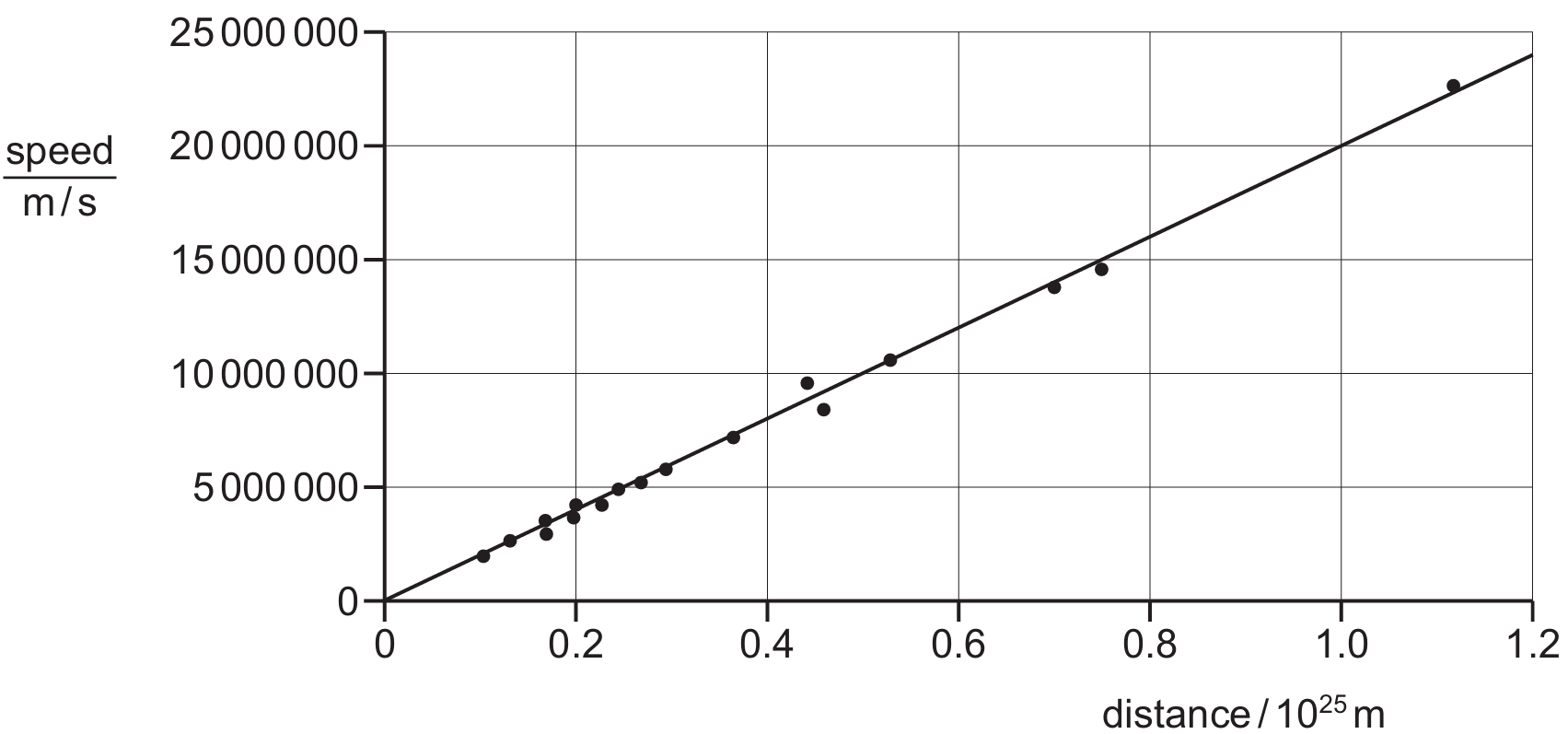
A student plots a graph of the speed of different galaxies moving away from the Earth against their distance from the Earth.
Using the best straight line shown on the graph, what is the value of the Hubble constant $H_0$?
A. $2.0 \times 10^{-18} \text{ s}^{-1}$
B. $2.2 \times 10^{-18} \text{ s}^{-1}$
C. $4.5 \times 10^{17} \text{ s}$
D. $5.0 \times 10^{17} \text{ s}$
▶️ Answer/Explanation
Correct Option: A

Detailed solution:

The Hubble constant $H_0$ is defined by the equation $H_0 = \frac{v}{d}$, which corresponds to the gradient of the speed-distance graph.
Selecting a point on the best-fit line, such as $d = 1.0 \times 10^{25} \text{ m}$ and $v = 20,000,000 \text{ m/s} = 2.0 \times 10^7 \text{ m/s}$.
Substituting these values into the formula: $H_0 = \frac{2.0 \times 10^7 \text{ m/s}}{1.0 \times 10^{25} \text{ m}}$.
This calculation yields $H_0 = 2.0 \times 10^{-18} \text{ s}^{-1}$.
Note that the units for the Hubble constant are $\text{s}^{-1}$ because the meters cancel out in the ratio of speed to distance.
Therefore, Option A is the correct value based on the gradient of the provided graph.

Question

A galaxy is at a distance of $60$ million light-years from the Earth. The galaxy is moving away at a speed of $1300\text{ km/s}$.

One light-year is about $9.5 \times 10^{12}\text{ km}$.
There are about $3.2 \times 10^{7}$ seconds in one year.

Which expression can be used to estimate the age of the Universe in years?

A. $\frac{60 \times 10^{6} \times 3.2 \times 10^{7}}{1300 \times 9.5 \times 10^{12}}$
B. $\frac{60 \times 10^{6} \times 9.5 \times 10^{12}}{1300 \times 3.2 \times 10^{7}}$
C. $\frac{1300 \times 9.5 \times 10^{12}}{60 \times 10^{6} \times 3.2 \times 10^{7}}$
D. $\frac{1300 \times 3.2 \times 10^{7}}{60 \times 10^{6} \times 9.5 \times 10^{12}}$
▶️ Answer/Explanation
Correct Option: B

Detailed solution:

The age of the Universe is estimated using the formula $t = \frac{d}{v}$.
The distance $d$ in km is $(60 \times 10^{6}\text{ light-years}) \times (9.5 \times 10^{12}\text{ km/light-year})$.
The recession speed $v$ is $1300\text{ km/s}$. Dividing $d$ by $v$ gives the age in seconds.
To convert the age from seconds to years, we divide the result by $3.2 \times 10^{7}\text{ s/year}$.
The final expression is $\text{Age} = \frac{60 \times 10^{6} \times 9.5 \times 10^{12}}{1300 \times 3.2 \times 10^{7}}$, which matches Option B.

Question
A distant galaxy is moving away from the Milky Way at $4\,400\,000 \text{ m/s}$.
What is the approximate distance between the Milky Way and this distant galaxy?
A. $2 \times 10^{12} \text{ m}$
B. $5 \times 10^{11} \text{ m}$
C. $2 \times 10^{24} \text{ m}$
D. $5 \times 10^{23} \text{ m}$
▶️ Answer/Explanation
Correct Option: C

Detailed solution:

To find the distance $d$, we use the Hubble Law equation: $v = H_{0}d$, which rearranges to $d = \frac{v}{H_{0}}$.
The velocity $v$ is given as $4.4 \times 10^{6} \text{ m/s}$.
According to the syllabus, the current estimate for the Hubble constant is $H_{0} \approx 2.2 \times 10^{-18} \text{ s}^{-1}$.
Substituting the values: $d = \frac{4.4 \times 10^{6}}{2.2 \times 10^{-18}}$.
This calculation yields $d = 2.0 \times 10^{24} \text{ m}$.
Therefore, the approximate distance to the galaxy is $2 \times 10^{24} \text{ m}$, matching option C.

Scroll to Top