Home / iGCSE Physics (0625) 1.5.1 Effects of forces-Exam Style Questions

iGCSE Physics (0625) 1.5.1 Effects of forces-Exam Style Questions- New Syllabus

Question

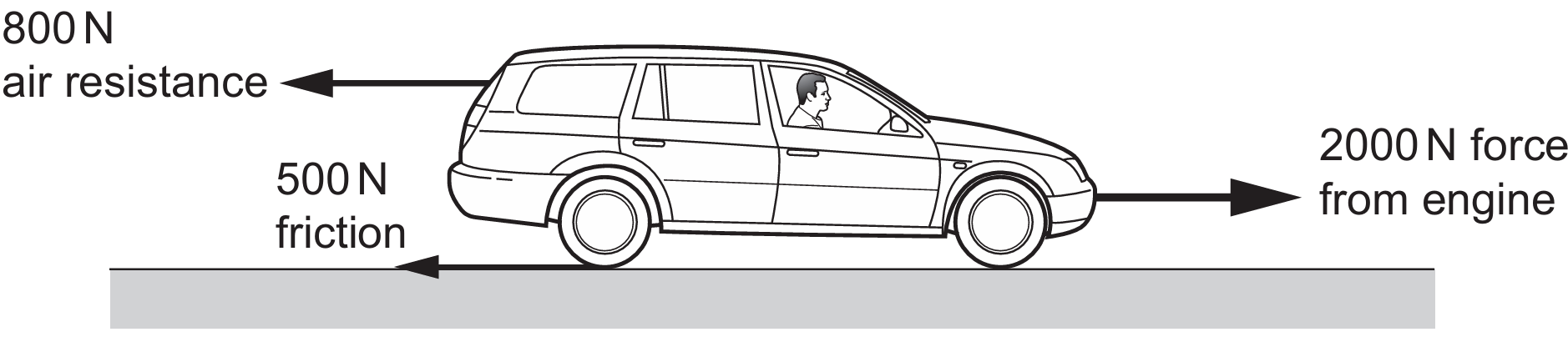
A car moves along a level road.
The diagram shows all of the horizontal forces acting on the car.
Which statement is correct?
A. The car is slowing down.
B. The car is speeding up.
C. The car is moving at a constant speed.
D. The car is moving backwards.
▶️ Answer/Explanation
Correct Option: B

Detailed solution:

To determine the motion, we calculate the resultant force $F_{res}$ acting on the car.
The forward force from the engine is $2000~N$, and the opposing backward forces are air resistance ($800~N$) and friction ($500~N$).
The total backward force is $800~N + 500~N = 1300~N$.
The resultant force is $F_{res} = 2000~N – 1300~N = 700~N$ in the forward direction.
According to Newton’s Second Law, $F = ma$, a non-zero resultant force causes the car to accelerate.
Since the resultant force is in the direction of motion, the car is speeding up.
Question

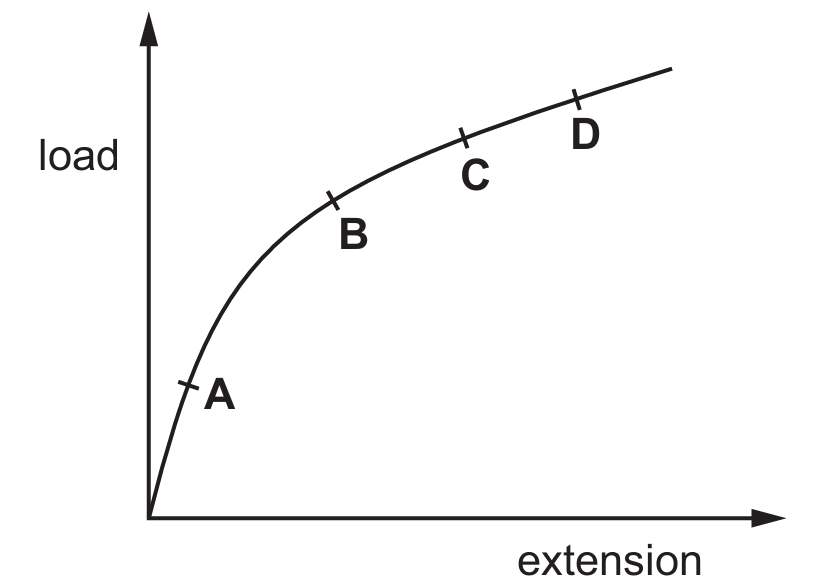
The load–extension graph for a material is shown.

Which point indicates the limit of proportionality?

▶️ Answer/Explanation
Correct Option: A

Detailed solution:

According to Hooke’s Law, the extension of a material is directly proportional to the applied load up to a specific limit.
On a load-extension graph, this region of direct proportionality is visually represented by a straight line starting from the origin.
The limit of proportionality is defined as the exact point where this linear relationship ends and the graph begins to curve.
Observing the provided graph, the line remains perfectly straight from the origin until it reaches point $A$.
Beyond point $A$, the gradient of the curve clearly decreases, indicating that extension is no longer directly proportional to the load.
Therefore, point $A$ correctly indicates the limit of proportionality for this material.

Question
A spring has a length of $25\text{ cm}$ when a load of $2.0\text{ N}$ is suspended from it. The spring has a length of $35\text{ cm}$ when a $7.0\text{ N}$ load is used. What is the spring constant of the spring?
A. $0.20\text{ N/cm}$
B. $0.50\text{ N/cm}$
C. $2.0\text{ N/cm}$
D. $5.0\text{ N/cm}$
▶️ Answer/Explanation
Correct Option: B

Detailed solution:

The spring constant $k$ is defined by the formula $F = kx$, where $x$ is the extension.
First, calculate the change in load: $\Delta F = 7.0\text{ N} – 2.0\text{ N} = 5.0\text{ N}$.
Next, calculate the change in length (extension): $\Delta x = 35\text{ cm} – 25\text{ cm} = 10\text{ cm}$.
The spring constant is the ratio of the change in force to the change in extension: $k = \frac{\Delta F}{\Delta x}$.
Substituting the values: $k = \frac{5.0\text{ N}}{10\text{ cm}} = 0.50\text{ N/cm}$.
This matches Option B.

Scroll to Top