
▶️ Answer/Explanation
Detailed solution:
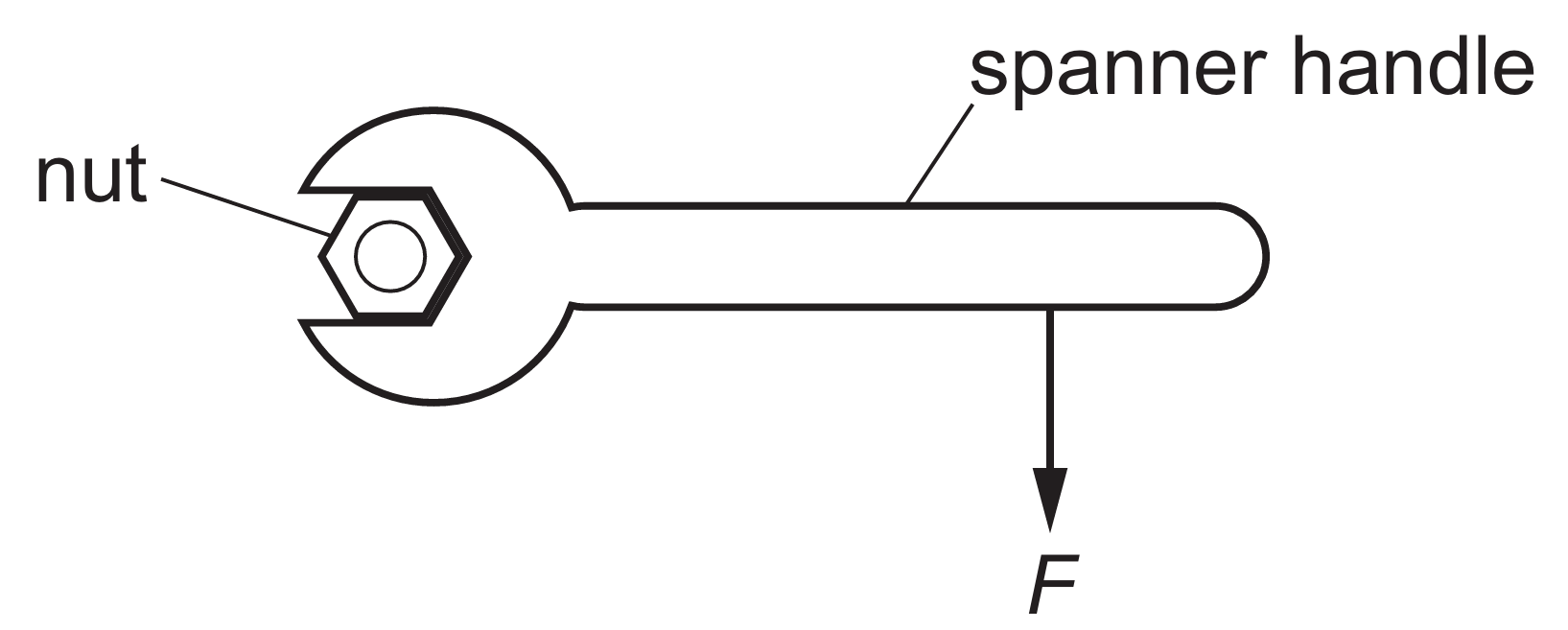
The moment of a force is defined by the equation $M = F \times d$, where $d$ is the perpendicular distance from the pivot (the nut) to the line of action of the force.
To increase the moment while keeping the force $F$ constant, the distance $d$ must be increased.
Moving the force to the right-hand end of the handle maximizes this distance, thereby increasing the turning effect.
Option B results in zero moment because the force passes through the pivot ($d = 0$), and option D decreases $d$.
Option C affects friction but does not change the calculated moment of the applied force $F$.
▶️ Answer/Explanation
Detailed solution:
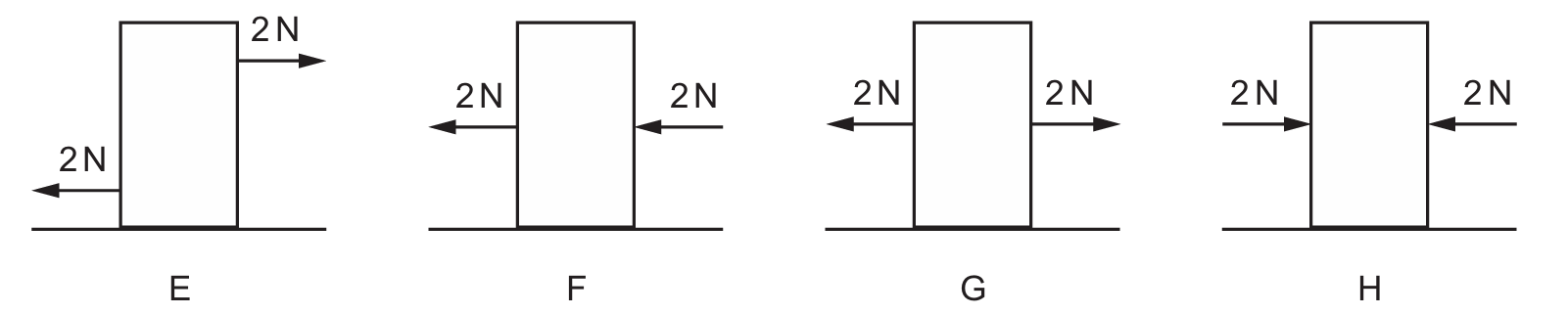
For an object to be in equilibrium, there must be no resultant force ($F_{net} = 0~N$) and no resultant moment.
In diagrams E and F, the forces are not aligned along the same line of action, creating a clockwise or anticlockwise moment that would cause the block to rotate.
In diagrams G and H, the two $2~N$ forces act in opposite directions along the same line of action.
This results in a net force of $2~N – 2~N = 0~N$ and zero turning effect.
Therefore, only blocks G and H satisfy the conditions for static equilibrium.
Consequently, option D is the correct choice as it identifies both G and H.