Home / iGCSE Physics (0625) 1.7.4 Power-Exam Style Questions

iGCSE Physics (0625) 1.7.4 Power -Exam Style Questions Paper 2 - New Syllabus

Question

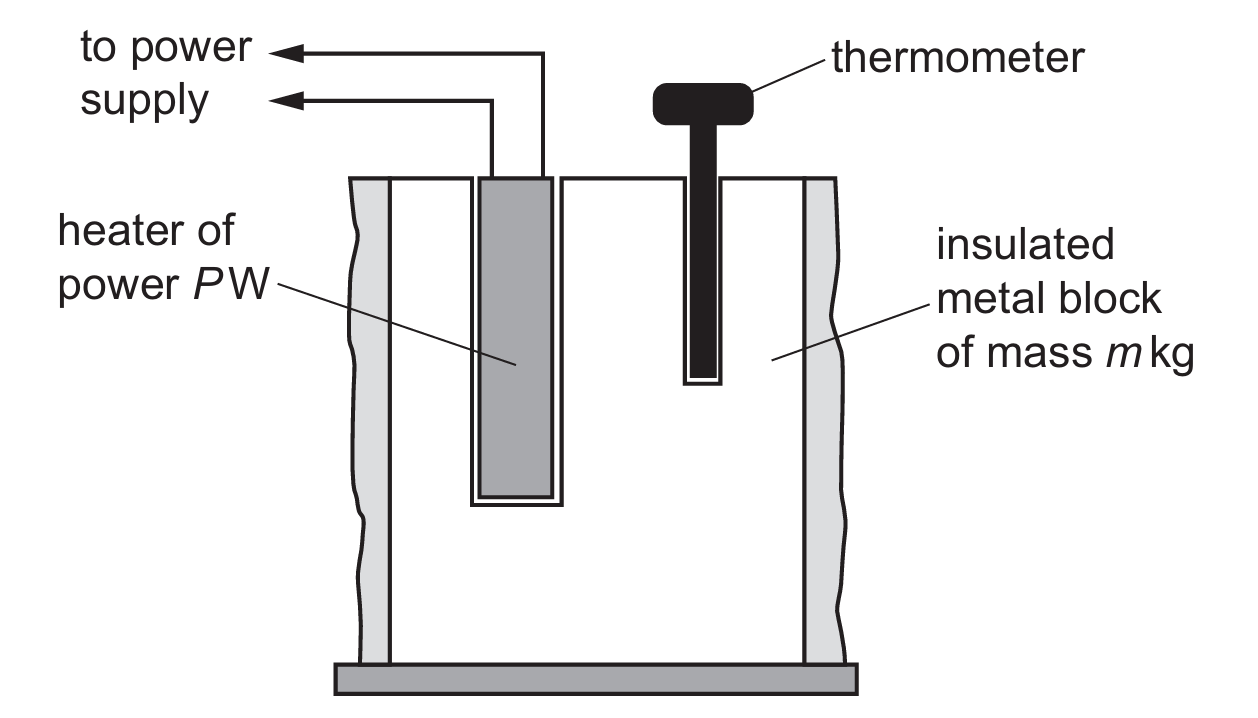
The diagram shows the equipment used in an experiment to determine the specific heat capacity of a metal.
In the experiment, a heater is switched on for $t$ s and the increase in temperature $\Delta \theta$ of a block of the metal is measured in °C.
Which equation gives the specific heat capacity of the metal?
A. $c = \frac{P}{tm\Delta \theta}$
B. $c = \frac{Pt}{m\Delta \theta}$
C. $c = \frac{tm\Delta \theta}{P}$
D. $c = \frac{m\Delta \theta}{Pt}$
▶️ Answer/Explanation
Correct Option: B

Detailed solution:

The energy transferred by the heater is given by $\Delta E = P \times t$, where $P$ is power and $t$ is time.
Specific heat capacity $c$ is defined by the thermal energy equation $\Delta E = mc\Delta \theta$.
By substituting the expression for energy, we get $Pt = mc\Delta \theta$.
Rearranging this formula to make $c$ the subject gives $c = \frac{Pt}{m\Delta \theta}$.
This matches the expression provided in Option B.

Question

A microwave oven is rated at 900 watts.
Which statement correctly describes the meaning of this value?
A. 900 joules are transferred every second.
B. 900 amperes are transferred every second.
C. 900 volts are transferred every second.
D. 900 ohms are transferred every second.
▶️ Answer/Explanation
Correct Option: A

Detailed solution:

Power is defined as the rate of energy transfer, meaning 1 watt equals 1 joule per second.
A rating of 900 watts therefore means the appliance transfers 900 joules of electrical energy into other forms (like heat) every second.
Options B, C, and D incorrectly associate power with units of current (amperes), potential difference (volts), or resistance (ohms).
This matches the syllabus definition of power in topic 1.7.4.

Question

The engine of a motor vehicle develops a large power. Which statement is correct?
A. The driving force acting on the vehicle must be large.
B. The engine must have a very large volume.
C. The engine must transfer large amounts of energy each second.
D. The vehicle must be very fast.
▶️ Answer/Explanation
Correct Option: C

Detailed solution:

Power is defined as the rate of doing work or the rate of energy transfer, given by $P = \frac{\Delta E}{t}$.
A large power output does not strictly require a large force, a fast speed, or a large engine volume.
It specifically means that a significant amount of energy is being transferred or converted per unit time.
Therefore, a vehicle engine with large power must transfer large amounts of energy each second.
This makes Option C the only necessarily correct statement based on the definition of power.

Scroll to Top