
▶️ Answer/Explanation
Detailed solution:
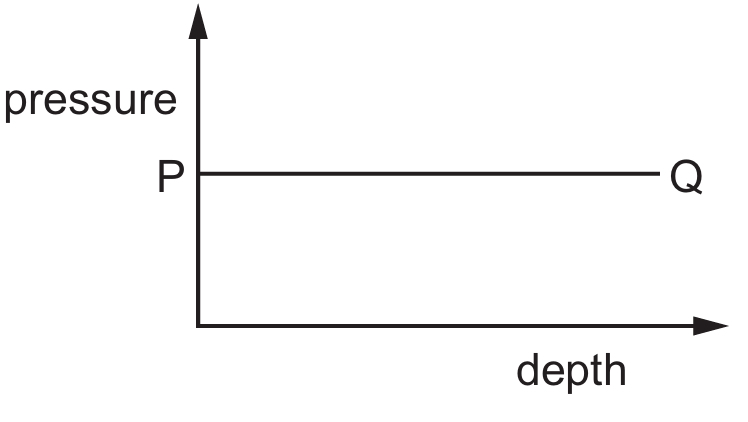
The pressure due to a liquid at a given depth is calculated using the equation $p = \rho g h$.
Since pressure is plotted on the y-axis and depth on the x-axis, the gradient (slope) of the graph is equal to $\frac{\Delta p}{\Delta h} = \rho g$.
This implies that the slope of the graph is directly proportional to the density $\rho$ of the liquid.
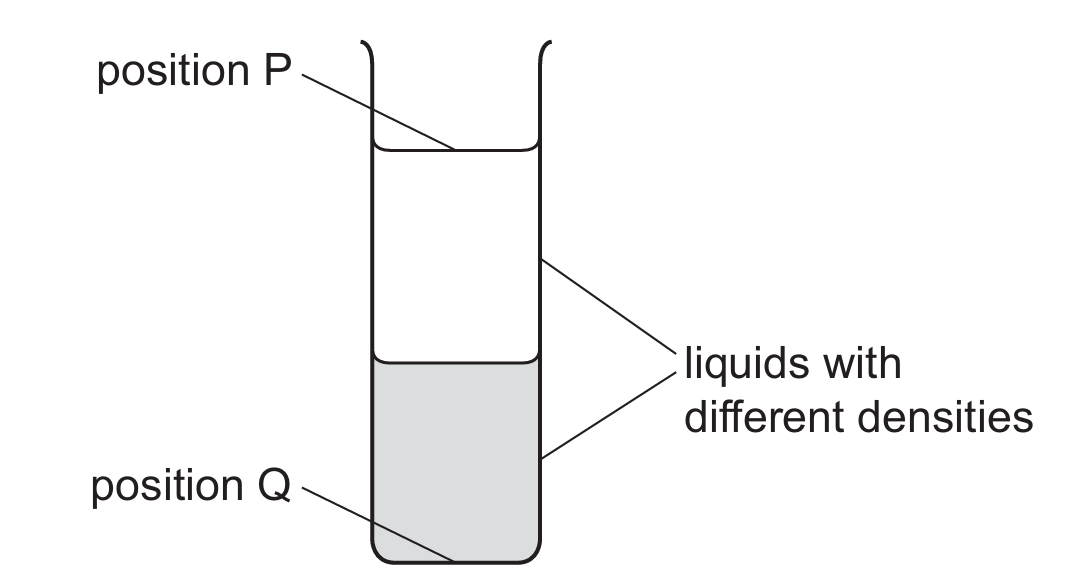
Because the two liquids do not mix and form distinct layers, the denser liquid must settle at the bottom.
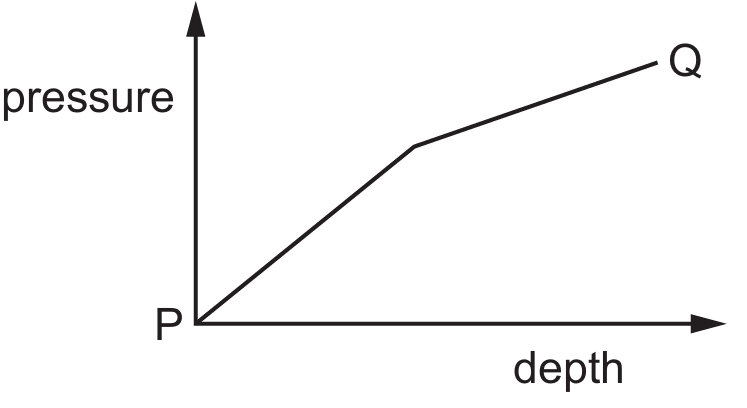
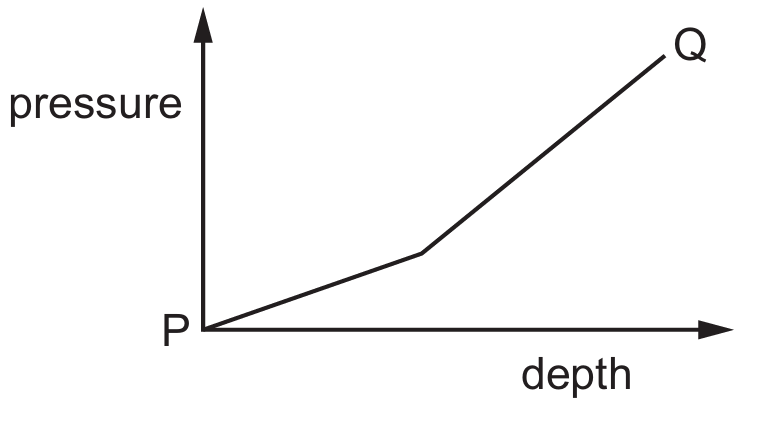
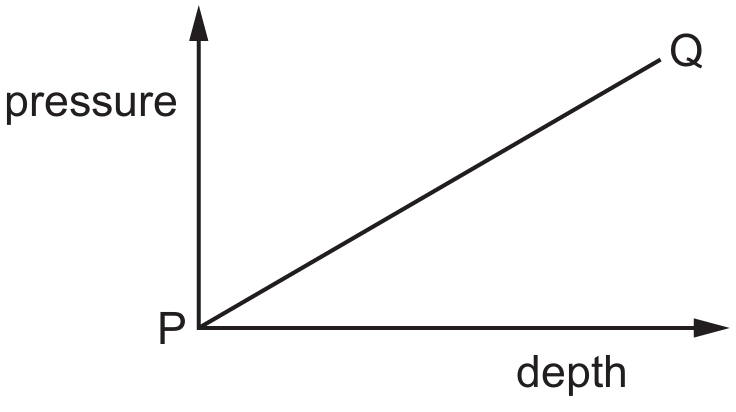
Therefore, the slope of the pressure-depth graph must be steeper for the bottom liquid compared to the top liquid.
Graph B correctly shows the pressure starting at $0$ at position P, increasing steadily, and then adopting a steeper positive slope in the denser bottom liquid.
▶️ Answer/Explanation
Detailed solution:
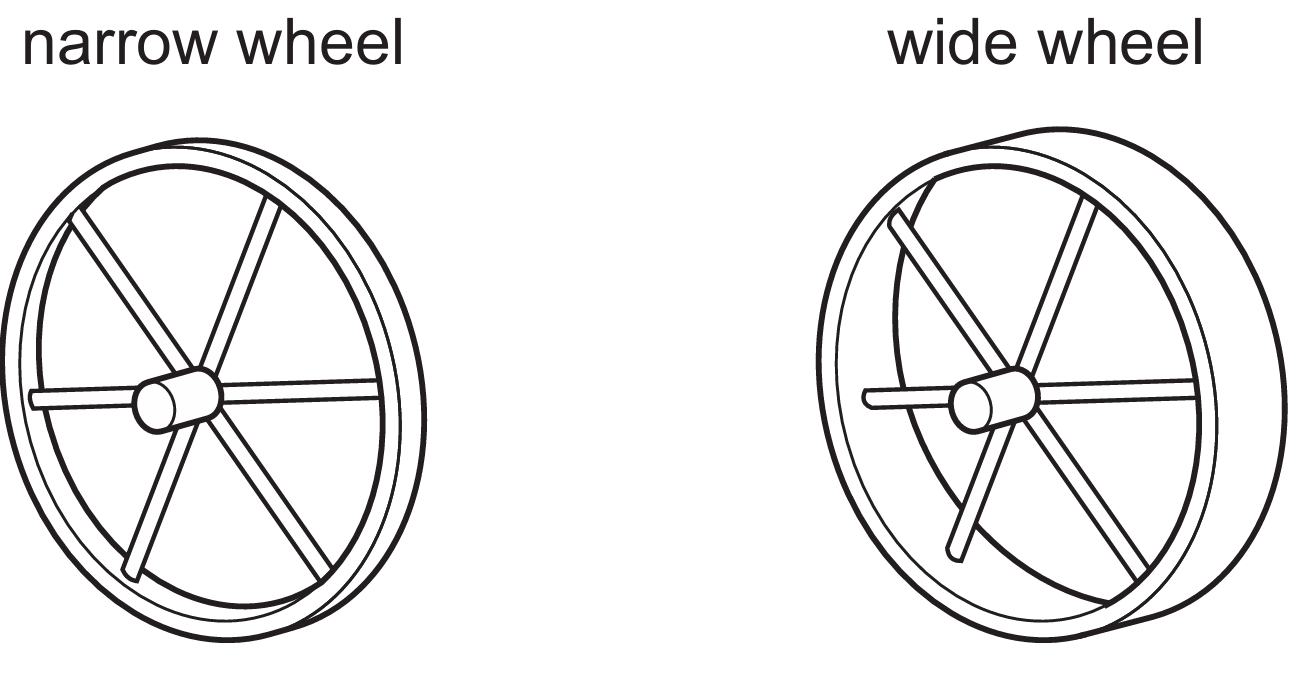
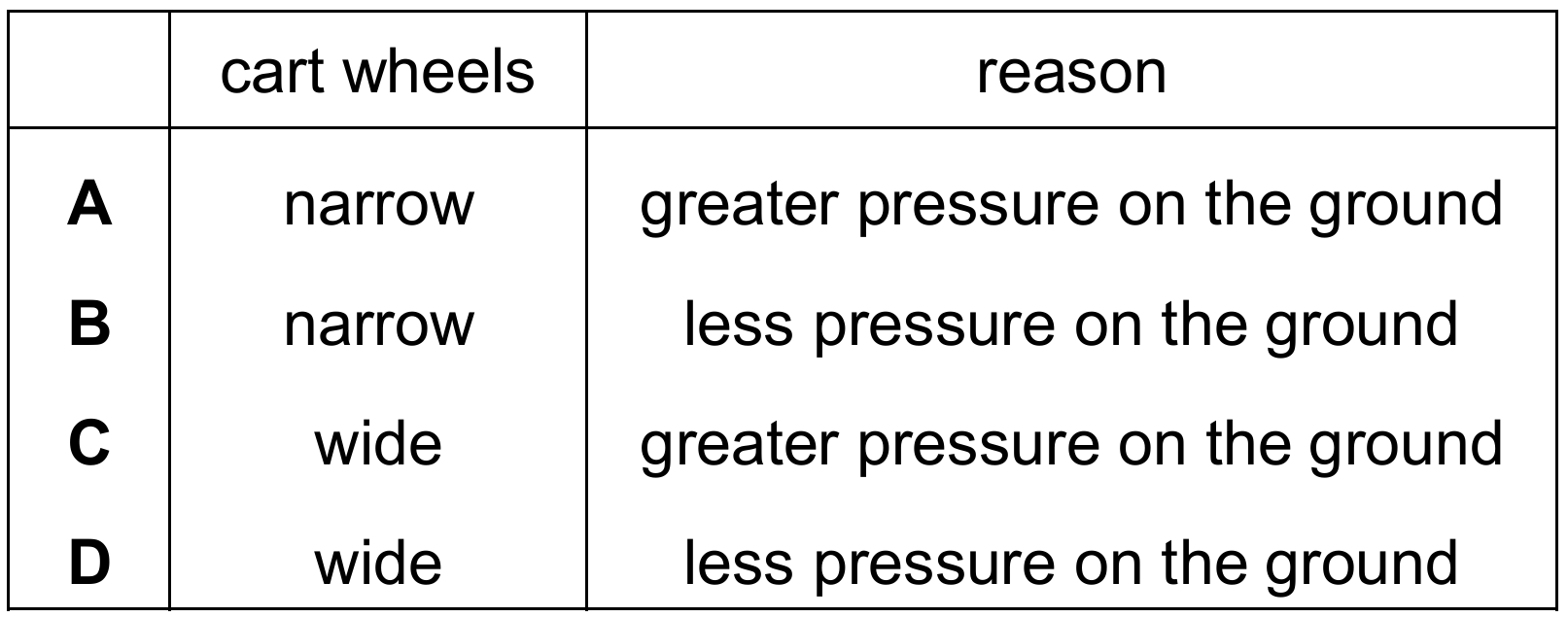
Pressure is defined as the force applied per unit area, expressed by the formula $p = \frac{F}{A}$. Since both carts have the same weight, the downward force $F$ exerted on the ground is constant for both. The wide wheels have a larger surface area $A$ in contact with the soft ground compared to the narrow wheels. According to the relationship $p \propto \frac{1}{A}$, a larger contact area results in a lower pressure $p$ exerted on the surface. Because the wide wheels exert less pressure, they are less likely to compress the soil, meaning they sink less into the ground. Therefore, Row D correctly identifies the wide wheels and the reason as less pressure.
▶️ Answer/Explanation
Detailed solution:
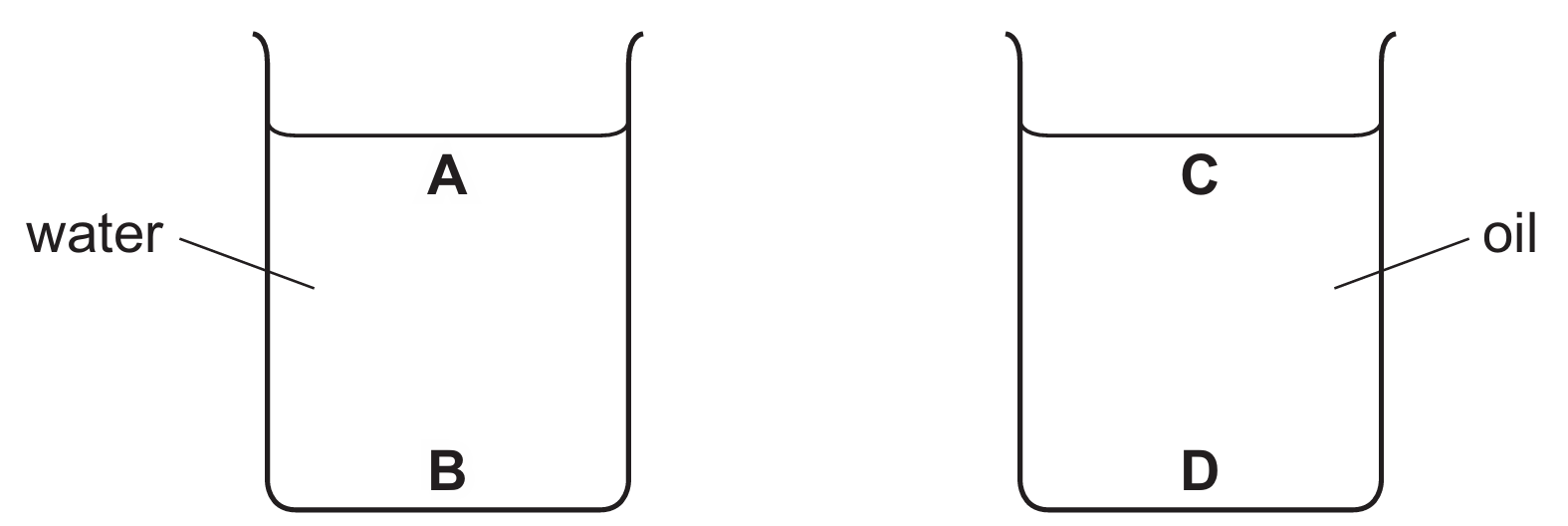
The pressure in a liquid is calculated using the formula $p = \rho g h$, where $\rho$ is density, $g$ is gravitational field strength, and $h$ is depth.
Pressure increases with depth, so positions B and D at the bottom of the beakers will have higher pressure than A and C.
Since both liquids have the same depth $h$, the pressure depends entirely on the density $\rho$ of the liquid.
Water has a higher density ($\rho_{water} = 1000~kg/m^{3}$) compared to oil ($\rho_{oil} = 920~kg/m^{3}$), leading to greater pressure.
Therefore, the pressure is greatest at the bottom of the water beaker, which is position B.