Home / iGCSE Physics (0625) 2.2.1 Thermal expansion of solids, liquids and gases-Exam Style Questions

iGCSE Physics (0625) 2.2.1 Thermal expansion of solids, liquids and gases-Exam Style Questions- New Syllabus

Question

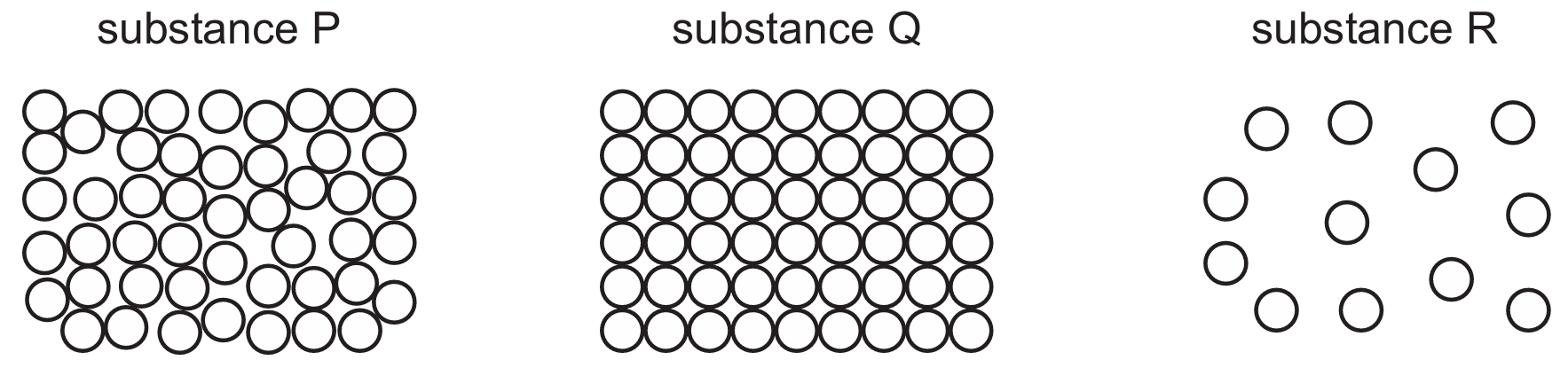
The diagram represents the particle arrangements in samples of three different substances, $P$, $Q$ and $R$.
The samples have equal volumes and the same temperature.
They are heated by the same temperature increase and no changes of state take place.
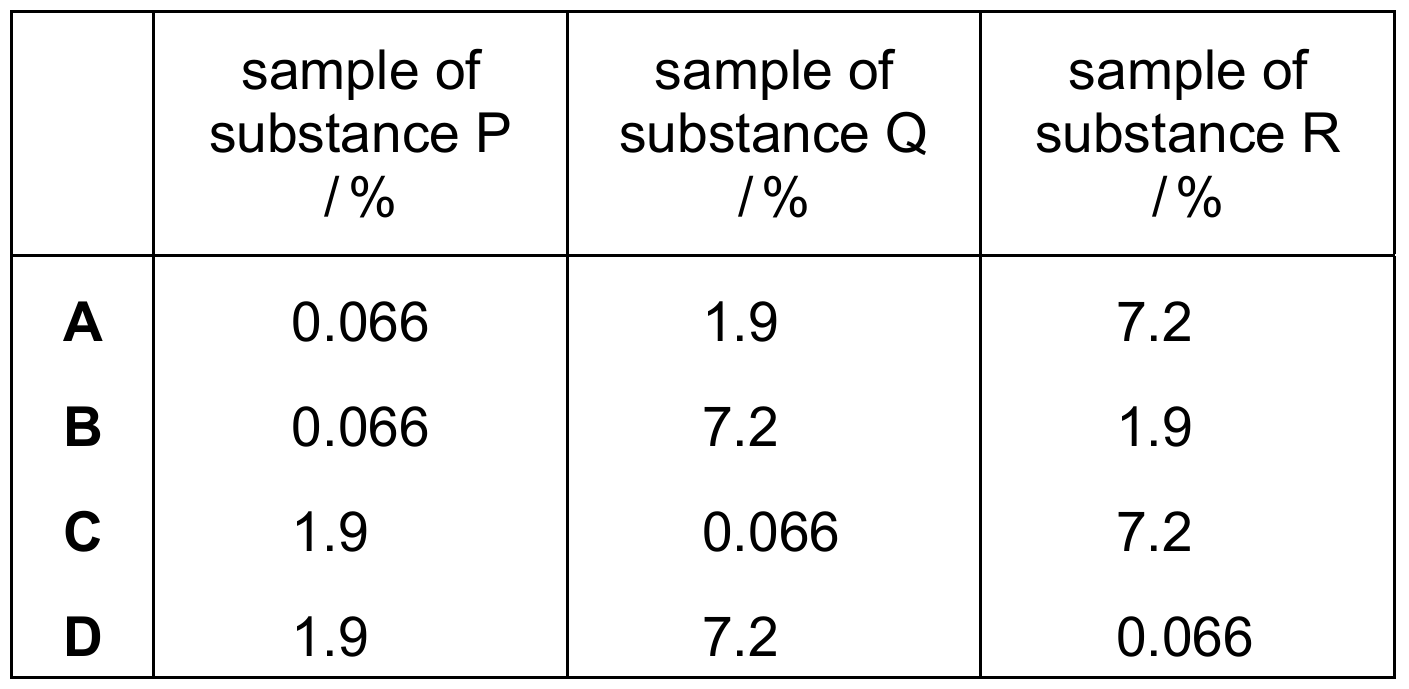
Which row shows possible percentage increases in volume for the three samples?
▶️ Answer/Explanation
Correct Option: C

Detailed solution:

Based on the particle diagrams, substance $Q$ is a solid (regularly arranged), $P$ is a liquid (randomly arranged but touching), and $R$ is a gas (widely spaced).
Gases expand significantly more than liquids, and liquids expand more than solids for the same temperature increase.
Therefore, the order of percentage increase in volume must be: $\text{Gas } (R) > \text{Liquid } (P) > \text{Solid } (Q)$.
Comparing the values: $7.2\% > 1.9\% > 0.066\%$.
This matches Row C, where $R = 7.2\%$, $P = 1.9\%$, and $Q = 0.066\%$.
Question

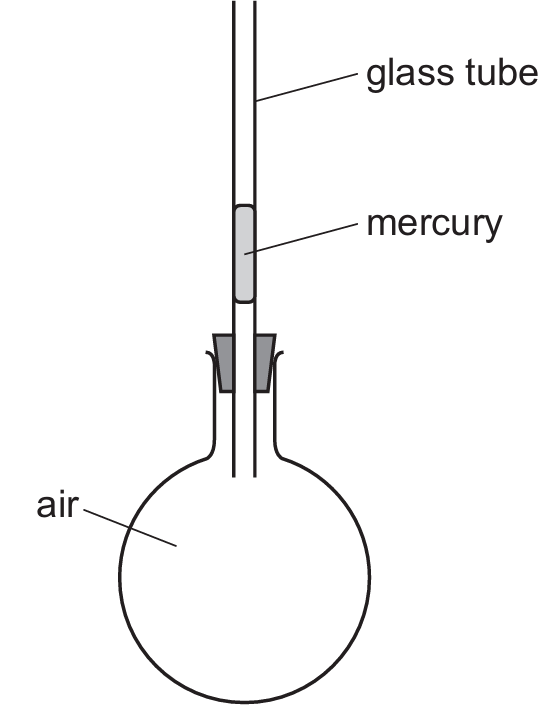
The diagram shows a glass flask sealed with a small volume of mercury in a glass tube. When the flask is gently warmed, the mercury rises up the tube.
What is the main cause of the movement of the mercury?
A. expansion of air in the flask
B. expansion of the glass flask
C. expansion of the glass tube
D. expansion of the mercury
▶️ Answer/Explanation
Correct Option: A

Detailed solution:

When the flask is warmed, the thermal energy is transferred to the air trapped inside. This increase in temperature causes the air molecules to move faster and push further apart, leading to significant thermal expansion. Gases expand much more than solids or liquids for the same increase in temperature. As the volume of the air increases, it exerts pressure on the mercury thread, forcing it to rise up the glass tube. While the glass and mercury also expand, their expansion is negligible compared to the air. Thus, the expansion of air is the primary cause of the mercury’s movement.

Question

The distance between two electricity pylons is 60 m. The cable that connects the two pylons is 62 m in length.
Why is the cable longer than the distance between the two pylons?
A. to allow for contraction of the cable in cold weather
B. to create a slope in the cable for electrons to flow down
C. to keep the current low and the voltage high
D. to reduce magnetic fields around the cable
▶️ Answer/Explanation
Correct Option: A

Detailed solution:

Most materials, including metal cables, undergo thermal expansion when heated and contraction when cooled.
In cold weather, the kinetic energy of the particles decreases, causing the cable to shorten in length.
If the 62 m cable were stretched tightly across the 60 m gap, contraction could cause it to snap or pull the pylons inward.
The extra 2 m of length provides a “slack” that ensures the cable remains intact even at very low temperatures.
Options B, C, and D are incorrect as they describe electrical or magnetic properties unrelated to the physical length of the wire.

Scroll to Top