Home / iGCSE Physics (0625) 2.3.3 Radiation-Exam Style Questions

iGCSE Physics (0625) 2.3.3 Radiation-Exam Style Questions- New Syllabus

Question

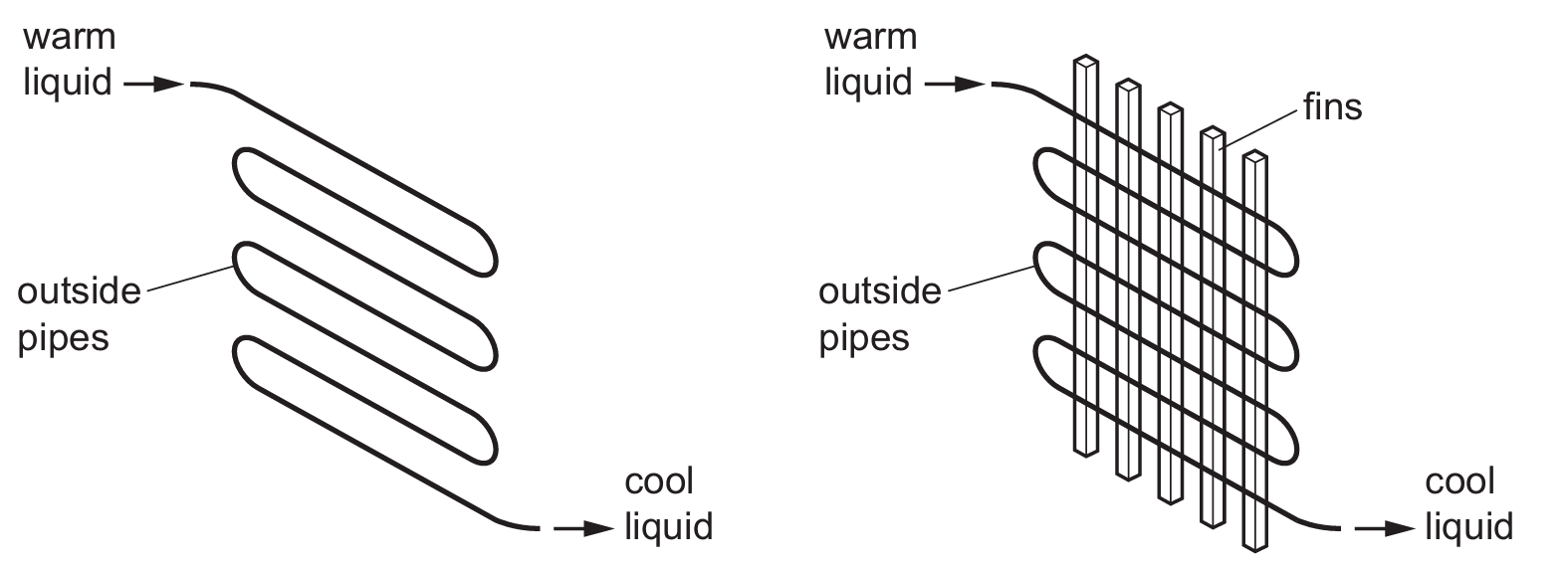
A liquid passes through pipes inside a refrigerator. The liquid warms as the inside of the refrigerator cools. The warm liquid is then passed through pipes on the outside of the refrigerator to cool it before it goes back through the refrigerator.
The diagrams show two designs for the outside cooling pipes. One design has copper rods, called fins, attached to the pipes.
The outside pipes and fins can be painted silver or black.
Which design of outside pipes will cool the liquid most quickly?
A. painted black with fins
B. painted black without fins
C. painted silver with fins
D. painted silver without fins
▶️ Answer/Explanation
Correct Option: A

Detailed solution:

To cool the liquid quickly, the rate of thermal energy transfer to the surroundings must be maximized. Surface color significantly affects this; dull black surfaces are the best emitters of infrared radiation compared to shiny silver ones. Additionally, attaching copper fins increases the total surface area $A$ available for both radiation and convection. Since the rate of emission is directly proportional to the surface area, the design with fins provides a higher cooling rate. Therefore, the combination of a black surface for high emissivity and fins for increased area ensures the most rapid cooling.

Question

A lamp has a metal filament that glows when heated by an electric current.
The middle of the filament has a very high temperature. The ends of the filament are connected to the base of the lamp and are cooler.
Which statement is correct?
A. Some thermal energy is conducted to the base of the lamp.
B. The filament radiates energy equally at all points along its length.
C. The lamp transfers all of the input energy as visible light.
D. When the potential difference (p.d.) across the filament is halved, the power output is halved.
▶️ Answer/Explanation
Correct Option: A

Detailed solution:

Thermal energy naturally flows from regions of higher temperature to lower temperature via conduction through solids.
Since the middle of the filament is at a very high temperature and the ends are cooler, energy is conducted toward the base.
Option B is incorrect because the rate of radiation depends on temperature; therefore, the hotter middle radiates more energy than the cooler ends.
Option C is incorrect as energy is also transferred via infrared radiation (heat) and conduction, not just visible light.
Option D is incorrect because power is proportional to the square of the voltage, $P = \frac{V^{2}}{R}$.
If the potential difference $V$ is halved to $\frac{V}{2}$, the power output becomes $\frac{1}{4}$ of its original value, assuming resistance $R$ is constant.

Question
Star $X$ has a larger diameter than star $Y$ but they both emit radiation with the same power. Which statement is correct?
A. The surface temperature of $X$ is less than the surface temperature of $Y$.
B. The surface temperatures of $X$ and $Y$ are the same.
C. The surface temperature of $X$ is greater than the surface temperature of $Y$.
D. The surface areas of $X$ and $Y$ are the same.
▶️ Answer/Explanation
Correct Option: A

Detailed solution:

The total power $P$ emitted by a star depends on its surface area $A$ and its surface temperature $T$.
Since star $X$ has a larger diameter than star $Y$, it has a significantly larger surface area ($A_X > A_Y$).
The problem states both stars emit the same total power, so $P_X = P_Y$.
For a larger object to emit the same total energy as a smaller one, its emission per unit area must be lower.
Since the rate of emission increases with temperature, star $X$ must be cooler to compensate for its larger size.
Therefore, the surface temperature of $X$ is less than the surface temperature of $Y$.

Scroll to Top