Home / iGCSE Physics (0625) 3.2.3 Thin lenses-Exam Style Questions

iGCSE Physics (0625) Paper 2 3.2.3 Thin lenses -Exam Style Questions Paper 2 - New Syllabus

Question

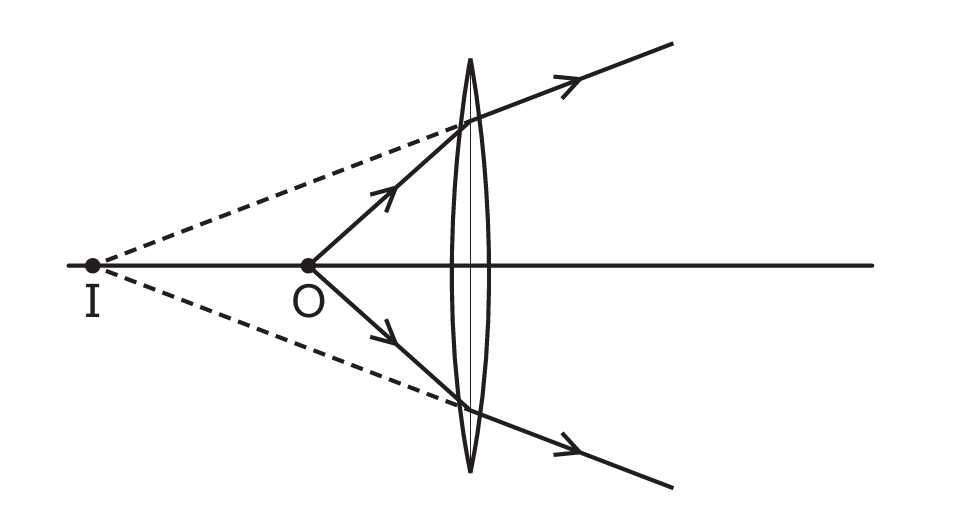
A small object $O$ is placed near a converging lens, as shown. The lens forms an image $I$.
Which statement is correct?
A. The image $I$ is diminished.
B. The image $I$ is inverted.
C. The image $I$ is real.
D. The object $O$ is closer to the lens than its principal focus.
▶️ Answer/Explanation
Correct Option: D

Detailed solution:

The ray diagram shows light rays from object $O$ diverging after passing through the lens. Since the rays do not meet on the opposite side, they are extrapolated backwards (dashed lines) to form a virtual image $I$. This specific configuration—where a converging lens produces an upright, enlarged, and virtual image—only occurs when the object $O$ is placed between the lens and its principal focus $F$. Thus, the object distance $u$ is less than the focal length $f$. Consequently, the image is not real, inverted, or diminished, making statement D the only correct choice.
Question

Which statement about a thin converging lens is correct?
A. All rays of light refracted by the lens pass through the principal focus.
B. All rays initially parallel to the principal axis of the lens are refracted through the principal focus.
C. The focal length of the lens is the distance between the image and the principal focus.
D. The focal length of the lens is the distance between the object and the image.
▶️ Answer/Explanation
Correct Option: B

Detailed solution:

By definition, a converging lens refracts incident rays that are parallel to the principal axis so that they meet at a single point called the principal focus (F).
Statement A is incorrect because rays not parallel to the axis (like those passing through the optical center) do not necessarily pass through the principal focus after refraction.
The focal length (f) is defined as the distance from the optical center of the lens to the principal focus, not the distance to the image or object as suggested in C and D.
Therefore, statement B is the only technically accurate description of the lens’s refractive properties.
This property is fundamental for constructing ray diagrams and determining the focal point of a lens experimentally.

Question
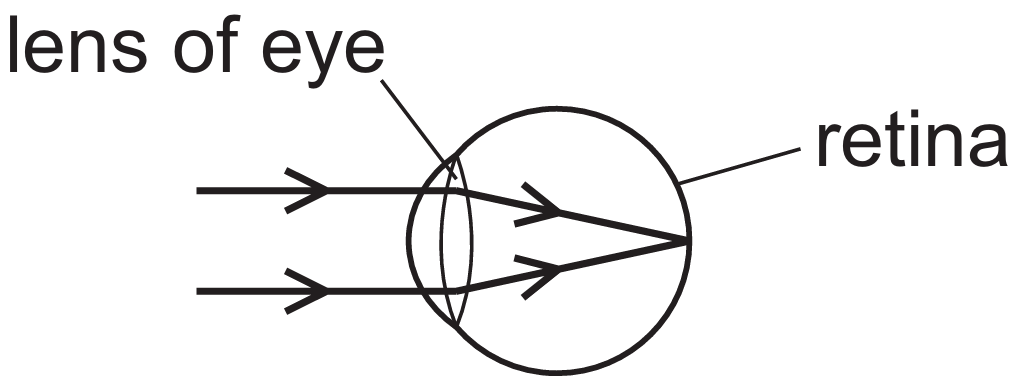
The diagram shows a human eye that correctly focuses the light on the retina.
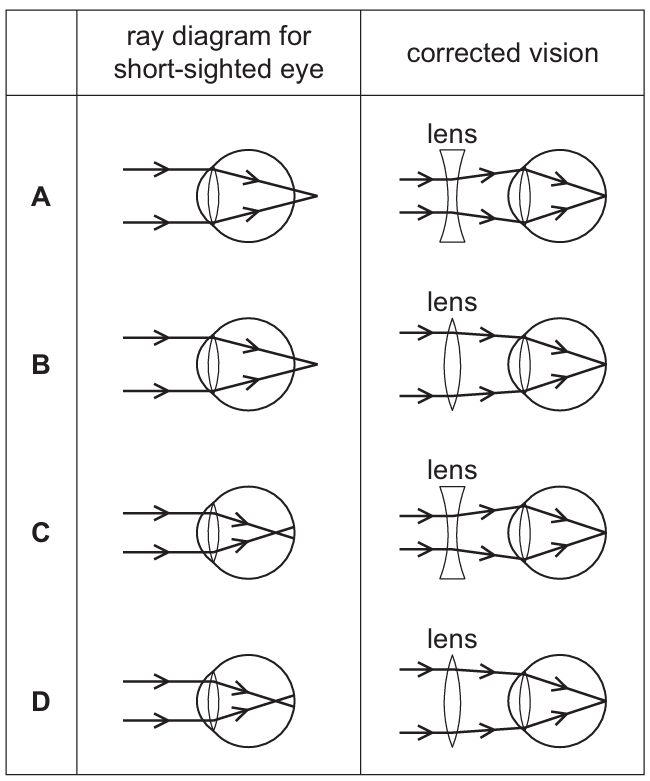
Which row shows a short-sighted eye and use of the correct lens to focus the image?
▶️ Answer/Explanation
Correct Option: C

Detailed solution:

Short-sightedness (myopia) occurs when the eye’s lens is too strong or the eyeball is too long, causing light rays from distant objects to focus in front of the retina rather than directly on it.
To correct this, a concave (diverging) lens is placed in front of the eye to spread the incoming parallel light rays slightly before they enter the eye.
This divergence allows the eye’s internal lens to focus the light further back, exactly onto the surface of the retina for a clear image.
In the provided table, Row C correctly illustrates the focal point being in front of the retina and the use of a diverging lens for correction.
Rows A and B are incorrect because they show long-sightedness, while Row D suggests an incorrect lens type for myopia.

Scroll to Top