iGCSE Physics (0625) 3.2.4 Dispersion of light -Exam Style Questions Paper 2 - New Syllabus
Question


▶️ Answer/Explanation
Detailed solution:
Dispersion occurs when white light separates into its constituent colors because different frequencies refract by different amounts.
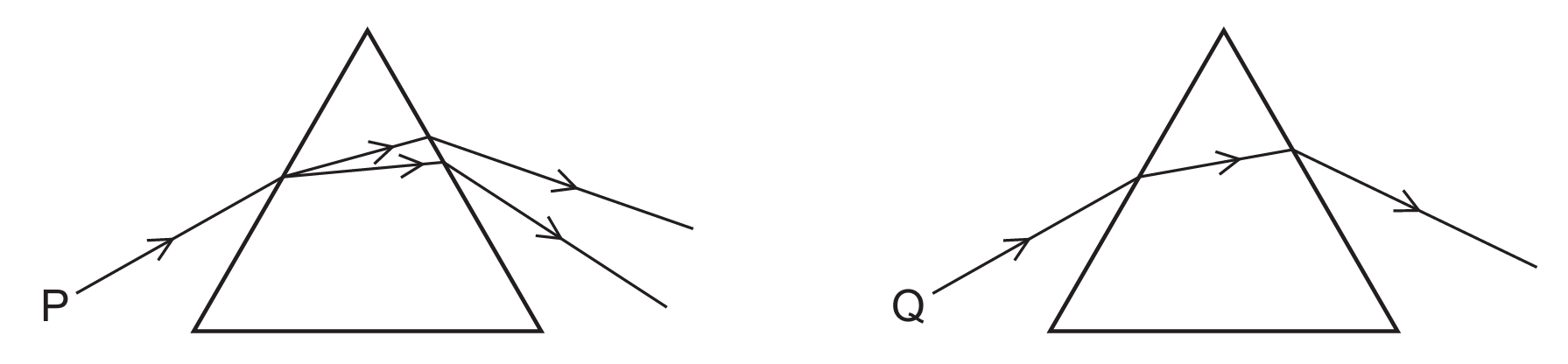
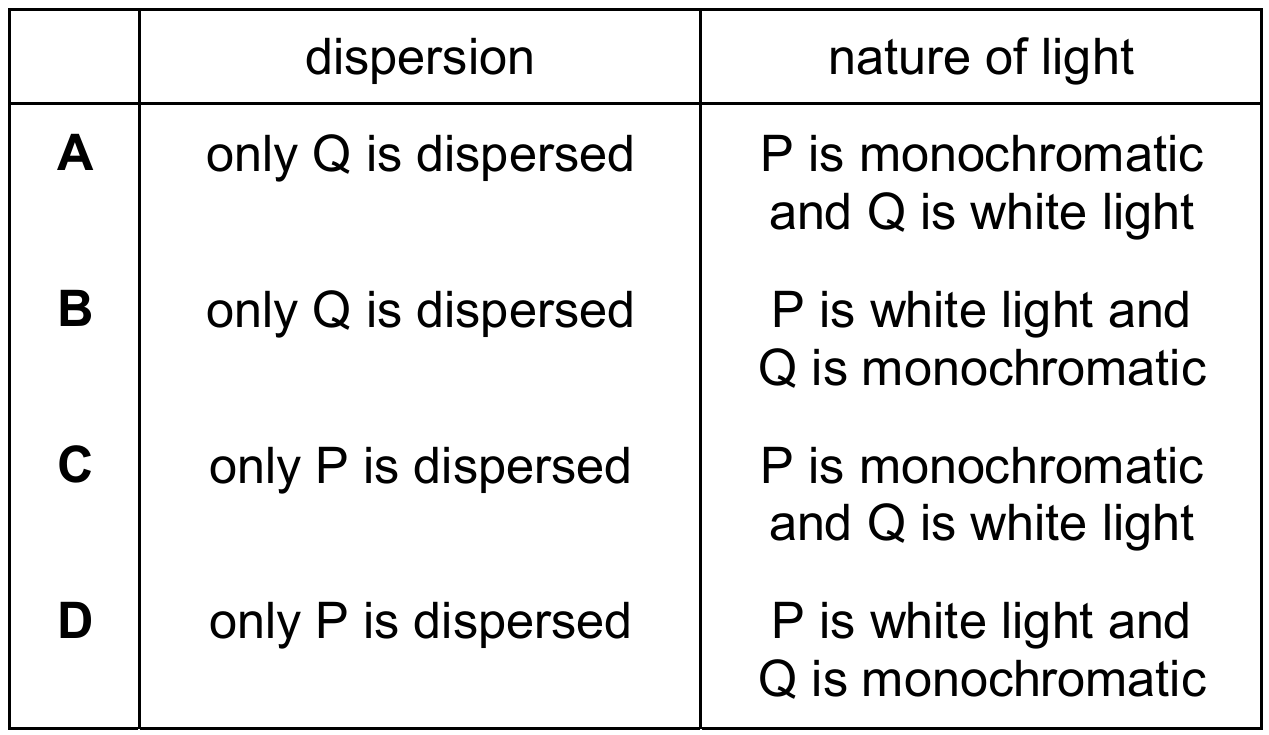
In the diagram, beam P splits into multiple rays after entering the prism, indicating it is white light undergoing dispersion.
Beam Q remains as a single ray, meaning it consists of only one frequency and is therefore monochromatic light.
Since only beam P shows a spread of colors, only P is dispersed.
Matching these observations, P must be white light and Q must be monochromatic.
This corresponds exactly to the information provided in Row D.
Question
▶️ Answer/Explanation
Detailed solution:
White light is composed of different wavelengths, each corresponding to a specific color of the visible spectrum. When white light enters a medium like a glass prism, each wavelength travels at a different speed, causing them to refract by different amounts. This separation of white light into its constituent colors—Red, Orange, Yellow, Green, Blue, Indigo, and Violet—is specifically defined as dispersion. While refraction is the underlying cause of the bending, the term for the resulting “splitting” into a spectrum is dispersion. Therefore, Option B is the correct term for this process.
Question
▶️ Answer/Explanation
Detailed solution:
When white light undergoes dispersion in a prism, red light is deviated the least while blue/violet light is deviated the most.
The spectrum always appears with red at one end and blue/violet at the other, with yellow in between.
Therefore, if the colours appear in sequence from least to most deviated, the correct order is red, yellow, blue.
This corresponds to Option C.
